
Last letters from the living dead man
David Patterson (Spirit) Hatch
THE CLASSIC COLLECTION · 1919
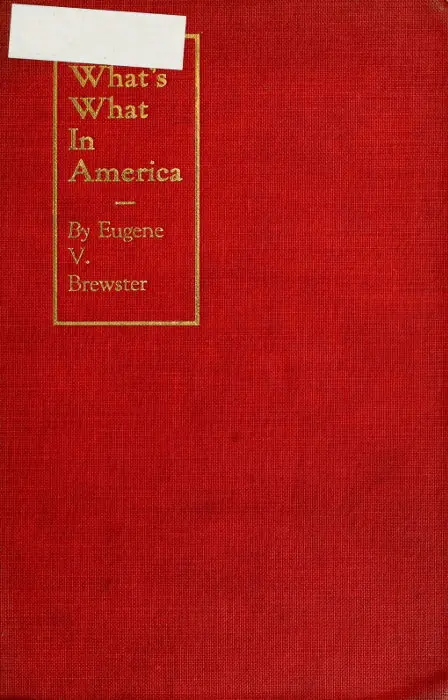
"What's What in America" by Eugene V. Brewster is a critical examination of societal trends and superstitions written in the early 20th century. The work discusses a variety of cultural phenomena viewed through Brewster's lens of skepticism, exploring the nature of credulity, self-deception, and the beliefs that take root in the American consciousness, including health fads and pseudosciences. At the start of the book, Brewster presents a preface outlining the complexities of American identity, highlighting the paradox of being a diverse yet unified society. He posits that Americans are drawn to various unorganized 'isms', such as Christian Science and phrenology, suggesting these credulities are indicative of a deeper social disarray. He introduces the themes of the book, indicating a series of essays that will dissect these ideologies, addressing the interplay of superstition, belief in the supernatural, and the sometimes absurd popularity of certain fads in the quest for understanding and meaning within the rapidly changing landscape of American life at the time.
Introduction adapted from the source catalogue; source summaries may be automatically generated.
Free to read · English · 46,415 words · No account needed
MAKE TIME FOR A GOOD BOOK
On by default. Untick to stop anonymous reading totals. Each page counts after 10 seconds in view. How this works.
Anonymous counting is on unless you have switched it off.
While Fortuna may proudly enumerate her great votaries in America, including Aaron Burr, Edgar Allen Poe, William Wirt, Luther Martin, Gouverneur Morris, Daniel Webster, Henry Clay, General Hayne, Sam Houston, Andrew Jackson, Generals Burnett, Sickles, Kearney, Steedman, Hooker, Hurlbut, Sheridan, Kilpatrick, Grant, George D. Prentiss, Sargeant S. Prentiss, Albert Pike, A. P. Hill, Beauregard, Early, Ben Hill, Robert Toombs, George H. Pendleton, Thaddeus Stevens, Green of Missouri, Herbert and Fitch of California, Jerry McKibben, James A. Bayard, Benjamin F. Wade, Broderick, John C. Fremont, Judge Magowan, Charles Spencer, Fernando Wood and his brother Benjamin, Colonel McClure, Senator Wolcott, Senator Pettigrew, Senator Farwell, Matthew Carpenter, Thomas Scott, Cornelius Vanderbilt, Hutchinson of Chicago, and Pierre Lorillard; think of the long list of greater men who were not addicted to gambling. This list is fairly complete, yet it is by no means representative. If these men had the passion, they no doubt felt sorry for it and they would be the first to warn others of the vice. Some of them were ruined by it. It is a folly to be ashamed of, not to be proud of. It is a weakness, and all great men have their weaknesses. Think of the great men who were inveterate smokers and drinkers; yet we would not hold them up as examples for the young simply because they acquired these bad habits. Are we to emulate the faults of the great, or their virtues?
Of all the passions that have enslaved mankind, none can reckon so many victims as gambling. In the wrecking of homes, in the destroying of character, in the encouragement of dishonesty, in the dissolving of fortunes, gambling has only one rival--drink. The two are brothers. They walk hand in hand. One seldom exists without the other. If drink comes first, gambling follows shortly; if gambling gets hold of its victim first, drink soon joins his brother. And with these two terrible, fascinating, insidious habits firmly entrenched in a man's system, all the other vices are invited in to keep the others company. Smoking, a lesser evil, usually accompanies the rest, in fact usually comes first; but it is hardly to be classed as a vice, since it in itself has no immoral effects, and is simply a bad and an expensive habit, although it is one that many enjoy without harm or danger, even with profit. Gambling appeals to a latent instinct, and hence is all the more alluring. It is a disease that, when it once gets hold, seldom lets go. The victim may shake it off, for a time, but it will surely show its fangs again, and it will require a struggle and many of them, throughout life, to conquer it. It will crop out in divers ways and its influence will be felt in all transactions. True, all life and business is a gamble, in one sense--that is, a chance, but that is no reason why we should make gambling King. Our efforts should be directed to dethroning it, not to crowning it.
Your reading position is saved on this browser. Take it to another device with a library code. Reading pages adapt to text, rather than matching a printed edition.
BEHIND THE BOOK
This eBook is for the use of anyone anywhere in the United States and most other parts of the world at no cost and with almost no restrictions whatsoever. You may copy it, give it away or re-use it under the terms of the Project Gutenberg License included with this eBook or online at www.gutenberg.org. If you are not located in the United States, you will have to check the laws of the country where you are located before using this eBook. Read the source licence.
The original source file, including credits and licence, is retained by this library. Request an original-format copy at no charge. Please include the book title and Project Gutenberg identifier #54370.
KEEP YOUR CURIOSITY GOING
David Patterson (Spirit) Hatch

David Patterson (Spirit) Hatch

David Patterson (Spirit) Hatch
Cécile Tormay

Moritz Busch
John L. Ransom