
Last letters from the living dead man
David Patterson (Spirit) Hatch
THE CLASSIC COLLECTION · 1919
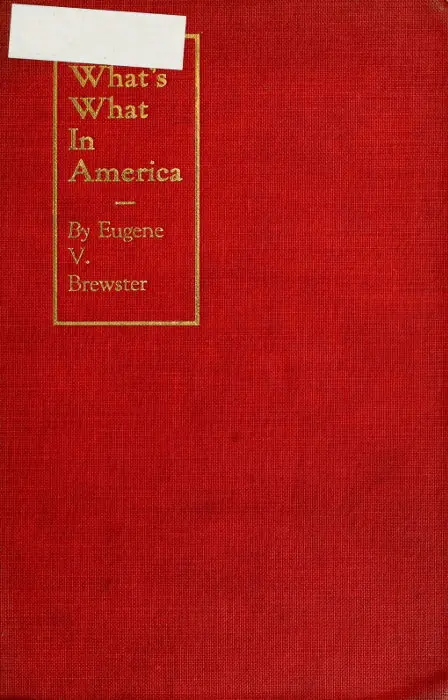
"What's What in America" by Eugene V. Brewster is a critical examination of societal trends and superstitions written in the early 20th century. The work discusses a variety of cultural phenomena viewed through Brewster's lens of skepticism, exploring the nature of credulity, self-deception, and the beliefs that take root in the American consciousness, including health fads and pseudosciences. At the start of the book, Brewster presents a preface outlining the complexities of American identity, highlighting the paradox of being a diverse yet unified society. He posits that Americans are drawn to various unorganized 'isms', such as Christian Science and phrenology, suggesting these credulities are indicative of a deeper social disarray. He introduces the themes of the book, indicating a series of essays that will dissect these ideologies, addressing the interplay of superstition, belief in the supernatural, and the sometimes absurd popularity of certain fads in the quest for understanding and meaning within the rapidly changing landscape of American life at the time.
Introduction adapted from the source catalogue; source summaries may be automatically generated.
Free to read · English · 46,415 words · No account needed
MAKE TIME FOR A GOOD BOOK
On by default. Untick to stop anonymous reading totals. Each page counts after 10 seconds in view. How this works.
Anonymous counting is on unless you have switched it off.
Then, again, the beard was often attacked by the assessors, as well as by the churches and fashions; for did not Peter the Great levy a heavy tax on all Russian beards, and did not Queen Elizabeth, in spite of bearded Raleigh, impose a tax of 3s. 4d. on all beards above a fortnight's growth? These were unfair handicaps to the beard, and greatly hampered its progress, but, beards, like truth, crushed to earth will rise again, and so always did the beard. For, observe that in the reign of Henry VIII the lawyers wore imposing beards, which became so fashionable that the authorities at Lincoln's Inn made them pay double common to sit at the great table; but mark that this was before 1535 when Henry raised his own crisp beard which afterwards became so celebrated. Beginning with the 13th century, when beards first came in fashion in England, up to the present, the poor beard has had a checkered career, but of late it has held its own with commendable persistency, and now all Europe is bearded, as it was in the beginning.
If the beard was sometimes held in respect, as in the Bastile, where an official was kept busy shaving the captives, and as in our own prisons, where the guests of the state are kept beardless, do you say that occasionally it was held in contempt and betokens laziness and rudeness? Yes, but, when your entire list of digressions is exposed, and your whole catalog of objections exhausted, you will find that His Majesty the Beard still waves triumphantly. It may be trod under foot for a time, but, just as the shaven beard will soon grow again, so will the beard that has been legislated against by court, church or fashion. In days of old, to touch the beard rudely was to assail the dignity of its owner; and when a man placed his hand upon his beard and swore by it, he felt bounden by the most sacred of oaths. We all have a certain reverence for traditions, and those of the beard are still respected, among the uncivilized as well as among the civilized. Was it not Juan de Castro, the Portuguese admiral, who borrowed a thousand pistoles and pledged one of his whiskers, saying, "All the gold in the world cannot equal this natural ornament of my valor?" Persius associated wisdom with the beard, and called Socrates "Magister Barbatus" in commendation of that gentleman's populous beard. And do not the sculptors and painters usually represent Jupiter, Hercules and Plato with the same tokens of strength, fortitude, sturdiness and virility? Who would favor a "beardless youth" to Numa Pimpolius--he of the magnificent flowing beard? Who would prefer a Shakespeare, a Longfellow, a Whitman, a Ruskin, a Charlemagne, shorn of their hirsute adornments? Or a Lincoln, Grant or Lee? But, of course, there are beards and beards; we are not lost in admiration at sight of such anomalies as those of John Mayo ("John the Bearded"), or of Emperor Frederick Barbarossa, nor even with that majestic forest of hair which was attached to Queen Mary's agent to Moscow, George Killingworth, whose beard measured five feet two inches, and which so pleased the grim Ivan the Terrible that he actually laughed and played with it. Coming down to the present, some of us will prefer the silky, golden beard, such as adorns the handsome countenance of Judge Wilkin, of the Children's Court; some the splendid snow-white beard of Hudson Maxim, or the shorter and less white beard of our able and amiable Edwin Markham; or the mixed, philosophic beard of General Vanderbilt; or, perchance, we prefer the sandy, semi-gray beard of that profound jurist, statesman, philosopher,--Judge Gaynor. And then there is the erudite Bernard Shaw, and our virtuous statesman Judge Hughes, and then there was the sage and honorable keeper of the public baths, Dr. Wm. H. Hale, and Oscar Hammerstein, the impressario. Yes, the beard is coming, so away with your safety razors, and supply your barber with shears. Away with your alum, salves and powders, and look up the old recipes for hair-restoring. The Roman youths used household oils to coax the hairs to grow, but the apothecaries of those days were not so cunning as ours, and soon we may expect to see the bill-boards and advertising pages filled with notices of new preparations guaranteed to grow a beard in a night, and directions how to care for, dress, comb, clip and preserve it. No doubt we shall soon become as careful of those sacred emblems of maturity and manhood, our whiskers, as Sir Thomas Moore was of his, who, as he put his head upon the block, carefully laid his beard out of the way, and then cracked a joke. What kind of a beard shall we wear? Consult the artists and barbers, and trim it as you do your hair--as best suits and becomes you. Charles the First adopted the Vandyke beard, after the artist of that name. Ruskin, and other philosophers, wore their beards as nature intended, trimming them about once every decade. Actors, waiters, and doctors will probably wear no beards, for obvious reasons, but they will all wish they could, if they read James Ward's "Defense of the Beard," in which eighteen excellent reasons are given, among which might be mentioned, protection to throat and chest, and Nature. And yet, on the other hand, there are serious objections to the beard, among which is the one made immortal by those classic lines of Homer--or was it Lewis Carroll?--which runneth thus:
Your reading position is saved on this browser. Take it to another device with a library code. Reading pages adapt to text, rather than matching a printed edition.
BEHIND THE BOOK
This eBook is for the use of anyone anywhere in the United States and most other parts of the world at no cost and with almost no restrictions whatsoever. You may copy it, give it away or re-use it under the terms of the Project Gutenberg License included with this eBook or online at www.gutenberg.org. If you are not located in the United States, you will have to check the laws of the country where you are located before using this eBook. Read the source licence.
The original source file, including credits and licence, is retained by this library. Request an original-format copy at no charge. Please include the book title and Project Gutenberg identifier #54370.
KEEP YOUR CURIOSITY GOING
David Patterson (Spirit) Hatch

David Patterson (Spirit) Hatch

David Patterson (Spirit) Hatch
Cécile Tormay

Moritz Busch
John L. Ransom