
Foods; nutrition and digestion
Susanna Cocroft
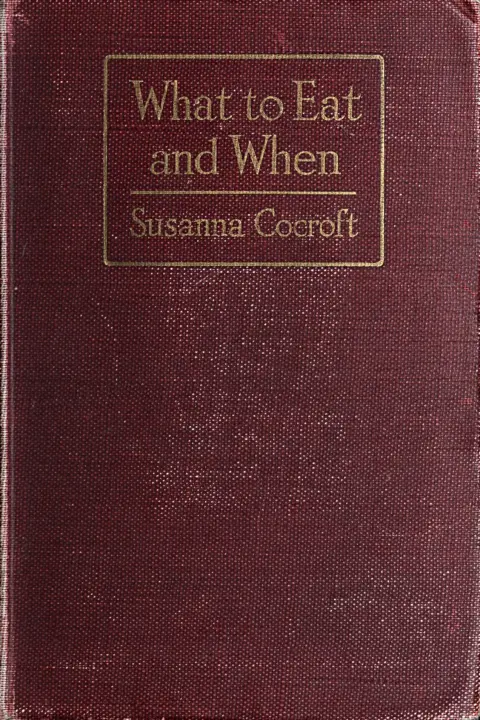
THE CLASSIC COLLECTION · 1916
"What to Eat and When" by Susanna Cocroft is a dietary guide written in the early 20th century. This work focuses on the science of nutrition and the link between diet, health, and bodily functions. Cocroft emphasizes that understanding the right food choices is essential for maintaining good health and achieving well-being, aiming to make complex dietary concepts accessible to laypeople. The opening of the book presents a comprehensive introduction to the importance of dietetics, arguing against historical views that neglect the body in favor of the soul. Cocroft discusses the relationship between food and bodily functions, asserting that a sound body supports a sound mind. She highlights the need for balance in nutrition and the role of various food elements in achieving physical and mental vitality. The introduction serves to prepare the reader for an exploration of detailed dietary principles that will follow in subsequent chapters.
Introduction adapted from the source catalogue; source summaries may be automatically generated.
Free to read · English · 95,562 words · No account needed
MAKE TIME FOR A GOOD BOOK
On by default. Untick to stop anonymous reading totals. Each page counts after 10 seconds in view. How this works.
Anonymous counting is on unless you have switched it off.
They are relishes and are to be employed in this manner judiciously, and not used generally in the diet.
Some strong condiments, as cayenne pepper, are of use in dyspeptic conditions to stimulate the gastric mucous membrane.
They are of value in the dietary of the invalid whose appetite must be stimulated and careful variations in flavoring will aid in varying a diet which otherwise would be monotonous, but the excessive use of condiments, particularly the various peppers, salt, horseradish, ginger, vinegar, and spices, as indulged by many, so overstimulates the gastric and intestinal membranes, as to cause catarrhal disease and dyspepsia. They tend to weaken digestion by calling for an undue secretion of digestive juices, which, if prolonged, tires out the glands.
The use of salts is discussed on pages 34-37.
A reasonable amount of condiments such as pepper, salt, nutmeg, cloves, allspice, sage, thyme, ginger, mustard, cinnamon, mace, horseradish, vanilla, dill, etc., may be used as appetizers, because the pleasing thought of them may incite the flow of gastric juice; but they should not be used to excess.
The taste is undoubtedly a cultivated one, and should not be encouraged in children. The child rarely cares for condiments and it is better that he continue to relish his food in its natural flavor.
If beef tea, which so soon becomes distasteful to the sick, is flavored with different savory or aromatic substances, as parsley, sage, or mint, it is taken with greater relish.
Mustard, so commonly used with cold ham or other meat and in salad dressing, is sometimes of benefit in stimulating the appetite, but when used in large quantities, or continuously, it may irritate the stomach. This irritant quality may be used to advantage, when it is deemed necessary, as a counter-irritant on the skin, as in the well-known mustard plaster. A teaspoonful of mustard to a pint of lukewarm water is an effectual emetic in cases in which it is necessary or advisable to empty the stomach.
Capers, the flower buds of a bush grown in the East, are put up in vinegar and used in sauces for mutton.
Cinnamon, nutmeg, and cloves are useful in flavoring foods; they take the flat taste from hot water and impart a pleasant spiciness. Many can take milk when flavored, and the slight amount necessary is in no way injurious.
Preserved ginger is of value for flavoring cereal foods and gruels
for invalids.
Vinegar, used in excess, reduces the alkalinity of the blood and aids in the destruction of red blood corpuscles. It may thus produce anemia when used in excess.
Your reading position is saved on this browser. Take it to another device with a library code. Reading pages adapt to text, rather than matching a printed edition.
Susanna Cocroft
BEHIND THE BOOK
This eBook is for the use of anyone anywhere in the United States and most other parts of the world at no cost and with almost no restrictions whatsoever. You may copy it, give it away or re-use it under the terms of the Project Gutenberg License included with this eBook or online at www.gutenberg.org. If you are not located in the United States, you will have to check the laws of the country where you are located before using this eBook. Read the source licence.
The original source file, including credits and licence, is retained by this library. Request an original-format copy at no charge. Please include the book title and Project Gutenberg identifier #72779.
KEEP YOUR CURIOSITY GOING

Charles G. (Charles Griffith) Ross
Hannah Webster Foster

Emily Lawless
Edwin Hamlin Carr

Charles De Lano Hine
Andrew Ure