
Foods; nutrition and digestion
Susanna Cocroft
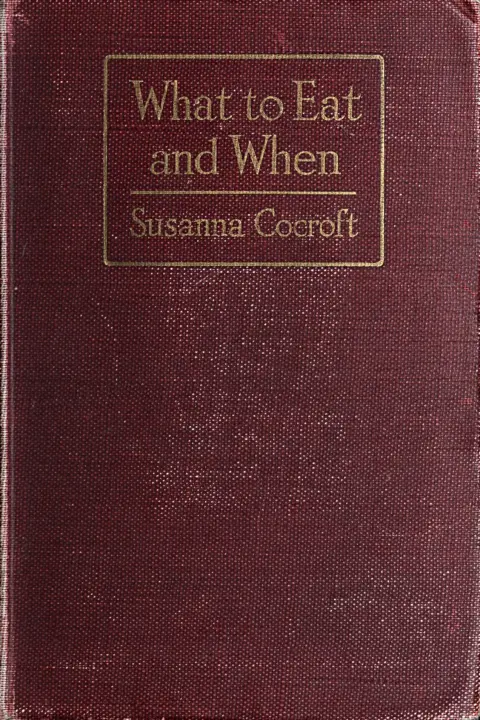
THE CLASSIC COLLECTION · 1916
"What to Eat and When" by Susanna Cocroft is a dietary guide written in the early 20th century. This work focuses on the science of nutrition and the link between diet, health, and bodily functions. Cocroft emphasizes that understanding the right food choices is essential for maintaining good health and achieving well-being, aiming to make complex dietary concepts accessible to laypeople. The opening of the book presents a comprehensive introduction to the importance of dietetics, arguing against historical views that neglect the body in favor of the soul. Cocroft discusses the relationship between food and bodily functions, asserting that a sound body supports a sound mind. She highlights the need for balance in nutrition and the role of various food elements in achieving physical and mental vitality. The introduction serves to prepare the reader for an exploration of detailed dietary principles that will follow in subsequent chapters.
Introduction adapted from the source catalogue; source summaries may be automatically generated.
Free to read · English · 95,562 words · No account needed
MAKE TIME FOR A GOOD BOOK
On by default. Untick to stop anonymous reading totals. Each page counts after 10 seconds in view. How this works.
Anonymous counting is on unless you have switched it off.
It must be carefully cooked and well prepared as, like oatmeal, it can be spoiled by insufficient or poor cooking. Owing to the limited demand it is not obtainable in all markets, as it has not yet become popularized.
Grapes, because of their wholesome qualities, are useful to the system, as they contain sodium, iron, magnesium, potassium, and calcium. Because of their appetizing flavor they are universally enjoyed, and because they are cheap are universally used. The skins and seeds are indigestible and, if swallowed, may cause severe irritation or obstruction of the intestines. Grapes are rich in sugar, and on this account must not be eaten by diabetics.
Grape juice, when unfermented, is a valuable drink, in health, or for the convalescent. It is agreeable in taste and is mildly laxative. Added to other fruit juices, as lemon or orange, it allays thirst and furnishes a pleasant flavor, but on account of its high percentage of sugar does not allay thirst when used alone.
Apples, so universally used, are easily digestible when ripe, and may be prepared in so many ways that they constitute a valuable addition to the diet. Their laxative qualities, when taken on an empty stomach, as before breakfast, or just before retiring, are well known. They are thus valuable in constipation, and in some forms of dyspepsia may, with benefit, be eaten raw.
Apples should be thoroughly masticated.
The apple peel contains potassium salts and should be eaten with the
fruit.
Most invalids digest apples better if they are cooked, especially baked. Stewed apples may have the beaten white of eggs whipped into them and invalids who revolt against eggs can take them thus prepared.
Because of the sugar necessary in cooking them they should be avoided by diabetics, and in conditions in which there is irritation of the gastro-intestinal tract.
Quinces are indigestible when raw, but well baked and eaten with cream are appetizing and nourishing.
Pineapples, if thoroughly ripe, contain a ferment which will digest protein, rapidly softening and disintegrating the tissue of meat. Like the pancreatic ferment it acts in both alkaline and acid mediums. Pineapple juice, therefore, is exceedingly valuable as an addition to the diet. The coarse fibers also have a laxative action. Care must be taken, however, to use this fruit only when it is well ripened, as when green, it is indigestible.
The juice of pineapple, because of the action of the ferment in dissolving tissue, is valuable in many forms of sore throat, particularly when accompanied by an ulcerous condition. The effort should be made to hold it in the mouth, allowing it to trickle down the throat by degrees.
Your reading position is saved on this browser. Take it to another device with a library code. Reading pages adapt to text, rather than matching a printed edition.
Susanna Cocroft
BEHIND THE BOOK
This eBook is for the use of anyone anywhere in the United States and most other parts of the world at no cost and with almost no restrictions whatsoever. You may copy it, give it away or re-use it under the terms of the Project Gutenberg License included with this eBook or online at www.gutenberg.org. If you are not located in the United States, you will have to check the laws of the country where you are located before using this eBook. Read the source licence.
The original source file, including credits and licence, is retained by this library. Request an original-format copy at no charge. Please include the book title and Project Gutenberg identifier #72779.
KEEP YOUR CURIOSITY GOING

Charles G. (Charles Griffith) Ross
Hannah Webster Foster

Emily Lawless
Edwin Hamlin Carr

Charles De Lano Hine
Andrew Ure