Southern Soldier Stories
George Cary Eggleston
THE CLASSIC COLLECTION · 1911
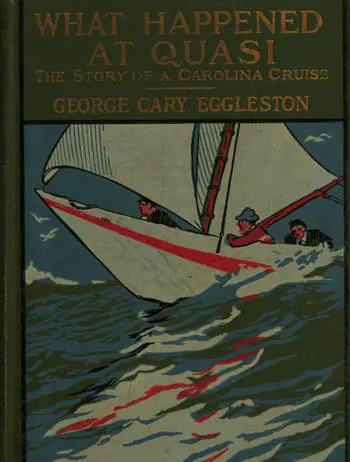
"What Happened at Quasi: The Story of a Carolina Cruise" by George Cary Eggleston is a novel written in the early 20th century. This adventure tale centers around a group of boys, particularly focusing on the characters Dick Wentworth, the Rutledge twins, and Tom Garnett, as they embark on a summer cruise along the Carolina coast in search of sport and adventure. Their journey leads them into the wilderness, where themes of friendship, bravery, and the spirit of exploration are prominent. At the start of the story, the boys are introduced in the oppressive heat of Charleston, where they plan to launch their newly acquired boat, the "Hunkydory," for a summer of fun. The preliminary chapters depict their camaraderie, discussions about sailing, and preparations for their voyage. They learn about the intricacies of sailing a dory, share playful banter, and express enthusiasm about the adventures awaiting them, including hunting and fishing along the coast. There is also a sense of mystery surrounding an old plantation called Quasi, which they hope to visit, hinting at deeper explorations related to family history and potential danger. The opening sets a lively tone for the adventure while introducing readers to the boys' personalities and dynamic relationships.
Introduction adapted from the source catalogue; source summaries may be automatically generated.
Free to read · English · 78,778 words · No account needed
MAKE TIME FOR A GOOD BOOK
On by default. Untick to stop anonymous reading totals. Each page counts after 10 seconds in view. How this works.
Anonymous counting is on unless you have switched it off.
It was nearly sunset when Tom reached the catalpa tree on his return. He had not found Dunbar, but for reasons of his own he waited rather impatiently for the coming of his comrades. They were not long delayed, but the blank, anxious face of each as he appeared was a sufficient report to the others.
“The search is a failure!” said Larry, dejectedly.
“Absolutely,” answered Cal.
“No, not absolutely,” said Tom, feeling in his pocket. “I found something, and I’ve waited till you should all be here before speaking of it.”
“What is it? Tell us quick.”
“This,” answered Tom, drawing forth a letter, “and this,” producing a pruning knife with a curved blade, which they had all seen Dunbar use. “The letter was pinned to a tree with the point of the knife blade.”
“Never mind that,” said Larry, impatiently; “read the letter.”
Tom read as follows:
“I expect to be with you young gentlemen very soon. But in case I never see you again, please don’t think me ungrateful for all your kindnesses. There are times when I cannot endure a human presence—even the—”
Tom stopped reading, and explained:
“It breaks off right there, and there is no signature, or address, or
anything else.”
The boys stared at each other in amazement, and for a time uttered no word. When they begun talking again it was only to wonder and offer conjectures, and the conjectures seemed so futile that at last the little company ceased to try to read the riddle. Then Larry said:
“Come on. There’s nothing more to be done to-night and we’re all half famished. We must have a good hearty supper, and then perhaps we’ll think of something more that we can do.”
“I doubt that,” said Cal; “but I say, Tom, you have a positive genius for finding things—turtles’ eggs, smugglers’ camps, sweet potato patches, letters hidden in the woods, and everything else. Perhaps you’ll find poor Mr. Dunbar yet.”
“I was just thinking of some other things that we ought to find, and
that right away.”
“What things?”
“Why, Mr. Dunbar’s. You know he has never brought any of them to our camp, and we know he writes and draws and all that. He must have some place up near his old bivouac where he can keep his papers and drawings and specimens dry. It seems to me we ought—”
“Of course we ought,” broke in Cal. “There may be something there to give us a clue. What do you say, Larry?”
“It is a good suggestion of Tom’s, and we’ll act upon it at once.”
Your reading position is saved on this browser. Take it to another device with a library code. Reading pages adapt to text, rather than matching a printed edition.
George Cary Eggleston
George Cary Eggleston
George Cary Eggleston
George Cary Eggleston
BEHIND THE BOOK
This eBook is for the use of anyone anywhere in the United States and most other parts of the world at no cost and with almost no restrictions whatsoever. You may copy it, give it away or re-use it under the terms of the Project Gutenberg License included with this eBook or online at www.gutenberg.org. If you are not located in the United States, you will have to check the laws of the country where you are located before using this eBook. Read the source licence.
The original source file, including credits and licence, is retained by this library. Request an original-format copy at no charge. Please include the book title and Project Gutenberg identifier #50811.
KEEP YOUR CURIOSITY GOING
Coulson Kernahan

Maurice Baring
Frances Wright
Cécile Tormay

Frederic Jesup Stimson

W. H. P. (William Henry Pope) Jarvis