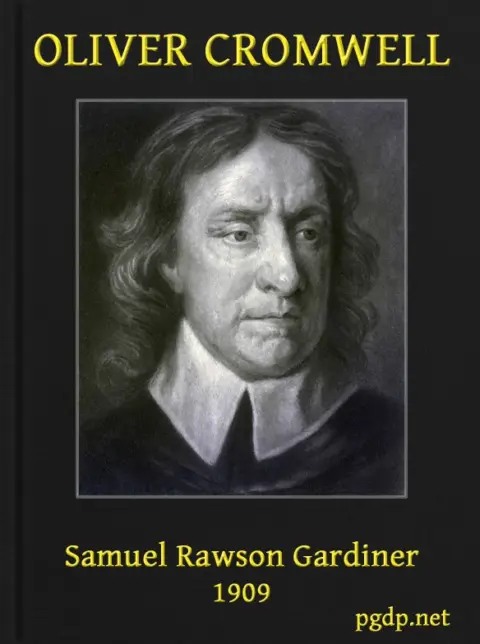
Oliver Cromwell
Samuel Rawson Gardiner
THE CLASSIC COLLECTION · 1897
"What Gunpowder Plot Was" by Samuel Rawson Gardiner is a historical account written in the late 19th century. The book examines the infamous Gunpowder Plot of 1605, challenging traditional narratives and exploring the motivations behind the conspiracy to blow up the British Parliament. Gardiner engages with various historical evidences and interpretations, particularly focusing on the claims made by Father Gerard regarding the conspirators' supposed manipulation by government officials. The opening of the text sets the stage for an in-depth analysis of the historical controversy surrounding the Gunpowder Plot. Gardiner begins by referencing Father Gerard’s examination of evidence asserting the plot was fabricated by the Earl of Salisbury for political gain. He discusses Gerard's conclusions, noting their implications on Catholic perceptions and the subsequent penalties they suffered following the event. Gardiner moves to critique Gerard's approach and the reliability of various sources, hinting at a meticulous inquiry into the established narrative while arguing for a thorough exploration of historical documents to discover the truth behind this pivotal moment in British history.
Introduction adapted from the source catalogue; source summaries may be automatically generated.
Free to read · English · 71,803 words · No account needed
MAKE TIME FOR A GOOD BOOK
On by default. Untick to stop anonymous reading totals. Each page counts after 10 seconds in view. How this works.
Anonymous counting is on unless you have switched it off.
After a further remonstrance from the ambassador, Cranborne returned to
the charge.
"Sir," he replied, "nothing else can be done. These are the laws, and they must be observed. Their object is undoubtedly to extinguish the Catholic religion in this kingdom, because we do not think it fit, in a well-governed monarchy, to increase the number of persons who profess to depend on the will of other Princes as the Catholics do, the priests not preaching anything more constantly than this, that the good Catholic ought to be firmly resolved in himself to be ready to rise for the preservation of his religion even against the life and state of his natural Prince.[252] This is a very perilous doctrine, and we will certainly never admit it here, but will rather do our best to overthrow it, and we will punish most severely those who teach it and impress it on the minds of good subjects."[253]
It is unnecessary to pursue the conversation further, or even to discuss how far Cranborne was serious when he expressed his intention of moderating the incidence of the laws which the Government had resolved to carry out. It is certain that they were not so moderated, and that the enforcement of law rapidly degenerated into mere persecution. What is important for our purposes is that the language I have just quoted leads us to the bed-rock of the situation. Between Pope and king a question of sovereignty had arisen, a question which could not be neglected without detriment to the national independence till the Pope either openly or tacitly abandoned his claim to excommunicate kings, and to release such subjects as looked up to him for guidance from the duty of obedience to their King. That the Pope should openly abandon this claim was more than could be expected; but he had not excommunicated James as his predecessor had excommunicated Elizabeth, and there was some reason to hope that he might allow the claim to be buried in oblivion. At all events, Clement VIII. had not only refused to excommunicate James, but had enjoined on the English Catholics the duty of abstaining from any kind of resistance to him. James had, however, wished to go further. Incapable--as most people in all ages are--of seeing the position with other eyes than his own, he wanted the Pope actively to co-operate with him in securing the obedience of his subjects. He even asked him to excommunicate turbulent Catholics, a thing to which it was impossible for the Pope--who also looked on these matters from his own point of view--to consent. In the meanwhile it was becoming evident that the Pope was not working for a Protestant England under a Protestant king, with a Catholic minority accepting what crumbs of toleration that king might fling to them, and renouncing for ever the right to resist his laws however oppressive they might be; but rather for a Catholic England under a Catholic King. This appeared in Clement's demand that Prince Henry should be educated in a religion which was not that of his father, and it appeared again in the reports of Lindsay, which had caused such a commotion at Whitehall. "His Holiness," wrote Lindsay, "hath commanded to continue to pray for your Majesty, and he himself stays every night two large hours in prayer for your Majesty, the Queen, and your children, and for the conversion of your Majesty and your dominions. This I may very well witness as one who was present."[254] We should have thought the worse of the Pope if he had done otherwise; but the news of it was hardly likely to be welcome to an English statesman. Who was to guarantee that, if the priests were allowed full activity in England a Roman Catholic majority would not be secured--or, that when such a majority was secured, the suspended excommunication would not be launched, and a rebellion, such as that of the League in France, encouraged against an obstinately Protestant Sovereign. We may be of opinion that those statesmen who attempted to meet the danger with persecution were men of little faith, who might have trusted to the strength of their religious and political creed--the two could not in those days be separated from one another; but there can be no doubt that the danger was there. We may hold Salisbury to have been but a commonplace man for meeting it as he did, but he had on his side nearly the whole of the official class which had stood by the throne of Elizabeth, and which now stood by the throne of James.
Your reading position is saved on this browser. Take it to another device with a library code. Reading pages adapt to text, rather than matching a printed edition.
Samuel Rawson Gardiner
Samuel Rawson Gardiner
BEHIND THE BOOK
This eBook is for the use of anyone anywhere in the United States and most other parts of the world at no cost and with almost no restrictions whatsoever. You may copy it, give it away or re-use it under the terms of the Project Gutenberg License included with this eBook or online at www.gutenberg.org. If you are not located in the United States, you will have to check the laws of the country where you are located before using this eBook. Read the source licence.
The original source file, including credits and licence, is retained by this library. Request an original-format copy at no charge. Please include the book title and Project Gutenberg identifier #34606.
KEEP YOUR CURIOSITY GOING
Cécile Tormay

Moritz Busch
John L. Ransom
Frances Wright
Cécile Tormay

Mabel Potter Daggett