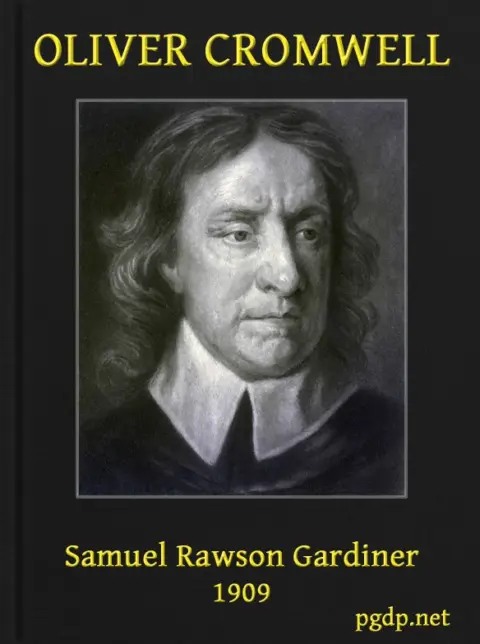
Oliver Cromwell
Samuel Rawson Gardiner
THE CLASSIC COLLECTION · 1897
"What Gunpowder Plot Was" by Samuel Rawson Gardiner is a historical account written in the late 19th century. The book examines the infamous Gunpowder Plot of 1605, challenging traditional narratives and exploring the motivations behind the conspiracy to blow up the British Parliament. Gardiner engages with various historical evidences and interpretations, particularly focusing on the claims made by Father Gerard regarding the conspirators' supposed manipulation by government officials. The opening of the text sets the stage for an in-depth analysis of the historical controversy surrounding the Gunpowder Plot. Gardiner begins by referencing Father Gerard’s examination of evidence asserting the plot was fabricated by the Earl of Salisbury for political gain. He discusses Gerard's conclusions, noting their implications on Catholic perceptions and the subsequent penalties they suffered following the event. Gardiner moves to critique Gerard's approach and the reliability of various sources, hinting at a meticulous inquiry into the established narrative while arguing for a thorough exploration of historical documents to discover the truth behind this pivotal moment in British history.
Introduction adapted from the source catalogue; source summaries may be automatically generated.
Free to read · English · 71,803 words · No account needed
MAKE TIME FOR A GOOD BOOK
On by default. Untick to stop anonymous reading totals. Each page counts after 10 seconds in view. How this works.
Anonymous counting is on unless you have switched it off.
'If he will not otherwise confess,' the King had ended by saying, 'the gentler tortures are to be first used unto him, et sic per gradus ad ima tenditur.' To us living in the nineteenth century these words are simply horrible. As a Scotchman, however, James had long been familiar with the use of torture as an ordinary means of legal investigation, whilst even in England, though unknown to the law, that is to say, to the practice of the ordinary courts of justice, it had for some generations been used not infrequently by order of the Council to extract evidence from a recalcitrant witness, though, according to Bacon, not for the purpose of driving him to incriminate himself. Surely, if the use of torture was admissible at all, this was a case for its employment. The prisoner had informed the Government that he had been at the bottom of a plot of the most sanguinary kind, and had acknowledged by implication that there were fellow-conspirators whom he refused to name. If, indeed, Father Gerard's view of the case, that the Government, or at least Salisbury, had for some time known all about the conspiracy, nothing--not even the Gunpowder Plot itself--could be more atrocious than the infliction of torments on a fellow-creature to make him reveal a secret already in their possession. If, however, the evidence I have adduced be worth anything, this was by no means the case. What it shows is, that on the afternoon of the 6th all that the members of the Government were aware of was that an unknown number of conspirators were at large--they knew not where--and might at that very moment be appealing--they knew not with what effect--to Catholic landowners and their tenants, who were, without doubt, exasperated by the recent enforcement of the penal laws. We may, if we please, condemn the conduct of the Government which had brought the danger of a general Catholic rising within sight. We cannot deny that, at that particular moment, they had real cause of alarm. At all events, no immediate steps were taken to put this part of the King's orders in execution. Some little information, indeed, was coming in from other witnesses. In his first examination, on November 5, Fawkes had stated that in his absence he locked up the powder, and 'one Gibbons' wife who dwells thereby had the charge of the residue of the house.' An examination of her husband on the 5th, however, only elicited that he, being a porter, had with two others carried 3,000 billets into the vault.[31] On the 6th Ellen, the wife of Andrew Bright, stated that Percy's servant had, about the beginning of March, asked her to let the vault to his master, and that she had consented to abandon her tenancy of it if Mrs. Whynniard, from whom she held it, would consent. Mrs. Whynniard's consent having been obtained, Mrs. Bright, or rather Mrs. Skinner--she being a widow remarried subsequently to Andrew Bright[32]--received 2l. for giving up the premises. The important point in this evidence is that the date of March 1605, given as that on which Percy entered into possession of the cellar, showed that Fawkes's statement that he had brought powder into the cellar at Christmas 1604 could not possibly be true. On the 7th, Mrs. Whynniard confirmed Mrs. Bright's statement, and also stated that, a year earlier, in March 1604, 'Mr. Percy began to labour very earnestly with this examinate and her husband to have the lodging by the Parliament House, which one Mr. Henry Ferris, of Warwickshire, had long held before, and having obtained the said Mr. Ferris's good will to part from it after long suit by himself and great entreaty of Mr. Carleton, Mr. Epsley,[33] and other gentlemen belonging to the Earl of Northumberland, affirming him to be a very honest gentleman, and that they could not have a better tenant, her husband and she were contented to let him have the said lodging at the same rent Mr. Ferris paid for it.'[34] Mrs. Whynniard had plainly never heard of the mine; and that the Government was in equal ignorance is shown by the endorsement on the agreement of Ferris, or rather Ferrers, to make over his tenancy to Percy. 'The bargain between Ferris and Percy for the bloody cellar, found in Winter's lodging.' Winter's name had been under consideration for some little time, and doubtless the discovery of this paper was made on, or more probably before, the 7th. The Government, having as yet nothing but Fawkes's evidence to go upon, connected the hiring of the house with the hiring of the cellar, and at least showed no signs of suspecting anything more.
Your reading position is saved on this browser. Take it to another device with a library code. Reading pages adapt to text, rather than matching a printed edition.
Samuel Rawson Gardiner
Samuel Rawson Gardiner
BEHIND THE BOOK
This eBook is for the use of anyone anywhere in the United States and most other parts of the world at no cost and with almost no restrictions whatsoever. You may copy it, give it away or re-use it under the terms of the Project Gutenberg License included with this eBook or online at www.gutenberg.org. If you are not located in the United States, you will have to check the laws of the country where you are located before using this eBook. Read the source licence.
The original source file, including credits and licence, is retained by this library. Request an original-format copy at no charge. Please include the book title and Project Gutenberg identifier #34606.
KEEP YOUR CURIOSITY GOING
Cécile Tormay

Moritz Busch
John L. Ransom
Frances Wright
Cécile Tormay

Mabel Potter Daggett