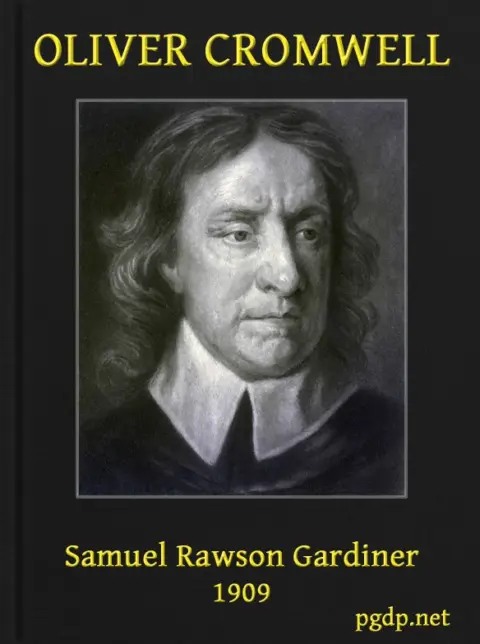
Oliver Cromwell
Samuel Rawson Gardiner
THE CLASSIC COLLECTION · 1897
"What Gunpowder Plot Was" by Samuel Rawson Gardiner is a historical account written in the late 19th century. The book examines the infamous Gunpowder Plot of 1605, challenging traditional narratives and exploring the motivations behind the conspiracy to blow up the British Parliament. Gardiner engages with various historical evidences and interpretations, particularly focusing on the claims made by Father Gerard regarding the conspirators' supposed manipulation by government officials. The opening of the text sets the stage for an in-depth analysis of the historical controversy surrounding the Gunpowder Plot. Gardiner begins by referencing Father Gerard’s examination of evidence asserting the plot was fabricated by the Earl of Salisbury for political gain. He discusses Gerard's conclusions, noting their implications on Catholic perceptions and the subsequent penalties they suffered following the event. Gardiner moves to critique Gerard's approach and the reliability of various sources, hinting at a meticulous inquiry into the established narrative while arguing for a thorough exploration of historical documents to discover the truth behind this pivotal moment in British history.
Introduction adapted from the source catalogue; source summaries may be automatically generated.
Free to read · English · 71,803 words · No account needed
MAKE TIME FOR A GOOD BOOK
On by default. Untick to stop anonymous reading totals. Each page counts after 10 seconds in view. How this works.
Anonymous counting is on unless you have switched it off.
[242] He told the Spanish Ambassador, 'che quelli del Consiglio gli havevano fatto tanta forza che no haveva potuto far altro, ma che no si sarebbe eseguito con rigore alcuno.' (Del Bufalo to Aldobrandino, March 27/April 6.)--Roman Transcripts, R. O.
[243] Precisely the course he had recommended in his letter written to Cecil whilst he was still in Scotland, see p. 144.
[244] See p. 33.
[245] A news-letter gives an account of the Council meeting, from which it appears that James began by haranguing against the Puritans, but Cranborne--Cecil was now known by this title--and others asked why the Catholics were not put on the same footing, on which the King got angry, and finally directed that the Catholics should also suffer. (Advices from London, Feb. 19/March 1).--Roman Transcripts, R.O.
[246] In those days liberty of conscience meant what we should call
liberty of worship.
[247] Lindsay at last got off to Rome in November 1604. On his proceedings there see History of England, 1603-1642, i. 224.
[248] In the MS. 'et non haverebbe.' Mr. Rawdon Brown, amongst whose papers, now in the Record Office, this despatch is found, remarks that mistakes of this kind frequently occur in letters first ciphered and then deciphered.
[249] In the margin is 'Questo poi e troppo,' perhaps an addition by the ambassador, or even by Mr. Rawdon Brown.
[250] 'Religione' is suggested by Mr. Rawdon Brown for the 'ragione' of
the decipherer.
[251] In the copy 'non si puo far di meno di non observar le leggi,' the 'non' being incorrectly repeated.
[252] "Non predicando li preti nessuna cosa piu constantemente di questa che il buon Cattolico bisogna che habbia questa ferma rissolutione in se medesimo di esser per conservar la Religione pronto a solevarsi etiam contra la vita e stato del suo Principe naturale."
[253] Molin to the Doge, March 7/17, 1605, Venetian Transcripts, R.O.
[254] Lindsay to James I. Jan. 26/Feb. 5, 1605, S. P. Italian States.
[255] Compare the last passage quoted from Molin's despatch, p. 161.
[256] This is, however, precisely what James had failed to induce the
Pope to do.
[257] Father Gerard asks what 'our offence' was. It was clearly nothing personal to the writer, and I am strongly inclined to interpret the words as referring to Lindsay's proceedings at Rome, of which so much had been made.
[258] Sir Everard Digby to Salisbury (S. P. Dom. xvii. 10.) As Father Gerard says, the date cannot be earlier than May 4, 1605, when the Earldom was conferred on Cranborne.
[259] Father Gerard gives the date of Davies's pardon from the Pardon Roll as April 25, 1605. It should be April 23, 1604.
Your reading position is saved on this browser. Take it to another device with a library code. Reading pages adapt to text, rather than matching a printed edition.
Samuel Rawson Gardiner
Samuel Rawson Gardiner
BEHIND THE BOOK
This eBook is for the use of anyone anywhere in the United States and most other parts of the world at no cost and with almost no restrictions whatsoever. You may copy it, give it away or re-use it under the terms of the Project Gutenberg License included with this eBook or online at www.gutenberg.org. If you are not located in the United States, you will have to check the laws of the country where you are located before using this eBook. Read the source licence.
The original source file, including credits and licence, is retained by this library. Request an original-format copy at no charge. Please include the book title and Project Gutenberg identifier #34606.
KEEP YOUR CURIOSITY GOING
Cécile Tormay

Moritz Busch
John L. Ransom
Frances Wright
Cécile Tormay

Mabel Potter Daggett