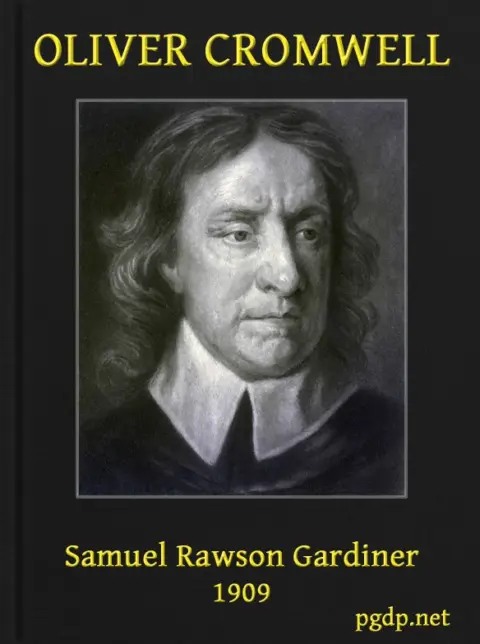
Oliver Cromwell
Samuel Rawson Gardiner
THE CLASSIC COLLECTION · 1897
"What Gunpowder Plot Was" by Samuel Rawson Gardiner is a historical account written in the late 19th century. The book examines the infamous Gunpowder Plot of 1605, challenging traditional narratives and exploring the motivations behind the conspiracy to blow up the British Parliament. Gardiner engages with various historical evidences and interpretations, particularly focusing on the claims made by Father Gerard regarding the conspirators' supposed manipulation by government officials. The opening of the text sets the stage for an in-depth analysis of the historical controversy surrounding the Gunpowder Plot. Gardiner begins by referencing Father Gerard’s examination of evidence asserting the plot was fabricated by the Earl of Salisbury for political gain. He discusses Gerard's conclusions, noting their implications on Catholic perceptions and the subsequent penalties they suffered following the event. Gardiner moves to critique Gerard's approach and the reliability of various sources, hinting at a meticulous inquiry into the established narrative while arguing for a thorough exploration of historical documents to discover the truth behind this pivotal moment in British history.
Introduction adapted from the source catalogue; source summaries may be automatically generated.
Free to read · English · 71,803 words · No account needed
MAKE TIME FOR A GOOD BOOK
On by default. Untick to stop anonymous reading totals. Each page counts after 10 seconds in view. How this works.
Anonymous counting is on unless you have switched it off.
[132] This name is given at a later time to the 'Passage leading to the Parliament Stairs' of Capon's plan, and I have, for convenience sake, referred to it throughout by that name.
[133] See p. 22.
[134] Gerard, p. 62.
[135] Gerard, pp. 141, 142.
[136] I suppose Thomas Barlow is meant. William Barlow, who was Bishop of Lincoln in the reign of James I., did not write about the plot.
[137] Speed's History, ed. 1611, p. 891.
[138] March 24th, 1604.
[139] Copy of the Agreement, G. P. B., No. 1.
[140] Pat. 44 Eliz., Part 22.
[141] Gerard, p. 60, note 1.
[142] Smith's Antiquities of Westminster, p. 39. The question of the number of doors in the cellar will be dealt with hereafter.
[143] Gerard, p. 67.
[144] Gerard, p. 65.
[146] Pat. 4 Edw. VI., Part 9.
[147] Pat. 6 Edw. VI., Part 5.
[148] Pat. 30 Eliz., Part 10.
[149] Parliament Place.
[150] Assignment, July 17, 42 Eliz., Land Revenue Records Office, Inrolments v. fol. 104. I have been unable to trac Whynniard's tenure of the house I have assigned to him. It was within the Old Palace, and was probably the official residence of its keeper. Whynniard was appointed Keeper of the Old Palace in 1602. Pat. 44 Eliz., Part 22.
[151] See plan at p. 81. Was this the baker in whose house Catesby tried in vain to secure a room?--'Bates's Confession, Dec. 4, 1605'; G. P. B. No. 145.
[152] Whynniard was Keeper of the Wardrobe at Hampton Court, which would account for his servant being concerned in the Queen's removal.
[153] Otherwise Parliament Stairs.
[154] I suspect that this was what was afterwards known as Cotton Garden. I have been unable to trace the date at which it was conveyed to Sir Robert Cotton.
[155] G. P. B. No. 40.
[156] See p. 63.
[157] See p. 90.
[158] This we know from Capon's pencilled notes to the sketch in the
frontispiece.
[159] The late Chairman of the Works Department of the London County Council; than whom no man is better qualified to speak on such matters.
[160] There are indeed old walls marked in Capon's plan beneath the ground, but we do not know of what substance they were composed or how near the surface they came.
[161] Speed, no doubt, rested this assertion on Winter's evidence that 'we underpropped it, as we went, with wood.' (See p. 64.)
[162] Gerard, pp. 66, 67.
[163] See the remarks of the Edinburgh Reviewer on the ease with which Baron Trenck executed a far harder piece of work without being discovered for a considerable time.
[164] Used as such, Father Gerard notes, till the Union with Ireland in
1800.
[165] This was true of the general line of the bank, but, as will be seen at pp. 81, 83, there was a kind of dock which brought the water within about thirty yards of the house.
[166] Gerard, pp. 59, 60.
[167] G. P. B. No. 129.
[168] This is clearly a slip. The cellar was not under the house hired
by Percy.
Your reading position is saved on this browser. Take it to another device with a library code. Reading pages adapt to text, rather than matching a printed edition.
Samuel Rawson Gardiner
Samuel Rawson Gardiner
BEHIND THE BOOK
This eBook is for the use of anyone anywhere in the United States and most other parts of the world at no cost and with almost no restrictions whatsoever. You may copy it, give it away or re-use it under the terms of the Project Gutenberg License included with this eBook or online at www.gutenberg.org. If you are not located in the United States, you will have to check the laws of the country where you are located before using this eBook. Read the source licence.
The original source file, including credits and licence, is retained by this library. Request an original-format copy at no charge. Please include the book title and Project Gutenberg identifier #34606.
KEEP YOUR CURIOSITY GOING
Cécile Tormay

Moritz Busch
John L. Ransom
Frances Wright
Cécile Tormay

Mabel Potter Daggett