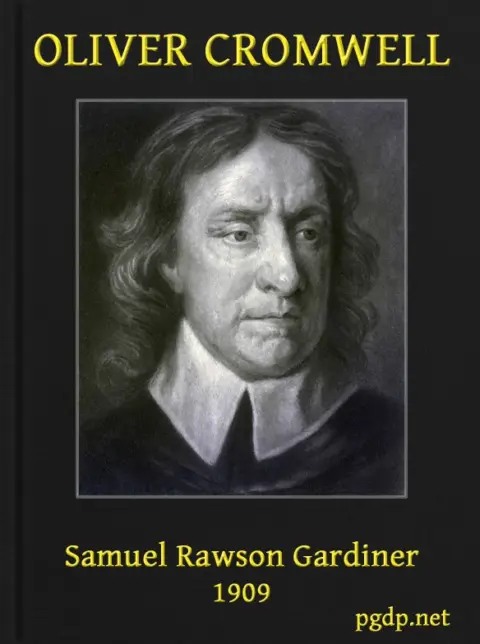
Oliver Cromwell
Samuel Rawson Gardiner
THE CLASSIC COLLECTION · 1897
"What Gunpowder Plot Was" by Samuel Rawson Gardiner is a historical account written in the late 19th century. The book examines the infamous Gunpowder Plot of 1605, challenging traditional narratives and exploring the motivations behind the conspiracy to blow up the British Parliament. Gardiner engages with various historical evidences and interpretations, particularly focusing on the claims made by Father Gerard regarding the conspirators' supposed manipulation by government officials. The opening of the text sets the stage for an in-depth analysis of the historical controversy surrounding the Gunpowder Plot. Gardiner begins by referencing Father Gerard’s examination of evidence asserting the plot was fabricated by the Earl of Salisbury for political gain. He discusses Gerard's conclusions, noting their implications on Catholic perceptions and the subsequent penalties they suffered following the event. Gardiner moves to critique Gerard's approach and the reliability of various sources, hinting at a meticulous inquiry into the established narrative while arguing for a thorough exploration of historical documents to discover the truth behind this pivotal moment in British history.
Introduction adapted from the source catalogue; source summaries may be automatically generated.
Free to read · English · 71,803 words · No account needed
MAKE TIME FOR A GOOD BOOK
On by default. Untick to stop anonymous reading totals. Each page counts after 10 seconds in view. How this works.
Anonymous counting is on unless you have switched it off.
[48] 'Unto,' in the Stowe copy.
[49] Robert Winter. The question whether Keyes worked at this time will
be discussed later on.
[50] 'Any man,' in the Stowe copy.
[51] 'Others,' in the Stowe copy.
[52] 'One' is inserted above the line.
[53] This is an obvious mistake, as the widow Skinner was not at this time married to Bright, but one just as likely to be made by Fawkes himself as by his examiners.
[54] 'Viewed it,' in the Stowe copy.
[55] 'Taken,' in Stowe copy.
[56] 'Thence,' in Stowe copy.
[57] Percy.
[58] The words in italics are marked by penstrokes across them for
omission.
[59] 'With that practice, that,' in the Stowe copy.
[60] 'Then,' omitted in the Stowe copy.
[61] 'But,' omitted in the Stowe copy.
[62] 'Whereof,' in the Stowe copy.
[63] G. P. B., No. 49. In the Stowe copy the names of the Commissioners are omitted, and a list of fifteen plotters added. As the paper was inclosed in a letter to Edmondes of the 14th, these might easily be added at any date preceding that.
[64] Gerard, p. 268.
[65] Stowe MSS., 168, fol. 223.
[66] Gerard, p. 170.
[67] Gerard, p. 169.
[68] S. P. Dom. xii. 24.
[69] Gerard, p. 175. Coke's questions are in S. P. Dom. xvi. 38.
[70] The handwriting is quite different.
[71] This declaration, therefore, was not, as Mrs. Everett Green says,
'made to Salisbury.'
[72] If anyone chooses to argue that this examination was drawn up regardless of its truth, and only signed by Fawkes after torture had made him incapable of distinguishing truth from falsehood, he may be answered that, in that case, those who prepared it would never have added to the allegation that some of the conspirators had received the Sacrament from Gerard the Jesuit to bind them to secrecy, the passage:--"But he saith that Gerard was not acquainted with their purpose." This passage is marked for omission by Coke, and it assuredly would not have been found in the document unless it had really proceeded from Fawkes.
[73] About whom more hereafter.
[74] Gerard afterwards denied that this was true, and the late Father Morris (Life of Gerard, p. 437) argues, with a good deal of probability, that Fawkes mistook another priest for Gerard. For my purpose it is not a matter of any importance.
[75] This should be John.
[76] Probably, as Father Gerard suggests, what would now be known as a
coursing match.
[77] Proclamation Book, R.O. p. 117.
[78] A late postscript added to the letter to the Ambassadors sent off on the 9th (Winwood, ii. 173) shows that before the end of the day Salisbury had learnt even more of the details than were comprised in the Sheriff's letter.
[79] Nov. 5.
[80] Nov. 6.
[81] Nov. 7.
[82] Nov. 8.
Your reading position is saved on this browser. Take it to another device with a library code. Reading pages adapt to text, rather than matching a printed edition.
Samuel Rawson Gardiner
Samuel Rawson Gardiner
BEHIND THE BOOK
This eBook is for the use of anyone anywhere in the United States and most other parts of the world at no cost and with almost no restrictions whatsoever. You may copy it, give it away or re-use it under the terms of the Project Gutenberg License included with this eBook or online at www.gutenberg.org. If you are not located in the United States, you will have to check the laws of the country where you are located before using this eBook. Read the source licence.
The original source file, including credits and licence, is retained by this library. Request an original-format copy at no charge. Please include the book title and Project Gutenberg identifier #34606.
KEEP YOUR CURIOSITY GOING
Cécile Tormay

Moritz Busch
John L. Ransom
Frances Wright
Cécile Tormay

Mabel Potter Daggett