THE CLASSIC COLLECTION✦Doesticks: What He SaysCLASSIC FREE BOOKS
Doesticks: What He Says
Q. K. Philander Doesticks
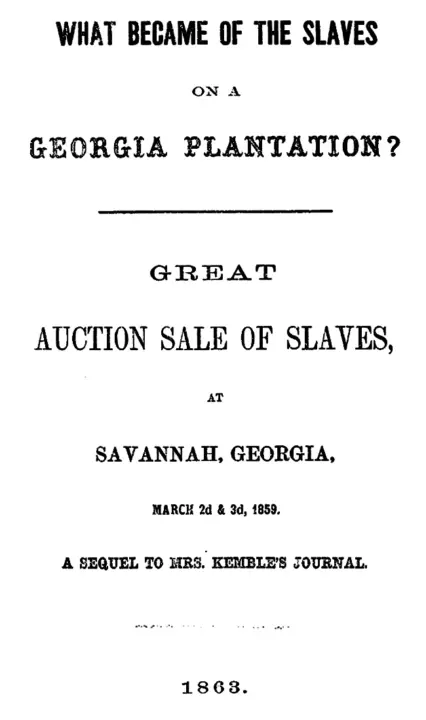
THE CLASSIC COLLECTION · 1863
"What Became of the Slaves on a Georgia Plantation?" by Q. K. Philander Doesticks is a historical account written during the early 1860s. The book delves into the experiences of enslaved individuals during a significant auction of slaves in Savannah, Georgia, specifically detailing the emotional and physical turmoil faced by those being sold. It offers a poignant perspective on the inhumane practices of slavery and the deep bonds of family and community that were ruthlessly severed during such sales. The narrative unfolds around a major slave auction that occurred in March 1859, spotlighting the human cost of such transactions. The book vividly depicts the conditions in which slaves were kept prior to the auction, their hopeful attempts to remain together as families, and the harsh realities as they were inspected and sold to the highest bidder. Through poignant scenes and dialogues, Doesticks captures the anguish of families torn apart, the silent suffering of individuals waiting for their fate, and the often crude behavior of the buyers. Each story adds to the collective heartbreak of being commoditized, underscoring the inherent humanity and dignity of the enslaved people despite their dire circumstances.
Introduction adapted from the source catalogue; source summaries may be automatically generated.
Free to read · English · 8,887 words · No account needed
MAKE TIME FOR A GOOD BOOK
On by default. Untick to stop anonymous reading totals. Each page counts after 10 seconds in view. How this works.
Anonymous counting is on unless you have switched it off.
The negroes were brought to Savannah in small lots, as many at a time as could be conveniently taken care of, the last of them reaching the city the Friday before the sale. They were consigned to the care of Mr. J. Bryan, Auctioneer and Negro Broker, who was to feed and keep them in condition until disposed of. Immediately on their arrival they were taken to the Race-course, and there quartered in the sheds erected for the accommodation of the horses and carriages of gentlemen attending the races. Into these sheds they were huddled pell-mell, without any more attention to their comfort than was necessary to prevent their becoming ill and unsaleable. Each "family" had one or more boxes or bundles, in which were stowed such scanty articles of their clothing as were not brought into immediate requisition, and their tin dishes and gourds for their food and drink.
It is, perhaps, a fit tribute to large-handed munificence to say that, when the negro man was sold, there was no extra charge for the negro man's clothes; they went with the man, and were not charged in the bill. Nor is this altogether a contemptible idea, for many of them had worldly wealth, in the shape of clothing and other valuables, to the extent of perhaps four or five dollars; and had all these been taken strictly into the account, the sum total of the sale would have been increased, possibly, a thousand dollars. In the North, we do not necessarily sell the harness with the horse; why, in the South, should the clothes go with the negro?
In these sheds were the chattels huddled together on the floor, there being no sign of bench or table. They eat and slept on the bare boards, their food being rice and beans, with occasionally a bit of bacon and corn bread. Their huge bundles were scattered over the floor, and thereon the slaves sat or reclined, when not restlessly moving about, or gathered into sorrowful groups, discussing the chances of their future fate. On the faces of all was an expression of heavy grief; some appeared to be resigned to the hard stroke of Fortune that had torn them from their homes, and were sadly trying to make the best of it; some sat brooding moodily over their sorrows, their chins resting on their hands, their eyes staring vacantly, and their bodies rocking to and fro, with a restless motion that was never stilled; few wept, the place was too public and the drivers too near, though some occasionally turned aside to give way to a few quiet tears. They were dressed in every possible variety of uncouth and fantastic garb, in every style and of every imaginable color; the texture of the garments was in all cases coarse, most of the men being clothed in the rough cloth that is made expressly for the slaves. The dresses assumed by the negro minstrels, when they give imitations of plantation character, are by no means exaggerated; they are, instead, weak and unable to come up to the original. There was every variety of hats, with every imaginable slouch; and there was every cut and style of coat and pantaloons, made with every conceivable ingenuity of misfit, and tossed on with a general appearance of perfect looseness that is perfectly indescribable, except to say that a Southern negro always looks as if he could shake his clothes off without taking his hands out of his pockets. The women, true to the feminine instinct, had made, in almost every case, some attempt at finery. All wore gorgeous turbans, generally manufactured in an instant out of a gay-colored handkerchief by a sudden and graceful twist of the fingers; though there was occasionally a more elaborate turban, a turban complex and mysterious, got up with care, and ornamented with a few beads or bright bits of ribbon. Their dresses were mostly coarse stuff, though there were some gaudy calicoes; a few had ear-rings, and one possessed the treasure of a string of yellow and blue beads. The little children were always better and more carefully dressed than the older ones, the parental pride coming out in the shape of a yellow cap pointed like a mitre, or a jacket with a strip of red broadcloth round the bottom. The children were of all sizes, the youngest being fifteen days old. The babies were generally good-natured; though when one would set up a yell, the complaint soon attacked the others, and a full chorus would be the result.
Your reading position is saved on this browser. Take it to another device with a library code. Reading pages adapt to text, rather than matching a printed edition.
Q. K. Philander Doesticks
Q. K. Philander Doesticks
Q. K. Philander Doesticks
BEHIND THE BOOK
This eBook is for the use of anyone anywhere in the United States and most other parts of the world at no cost and with almost no restrictions whatsoever. You may copy it, give it away or re-use it under the terms of the Project Gutenberg License included with this eBook or online at www.gutenberg.org. If you are not located in the United States, you will have to check the laws of the country where you are located before using this eBook. Read the source licence.
The original source file, including credits and licence, is retained by this library. Request an original-format copy at no charge. Please include the book title and Project Gutenberg identifier #64804.
KEEP YOUR CURIOSITY GOING
Cécile Tormay

Moritz Busch
John L. Ransom
Frances Wright
Cécile Tormay

Mabel Potter Daggett