Discovering “Evelina”: An Old-fashioned Romance A Companion Book to “The Jessamy Bride”
Frank Frankfort Moore
THE CLASSIC COLLECTION · 1899
"Well, After All" by F. Frankfort Moore is a novel written in the late 19th century. The story unfolds around a financial crisis at the Bracken-shire Bank, led by Richard Westwood, who is faced with a panicked run on the bank as customers scramble to withdraw their money. The narrative explores the reactions of various characters, including Westwood and his friend Cyril Mowbray, as they navigate the tension of the situation alongside themes of gender dynamics and personal relationships. At the start of the novel, we witness the immediate chaos of the banking crisis through the conversations between Mr. Westwood and Cyril Mowbray, highlighting the varying reactions of men and women in moments of panic. As Westwood attempts to manage the situation with calmness and strategic thinking, Cyril reflects on the social dynamics at play, specifically regarding women's more straightforward, primal reactions compared to men's pretense of nonchalance. The opening chapters set the stage for examining personal struggles in the face of societal pressures, hinting at deeper emotional undercurrents that will be explored as the story unfolds, particularly concerning love, loyalty, and the burdens of expectation during tumultuous times.
Introduction adapted from the source catalogue; source summaries may be automatically generated.
Free to read · English · 79,109 words · No account needed
MAKE TIME FOR A GOOD BOOK
On by default. Untick to stop anonymous reading totals. Each page counts after 10 seconds in view. How this works.
Anonymous counting is on unless you have switched it off.
“What, you consider that a sufficient explanation?” said Agnes.
Clare laughed more uneasily still.
“He has been saying something that startled me. The fact is that he--well, he thinks that I--that he--I should rather say that we, he and I, would complete the book more satisfactorily if we were--You see, Agnes dear, he does not like coming here so frequently; he feels that he is trespassing upon your patience.”
“He is wrong, then,” said Agnes. “But what is the alternative that he
proposes?”
“He thinks that we should get married at once and go to the Court together,” replied Clare, in a low voice.
“And what do you say to that proposal?”
“Well, you know, dearest Agnes, it is not six months since my dear mother's death: still--ah, dear, would she not wish to see me happy?”
“Yes; but is that saying that she would wish to see you married?”
“He is coming to talk to you about it after dinner to-night.”
Clare spoke quietly as she rose from her seat and left the room.
He came very late. Agnes only was in the drawing-room, for Clare had gone to her studio after dinner, saying she wished to finish one of the pictures.
He was as uneasy in addressing her as Clare had been. He began to speak the moment he entered the room. Agnes interrupted him.
“You have not yet seen Clare,” she said.
“I have not come to see her. It is you whom I have come to see,” said he. “The fact is, my dear Agnes”--
“Go to her,” said Agnes. “Go to her and kiss her; it will be for the
last time.”
She spoke almost sorrowfully. He was impressed by the tone.
“For the last time--to-night, you mean to say,” he suggested.
“For the last time on earth!” said she.
“You are mad,” he cried, after a pause, during which he stared at her. “You are mad; you do not know me--you do not know her.”
“You will not go to her?”
“I will not go to her--I will not leave this room until you have told me what you mean by saying these words. You shall tell me what these words mean--if they have any meaning.”
“Very well, I will tell you. A week ago you said some words to me. You put a question to me which I promised to answer at my own time. You said, 'Will you force me to wish that I had never seen you?' You said that to me--you--Claude Westwood--to me.”
“I admit that I was cruel--I know that I was cruel.”
Your reading position is saved on this browser. Take it to another device with a library code. Reading pages adapt to text, rather than matching a printed edition.
Frank Frankfort Moore
Frank Frankfort Moore
Frank Frankfort Moore
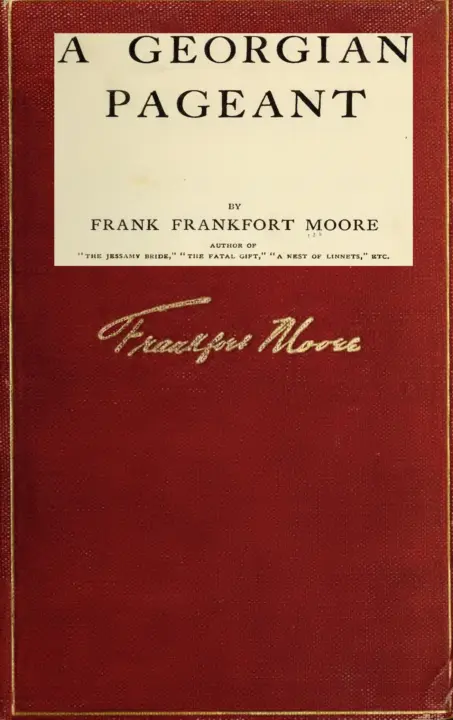
Frank Frankfort Moore
BEHIND THE BOOK
This eBook is for the use of anyone anywhere in the United States and most other parts of the world at no cost and with almost no restrictions whatsoever. You may copy it, give it away or re-use it under the terms of the Project Gutenberg License included with this eBook or online at www.gutenberg.org. If you are not located in the United States, you will have to check the laws of the country where you are located before using this eBook. Read the source licence.
The original source file, including credits and licence, is retained by this library. Request an original-format copy at no charge. Please include the book title and Project Gutenberg identifier #51988.
KEEP YOUR CURIOSITY GOING
Coulson Kernahan

Maurice Baring
Frances Wright
Cécile Tormay

Frederic Jesup Stimson

W. H. P. (William Henry Pope) Jarvis