
The lost dirigible
Ralph Henry Barbour
THE CLASSIC COLLECTION · 1903
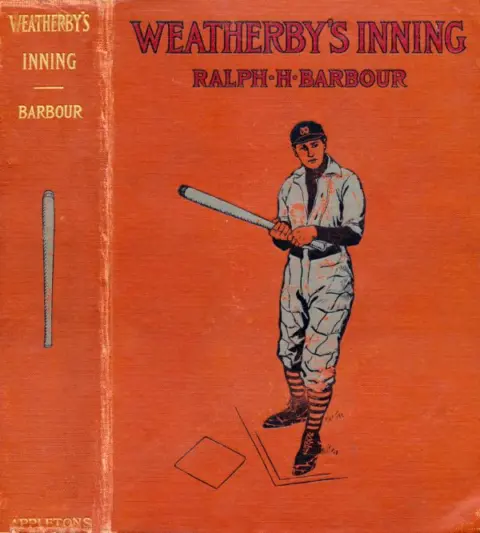
"Weatherby's Inning: A Story of College Life and Baseball" by Ralph Henry Barbour is a novel written in the early 20th century. The story revolves around Jack Weatherby, a freshman at Erskine College, who grapples with feelings of isolation and the stigma of being labeled a coward after failing to rescue a drowning boy. With themes of friendship, personal growth, and the spirit of competition in college baseball, the book promises to explore the personal challenges that arise in the formative years of young adulthood. At the start of the novel, we are introduced to Jack Weatherby, who faces a tumultuous emotional environment at Erskine College following a traumatic incident at the river. Overwhelmed by loneliness and struggling with a sense of alienation from his peers, Jack's journey is marked by introspection and a desire for acceptance. After being publicly accused of cowardice when he hesitated to act during the emergency, he decides to persist and try out for the college baseball team, seeking redemption. The opening chapters lay the groundwork for Jack's evolving relationships and highlight the contrasting personalities he encounters, setting the stage for his quest to prove himself both on and off the field.
Introduction adapted from the source catalogue; source summaries may be automatically generated.
Free to read · English · 54,246 words · No account needed
MAKE TIME FOR A GOOD BOOK
On by default. Untick to stop anonymous reading totals. Each page counts after 10 seconds in view. How this works.
Anonymous counting is on unless you have switched it off.
“Going to take your trunk?” asked the other, waving his pipe toward it.
“No, just a bag. I’ll send for the trunk later.” Then, as he realized his mistake, the blood rushed into his cheeks. He looked up at Tidball and found that person eying him quizzically. “I--I mean--that----”
“No harm done,” interrupted the visitor. “Thought when I came in you meant to cut and run. Why?”
“Because--because I can’t stay,” answered Jack defiantly. “You--you were there and you saw it. Everybody thinks I’m a coward! Professor White said--said--” He choked and looked down miserably at his twisting fingers.
“Well, you aren’t, are you?”
Jack glanced up startledly.
“Why--why--no, I’m not a coward!” he cried.
“Didn’t think you were. You don’t look it.”
Jack experienced a grateful warmth at the heart and looked shyly and thankfully at the queer, lean face across the room.
“But--but they all think I am,” he muttered.
“I wouldn’t prove them right, then, if I were you.”
“Prove-- What do you mean?”
“Mean I wouldn’t run away; mean I’d stay and fight it out. Any one can run; takes a brave man to stand and fight.”
“Oh!” Jack stared wonderingly at Tidball. “I hadn’t thought of that.”
“’Tisn’t too late.”
“N--no,” answered Jack doubtfully. “You--think I ought to stay?”
“Yes, I honestly do, Weatherby. You’ve got nothing to be ashamed of; ’twouldn’t have done any good if you’d gone into the river; guess you’d been drowned--’tother chap, too. White jumped at conclusions and landed wrong. Can’t much blame him, though. You see, the fellows here at Erskine come from the country, or the coast, or some small town, and swimming’s as natural as eating, and I guess it didn’t occur to them that maybe you couldn’t swim. But when they learn the truth of the matter----”
“But they won’t know,” said Jack.
“Bound to. I’ll see White myself, and I’ll tell all the chaps I know; ’twon’t take long for the facts to get around.”
“I’d rather you didn’t, if you don’t mind,” said Jack. “It’s awfully kind of you----”
“Didn’t what?”
“See Professor White.”
“Well--of course, I know you’re feeling kind of sore at him, Weatherby, and I don’t much blame you; still, there’s no use in allowing the misunderstanding to continue when a word or two will set things right.”
“I don’t care what he thinks,” said Jack, bitterly.
“All right,” replied Tidball calmly. “How about the others?”
Your reading position is saved on this browser. Take it to another device with a library code. Reading pages adapt to text, rather than matching a printed edition.
Ralph Henry Barbour
Ralph Henry Barbour

Ralph Henry Barbour

Ralph Henry Barbour
BEHIND THE BOOK
This eBook is for the use of anyone anywhere in the United States and most other parts of the world at no cost and with almost no restrictions whatsoever. You may copy it, give it away or re-use it under the terms of the Project Gutenberg License included with this eBook or online at www.gutenberg.org. If you are not located in the United States, you will have to check the laws of the country where you are located before using this eBook. Read the source licence.
The original source file, including credits and licence, is retained by this library. Request an original-format copy at no charge. Please include the book title and Project Gutenberg identifier #45142.
KEEP YOUR CURIOSITY GOING
Coulson Kernahan

Maurice Baring
Frances Wright
Cécile Tormay

Frederic Jesup Stimson

W. H. P. (William Henry Pope) Jarvis