
Life of Harriet Beecher Stowe Compiled From Her Letters and Journals by Her Son Charles Edward Stowe
Harriet Beecher Stowe
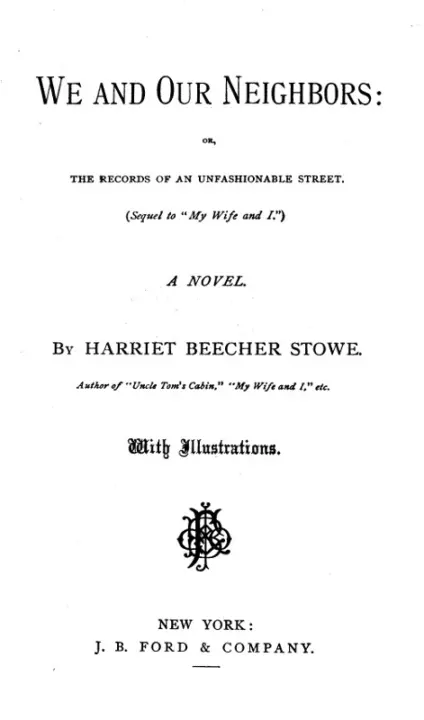
THE CLASSIC COLLECTION · 1875
"We and Our Neighbors; or, The Records of an Unfashionable Street" by Harriet Beecher Stowe is a novel written in the late 19th century. The story revolves around the lives of two elderly sisters, Miss Dorcas Vanderheyden and Mrs. Betsey Benthusen, who are observing the arrival of new neighbors in their historic New York home. Their interactions and reflections introduce themes of social status, family dynamics, and changing times, establishing a rich social landscape as the sisters grapple with their past and the modern world around them. The opening of the novel introduces the two sisters keenly watching their new neighbors move in, highlighting their curious natures and subtle snobbery. As they speculate about the young couple they see, they reveal their old-world values in contrast to the new life blossoming across the street. Through their perspectives, Stowe sets up a social commentary that blends humor with gentle critique, positioning the sisters as both endearing and comical figures. The interactions of the sisters, along with the presence of the playful terrier Jack, not only create a vivid picture of domestic life but also signal the impending changes that their unfashionable street will witness with the arrival of modernity and new social circles.
Introduction adapted from the source catalogue; source summaries may be automatically generated.
Free to read · English · 147,192 words · No account needed
MAKE TIME FOR A GOOD BOOK
On by default. Untick to stop anonymous reading totals. Each page counts after 10 seconds in view. How this works.
Anonymous counting is on unless you have switched it off.
"Well, there's your wood fire, for instance; very cheerful, I admit, but it's a downright piece of extravagance. I know that the very richest and most elegant people, that have everything they can think of, have fallen back on the fancy of having open wood fires in their parlors, just for a sort of ornament to their rooms, but you don't really need it--your furnace keeps you warm enough."
"But, Aunty, it looks so bright and cheerful, and Harry is so fond of it! We only have it evenings, when he comes home tired, and he says the very sight of it rests him."
"There you go, now, Eva--with wood at fifteen dollars a cord!--going in for a mere luxury just because it pleases your fancy, and you can't go into society because it's so expensive. Eva, child, that's just like you. And there are twenty other little things that I see about here," said Aunt Maria, glancing round, "pretty enough, but each costs a little. There, for instance, those cut flowers in the vases cost something."
"But, Aunty, I got them of a poor little man just setting up a green-house, and Harry and I have made up our minds that it's our duty to patronize him. I'm going up to Sophie's to get her to take flowers for her parties of him."
"It's well enough to get Sophie to do it, but you oughtn't to afford it," said Aunt Maria; "nor need you buy a new matting and pictures for your servant's room."
"Oh, Aunty, mattings are so cheap; and those pictures didn't cost much, and they make Mary so happy!"
"Oh, she'd be happy enough any way. You ought to look out a little for
yourself, child."
"Well, I do. Now, just look at the expense of going to parties. To begin with, it annihilates all your dresses, at one fell swoop. If I make up my mind, for instance, not to go to parties this winter, I have dresses enough and pretty enough for all my occasions. The minute I decide I must go, I have nothing, absolutely nothing, to wear. There must be an immediate outlay. A hundred dollars would be a small estimate for all the additions necessary to make me appear with credit. Even if I take my old dresses as the foundation, and use my unparalleled good taste, there are trimmings, and dressmaker's bills, and gloves, and slippers, and fifty things; and then a carriage for the evening, at five dollars a night, and all for what? What does anybody get at a great buzzing party, to pay for all this? Then Harry has to use all his time, and all his nerves, and all his strength on his work. He is driven hard all the time with writing, making up the paper, and overseeing at the office. And you know parties don't begin till near ten o'clock, and if he is out till twelve he doesn't rest well, nor I either--it's just so much taken out of our life--and we don't either of us enjoy it. Now, why should we put out our wood fire that we do enjoy, and scrimp in our flowers, and scrimp in our home comforts, and in our servant's comforts, just to get what we don't want after all?"
Your reading position is saved on this browser. Take it to another device with a library code. Reading pages adapt to text, rather than matching a printed edition.
Harriet Beecher Stowe

Harriet Beecher Stowe
Harriet Beecher Stowe

Harriet Beecher Stowe
BEHIND THE BOOK
This eBook is for the use of anyone anywhere in the United States and most other parts of the world at no cost and with almost no restrictions whatsoever. You may copy it, give it away or re-use it under the terms of the Project Gutenberg License included with this eBook or online at www.gutenberg.org. If you are not located in the United States, you will have to check the laws of the country where you are located before using this eBook. Read the source licence.
The original source file, including credits and licence, is retained by this library. Request an original-format copy at no charge. Please include the book title and Project Gutenberg identifier #48603.
KEEP YOUR CURIOSITY GOING
Coulson Kernahan

Maurice Baring
Frances Wright
Cécile Tormay

Frederic Jesup Stimson

W. H. P. (William Henry Pope) Jarvis