
Life of Harriet Beecher Stowe Compiled From Her Letters and Journals by Her Son Charles Edward Stowe
Harriet Beecher Stowe
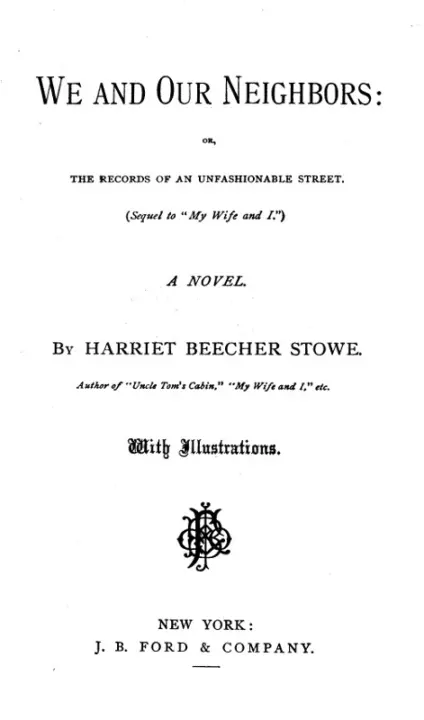
THE CLASSIC COLLECTION · 1875
"We and Our Neighbors; or, The Records of an Unfashionable Street" by Harriet Beecher Stowe is a novel written in the late 19th century. The story revolves around the lives of two elderly sisters, Miss Dorcas Vanderheyden and Mrs. Betsey Benthusen, who are observing the arrival of new neighbors in their historic New York home. Their interactions and reflections introduce themes of social status, family dynamics, and changing times, establishing a rich social landscape as the sisters grapple with their past and the modern world around them. The opening of the novel introduces the two sisters keenly watching their new neighbors move in, highlighting their curious natures and subtle snobbery. As they speculate about the young couple they see, they reveal their old-world values in contrast to the new life blossoming across the street. Through their perspectives, Stowe sets up a social commentary that blends humor with gentle critique, positioning the sisters as both endearing and comical figures. The interactions of the sisters, along with the presence of the playful terrier Jack, not only create a vivid picture of domestic life but also signal the impending changes that their unfashionable street will witness with the arrival of modernity and new social circles.
Introduction adapted from the source catalogue; source summaries may be automatically generated.
Free to read · English · 147,192 words · No account needed
MAKE TIME FOR A GOOD BOOK
On by default. Untick to stop anonymous reading totals. Each page counts after 10 seconds in view. How this works.
Anonymous counting is on unless you have switched it off.
"Well, if you write and ask them for it, and tell them that you must have it, and can't get along without, won't they send it back to you?"
"No, they won't think of such a thing. They never do business that
way."
"Won't? Why, I never heard of such folks. Why, there's no justice in
it."
"You don't understand these things, Betsey; nor I, very well. All I know is, that Dick took our money and bought stock with it, and we are stockholders of this company."
"And what is being a stockholder?"
"As far as I can perceive, it is this: when old women like you and me are stockholders, it means that a company of men take our money and use it for their own purposes, and pay us what they like, when it comes convenient; and when it's not convenient, they don't pay us at all. It is borrowing people's money, without paying interest."
"Why, that is horrid. Why, it's the most unjust thing I ever heard of," said Mrs. Betsey. "Don't you think so, Dorcas?"
"Well, it seems so to me; but women never understand business. Dick used to say so. The fact is, old women have no business anywhere," said Miss Dorcas bitterly. "It's time we were out of the world."
"I'm sure I haven't wanted to live so very much," said Mrs. Betsey, tremulously. "I don't want to die, but I had quite as lieve be dead."
"Come, Betsey, don't let us talk that way," said Miss Dorcas. "We sha'n't gain anything by flying in the face of Providence."
"But, Dorcas, I don't think it can be quite as bad as you think. People couldn't be so bad, if they knew just how much we wanted our money. Why, we haven't anything to go on--only think! The company has been making money, you say?"
"Oh, yes, never so large profits as this year; but, instead of paying the stockholders, they have voted to put up a new mill and enlarge the business."
"Who voted so?"
"The stockholders themselves. As far as I can learn, that means one or two men who have bought all the stock, and now can do what they like."
"But couldn't you go to the stockholders' meeting and vote?"
"What good would it do, if I have but ten votes, where each of these men has five hundred? They have money enough. They don't need this income to live on, and so they use it, as they say, to make the property more valuable; and perhaps, Betsey, when we are both dead, it will pay fifty per cent. to somebody, just as Dick always said it would."
Your reading position is saved on this browser. Take it to another device with a library code. Reading pages adapt to text, rather than matching a printed edition.
Harriet Beecher Stowe

Harriet Beecher Stowe
Harriet Beecher Stowe

Harriet Beecher Stowe
BEHIND THE BOOK
This eBook is for the use of anyone anywhere in the United States and most other parts of the world at no cost and with almost no restrictions whatsoever. You may copy it, give it away or re-use it under the terms of the Project Gutenberg License included with this eBook or online at www.gutenberg.org. If you are not located in the United States, you will have to check the laws of the country where you are located before using this eBook. Read the source licence.
The original source file, including credits and licence, is retained by this library. Request an original-format copy at no charge. Please include the book title and Project Gutenberg identifier #48603.
KEEP YOUR CURIOSITY GOING
Coulson Kernahan

Maurice Baring
Frances Wright
Cécile Tormay

Frederic Jesup Stimson

W. H. P. (William Henry Pope) Jarvis