
Life of Harriet Beecher Stowe Compiled From Her Letters and Journals by Her Son Charles Edward Stowe
Harriet Beecher Stowe
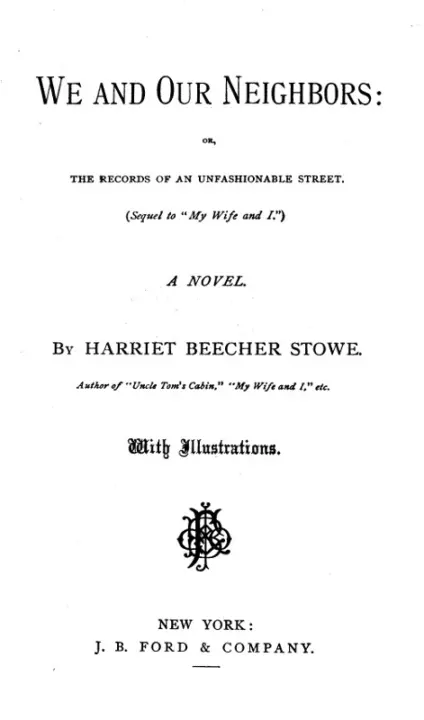
THE CLASSIC COLLECTION · 1875
"We and Our Neighbors; or, The Records of an Unfashionable Street" by Harriet Beecher Stowe is a novel written in the late 19th century. The story revolves around the lives of two elderly sisters, Miss Dorcas Vanderheyden and Mrs. Betsey Benthusen, who are observing the arrival of new neighbors in their historic New York home. Their interactions and reflections introduce themes of social status, family dynamics, and changing times, establishing a rich social landscape as the sisters grapple with their past and the modern world around them. The opening of the novel introduces the two sisters keenly watching their new neighbors move in, highlighting their curious natures and subtle snobbery. As they speculate about the young couple they see, they reveal their old-world values in contrast to the new life blossoming across the street. Through their perspectives, Stowe sets up a social commentary that blends humor with gentle critique, positioning the sisters as both endearing and comical figures. The interactions of the sisters, along with the presence of the playful terrier Jack, not only create a vivid picture of domestic life but also signal the impending changes that their unfashionable street will witness with the arrival of modernity and new social circles.
Introduction adapted from the source catalogue; source summaries may be automatically generated.
Free to read · English · 147,192 words · No account needed
MAKE TIME FOR A GOOD BOOK
On by default. Untick to stop anonymous reading totals. Each page counts after 10 seconds in view. How this works.
Anonymous counting is on unless you have switched it off.
Mr. St. John immediately read the inscription in concert with Miss Gusher, who was a very mediæval young lady and quite up to reading Gothic, or Anglo Saxon, or Latin, or any Churchly tongue.
"Oh!" was all the answer Angie made; and then, seeing something more was expected, she added again, "I think the effect of the lettering very pretty," and turned away, and busied herself with a cross of ground-pine that she was making in a retired corner.
The chorus were loud and continuous in their acclaims, and Miss Gusher talked learnedly of lovely inscriptions in Greek and Latin, offering to illuminate some of them for the occasion. Mr. St. John thanked her and withdrew to his sanctum, less satisfied than before.
About half an hour after, Angie, who was still quietly busy upon her cross in her quiet corner, under the shade of a large hemlock tree which had been erected there, was surprised to find Mr. St. John standing, silently observing her work.
"I like your work," he said, "better than you did mine."
"I didn't say that I didn't like yours," said Angie, coloring, and with that sort of bright, quick movement that gave her the air of a bird just going to fly.
"No, you did not say, but you left approbation unsaid, which amounts to the same thing. You have some objection, I see, and I really wish you would tell me frankly what it is."
"O Mr. St. John, don't say that! Of course I never thought of objecting; it would be presumptuous in me. I really don't understand these matters at all, not at all. I just don't know anything about Gothic letters and all that, and so the card doesn't say anything to me. And I must confess, I thought"--
Here Angie, like a properly behaved young daughter of the Church, began to perceive that her very next sentence might lead her into something like a criticism upon her rector; and she paused on the brink of a gulf so horrible, "with pious awe that feared to have offended."
Mr. St. John felt a very novel and singular pleasure in the progress of this interview. It interested him to be differed with, and he said, with a slight intonation of dictation:
"I must insist on your telling me what you thought, Miss Angie."
"Oh, nothing, only this--that if I, who have had more education than our Sunday-school scholars, can't read a card like that, why, they could not. I'm quite sure that an inscription in plain modern letters that I could read would have more effect upon my mind, and I am quite sure it would on them."
Your reading position is saved on this browser. Take it to another device with a library code. Reading pages adapt to text, rather than matching a printed edition.
Harriet Beecher Stowe

Harriet Beecher Stowe
Harriet Beecher Stowe

Harriet Beecher Stowe
BEHIND THE BOOK
This eBook is for the use of anyone anywhere in the United States and most other parts of the world at no cost and with almost no restrictions whatsoever. You may copy it, give it away or re-use it under the terms of the Project Gutenberg License included with this eBook or online at www.gutenberg.org. If you are not located in the United States, you will have to check the laws of the country where you are located before using this eBook. Read the source licence.
The original source file, including credits and licence, is retained by this library. Request an original-format copy at no charge. Please include the book title and Project Gutenberg identifier #48603.
KEEP YOUR CURIOSITY GOING
Coulson Kernahan

Maurice Baring
Frances Wright
Cécile Tormay

Frederic Jesup Stimson

W. H. P. (William Henry Pope) Jarvis