
Life of Harriet Beecher Stowe Compiled From Her Letters and Journals by Her Son Charles Edward Stowe
Harriet Beecher Stowe
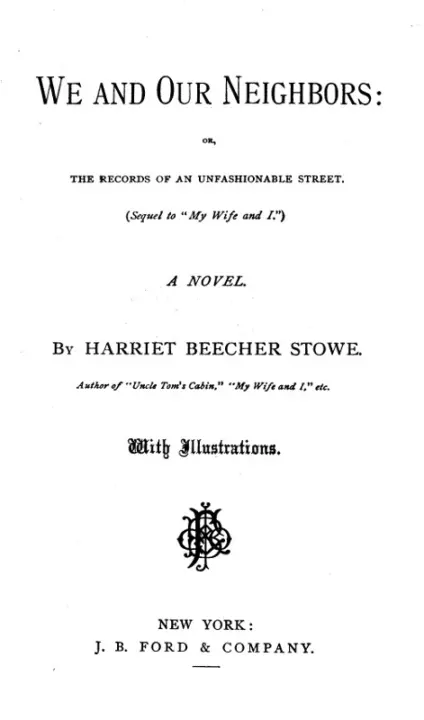
THE CLASSIC COLLECTION · 1875
"We and Our Neighbors; or, The Records of an Unfashionable Street" by Harriet Beecher Stowe is a novel written in the late 19th century. The story revolves around the lives of two elderly sisters, Miss Dorcas Vanderheyden and Mrs. Betsey Benthusen, who are observing the arrival of new neighbors in their historic New York home. Their interactions and reflections introduce themes of social status, family dynamics, and changing times, establishing a rich social landscape as the sisters grapple with their past and the modern world around them. The opening of the novel introduces the two sisters keenly watching their new neighbors move in, highlighting their curious natures and subtle snobbery. As they speculate about the young couple they see, they reveal their old-world values in contrast to the new life blossoming across the street. Through their perspectives, Stowe sets up a social commentary that blends humor with gentle critique, positioning the sisters as both endearing and comical figures. The interactions of the sisters, along with the presence of the playful terrier Jack, not only create a vivid picture of domestic life but also signal the impending changes that their unfashionable street will witness with the arrival of modernity and new social circles.
Introduction adapted from the source catalogue; source summaries may be automatically generated.
Free to read · English · 147,192 words · No account needed
MAKE TIME FOR A GOOD BOOK
On by default. Untick to stop anonymous reading totals. Each page counts after 10 seconds in view. How this works.
Anonymous counting is on unless you have switched it off.
Harry, you see, leaves every thing to me. He has to be off to his office by seven o'clock every morning, and I am head marshal of the commisariat department--committee of one on supplies, and all that--and it takes up a good deal of my time.
You would laugh, Belle, to see me with my matronly airs and graces going my daily walk to the provision-store at the corner, which is kept by a tall, black-browed lugubrious man, with rough hair and a stiff stubby beard, who surveys me with a severe gravity over the counter, as if he wasn't sure that my designs were quite honest.
"Mr. Quackenboss," I say, with my sweetest smile, "have you any nice
butter?"
He looks out of the window, drums on the counter, and answers "Yes,"
in a tone of great reserve.
"I should like to look at some," I say, undiscouraged.
"It's down cellar," he replies, gloomily chewing a bit of chip and casting sinister glances at me.
"Well," I say, cheerfully, "shall I go down there and look at it?"
"How much do you want?" he asks, suspiciously.
"That depends on how well I like it," say I.
"I s'pose I could get up a cask," he says in a ruminating tone; and now he calls his partner, a cheerful, fat, roly-poly little cockney Englishman, who flings his h's round in the most generous and reckless style. His alert manner seems to say that he would get up forty casks a minute and throw them all at my feet, if it would give me any pleasure.
So the butter-cask is got up and opened, and my severe friend stands looking down on it and me as if he would say, "This also is vanity."
"I should like to taste it," I say, "if I had something to try it
with."
He scoops up a portion on his dirty thumbnail and seems to hold it reflectively, as if a doubt was arising in his mind of the propriety of this mode of offering it to me.
And now my cockney friend interposes with a clean knife. I taste the butter and find it excellent, and give a generous order which delights his honest soul; and as he weighs it out he throws in, gratis, the information that his little woman has tried it, and he was sure I would like it, for she is the tidiest little woman and the best judge of butter; that they came from Yorkshire, where the pastures round were so sweet with a-many violets and cowslips--in fact, my little cockney friend strays off into a kind of pastoral that makes the little grocery store quite poetic.
Your reading position is saved on this browser. Take it to another device with a library code. Reading pages adapt to text, rather than matching a printed edition.
Harriet Beecher Stowe

Harriet Beecher Stowe
Harriet Beecher Stowe

Harriet Beecher Stowe
BEHIND THE BOOK
This eBook is for the use of anyone anywhere in the United States and most other parts of the world at no cost and with almost no restrictions whatsoever. You may copy it, give it away or re-use it under the terms of the Project Gutenberg License included with this eBook or online at www.gutenberg.org. If you are not located in the United States, you will have to check the laws of the country where you are located before using this eBook. Read the source licence.
The original source file, including credits and licence, is retained by this library. Request an original-format copy at no charge. Please include the book title and Project Gutenberg identifier #48603.
KEEP YOUR CURIOSITY GOING
Coulson Kernahan

Maurice Baring
Frances Wright
Cécile Tormay

Frederic Jesup Stimson

W. H. P. (William Henry Pope) Jarvis