
Last letters from the living dead man
David Patterson (Spirit) Hatch
THE CLASSIC COLLECTION · 1910
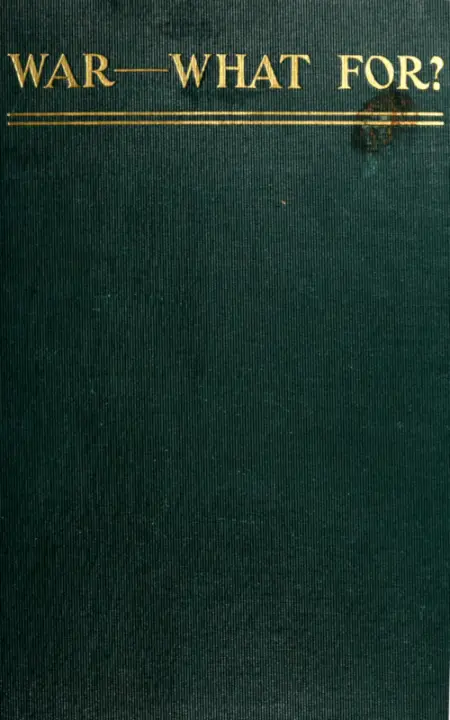
"War—What For?" by George R. Kirkpatrick is a socialist political pamphlet written in the early 20th century. The work delves into the concept of war from a working-class perspective, arguing that it primarily serves the interests of the capitalist class while leading to the suffering and death of the working class. Kirkpatrick aims to awaken class consciousness among wage earners, urging them to recognize their common struggles and unite against their oppressors. At the start of the book, Kirkpatrick addresses the working class directly, emphasizing their shared brotherhood and urging them to reject the notion of fighting against their own kind under the manipulation of the capitalist class. He paints war as a sham set in motion by the ruling elite, who gain wealth and power by enlisting the working class to fight their battles. By breaking down societal roles and pressure, he aims to enlighten the labor force about the true costs of war—both in blood and in economic terms—while prompting them to demand justice and social reform. The opening sets the stage for a critical examination of militarism and class struggle, highlighting the need for solidarity among workers.
Introduction adapted from the source catalogue; source summaries may be automatically generated.
Free to read · English · 115,939 words · No account needed
MAKE TIME FOR A GOOD BOOK
On by default. Untick to stop anonymous reading totals. Each page counts after 10 seconds in view. How this works.
Anonymous counting is on unless you have switched it off.
The fifth day millions looked toward Virginia—and were sickened with
grief.
But certain prominent gentlemen in Washington cheerfully jested, ate the best food on earth, lolled in easy chairs, gracefully reclined on elegantly upholstered sofas, craftily plotted—and waited, in calm confidence waited.
The sixth day of the battle was “Death’s feast.” The nation, North and South, was stupefied with the horror of the war.
But certain “highly respected leading citizens,” Christian business men—flag-waving patriots all of them—quaffed their wine, chatted gaily, plotted, and, like reptiles, coiled to strike—waited, confident.
The seventh day, the last day, the baptism of blood and fire broke the nation’s heart. As morning dawned the nation’s one thought was: The war—the awful battles—the week-long harvest of death in Virginia. Millions sobbed and eagerly sought more news. The storm of death completely absorbed the nation’s attention. The Seven Days of slaughter was the nation’s one heart-gripping thought.
For this day certain patriots, certain “men of energy and push and enterprise,” certain distinguished business men, had patiently and craftily waited. The psychological moment! The nation was blinded with rage, tears and despair. Half insane with an awful joy and a sickening sorrow, the people, millions of them, wildly screamed, sobbed and cursed—on July 1.
Intense day.
The Union army in retreat—defeated.
The President in profound alarm, half crazed with the agony of it all, decided, July 1, to call for 300,000 more soldiers for three years’ service.
Supreme moment—for the business man.
Now!
The people are not looking.
Now!
Strike, viper, strike!
Leap, gold-hungry patriot! Leap! Leap now—leap for your country’s
throat!
Not another hour’s delay.... Place the final pressure on the President.
“Mr. President! Mr. Lincoln! Sign our bill! Please sign our bill now—right now. Quickly, Mr. President! Don’t delay longer. Now!”
Hundreds of cannon were roaring in Virginia. The President was devouring the telegraphic news from the firing line.
Business men—Christian business men—including flag-loving Congressmen, very noble Senators, and many other dollar-mark statesmen, were directly and indirectly urging that the bill be signed—at once, “for the country’s welfare,” of course.
The President, urged by these money-hungry patriots, urged by these “men of high standing,” thus urged, the President, writhing with grief over the Seven Days’ slaughter of his brave volunteers, almost sweating blood in his profound fear,—signed the bill, July 1.
What bill?
Your reading position is saved on this browser. Take it to another device with a library code. Reading pages adapt to text, rather than matching a printed edition.
BEHIND THE BOOK
This eBook is for the use of anyone anywhere in the United States and most other parts of the world at no cost and with almost no restrictions whatsoever. You may copy it, give it away or re-use it under the terms of the Project Gutenberg License included with this eBook or online at www.gutenberg.org. If you are not located in the United States, you will have to check the laws of the country where you are located before using this eBook. Read the source licence.
The original source file, including credits and licence, is retained by this library. Request an original-format copy at no charge. Please include the book title and Project Gutenberg identifier #58266.
KEEP YOUR CURIOSITY GOING
David Patterson (Spirit) Hatch
Cécile Tormay

Moritz Busch
Coulson Kernahan
John L. Ransom

Ralph Waldo Emerson