
Last letters from the living dead man
David Patterson (Spirit) Hatch
THE CLASSIC COLLECTION · 1910
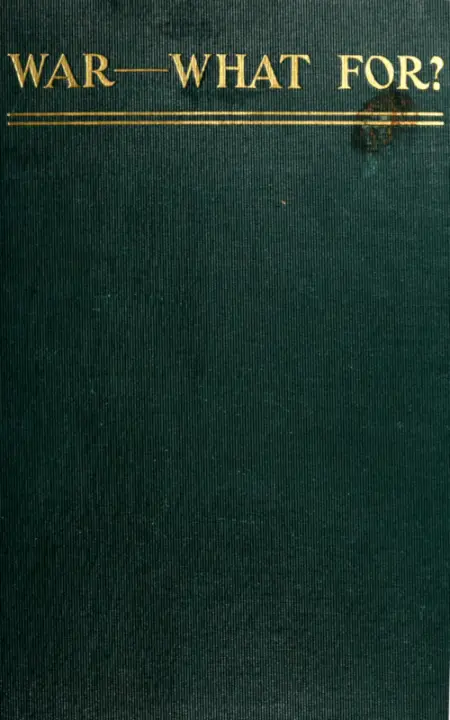
"War—What For?" by George R. Kirkpatrick is a socialist political pamphlet written in the early 20th century. The work delves into the concept of war from a working-class perspective, arguing that it primarily serves the interests of the capitalist class while leading to the suffering and death of the working class. Kirkpatrick aims to awaken class consciousness among wage earners, urging them to recognize their common struggles and unite against their oppressors. At the start of the book, Kirkpatrick addresses the working class directly, emphasizing their shared brotherhood and urging them to reject the notion of fighting against their own kind under the manipulation of the capitalist class. He paints war as a sham set in motion by the ruling elite, who gain wealth and power by enlisting the working class to fight their battles. By breaking down societal roles and pressure, he aims to enlighten the labor force about the true costs of war—both in blood and in economic terms—while prompting them to demand justice and social reform. The opening sets the stage for a critical examination of militarism and class struggle, highlighting the need for solidarity among workers.
Introduction adapted from the source catalogue; source summaries may be automatically generated.
Free to read · English · 115,939 words · No account needed
MAKE TIME FOR A GOOD BOOK
On by default. Untick to stop anonymous reading totals. Each page counts after 10 seconds in view. How this works.
Anonymous counting is on unless you have switched it off.
(18) Untermann: The Dick Militia Law (U. S., 1903).
19 Commons: “Is Class Conflict in America Growing and Is It Inevitable?” * * * Carver: “The Basis of Social Conflict”; * * * Keasby: “Competition.” American Journal of Sociology, March, 1908. See also Papers and Proceedings of the American Sociological Society, Vol. II., Special Topic: “Social Conflicts.”
20 Small: General Sociology, Chapters 26 and 27.
(21) Shaler: “The Natural History of War,” International Quarterly, Sept., 1903; also The Neighbor.
22 Ridpath: “Plutocracy and War,” Arena, Jan., 1898.
(23) Jordan: “The Biology of War,” an Address, Chicago, 1909, reported in Unity, June 10, 1909; Imperial Democracy, Chapters 1, 2, 3, and 7; The Human Harvest; The Blood of the Nation.
24 Chatterton-Hill: Heredity and Selection in Sociology, pp. 316–24. Thompson: Heredity, pp. 532–34.
(25) Jefferson: “The Peace-at-any-Price Men,” The Independent, Feb. 4, 1909; “The Delusions of the Militarist,” Atlantic Monthly, March, 1909.
(26) Charles Edward Russell: Why I Am a Socialist.
27 Tolstoi: Bethink Yourselves; Patriotism and Christianity, and
Thou Shalt Not Kill.
(28) Robinson: “War and Economics in History and in Theory,” Political Science Quarterly, Dec., 1900.
(29) Ghent: Mass and Class.
(30) London: The War of the Classes; Revolution, Chapter, “The Yellow Peril”; also, “Revolution,” Contemporary Review, Jan., 1908.
(31) W. T. Mills: The Struggle for Existence, Chapters 4–23.
(32) Hillquit: Socialism in Theory and Practice, pp. 36–65,
153–167, 296–302.
(33) Spargo: Socialism, Chapters 4, 5, 6, and Common Sense of
Socialism, Chapters 2–7.
(34) Ferri: Socialism and Modern Science, Chapter 7.
35 Seligman: The Economic Interpretation of History.
36 Boudin: The Theoretical System of Karl Marx, Chapters 1–5,
8–10.
37 Patten: “The Economic Causes of Moral Progress,” Annals of Amer. Soc. Pol. and Soc. Sci., Sept., 1892.
(38) Engels: The Origin of the Family, Property and the State, special attention to Chapters 8, 9; and Socialism—Utopian and Scientific.
(39) Hobson: The Evolution of Modern Capitalism; Imperialism, special attention to first six chapters; The Psychology of Jingoism; The War in South Africa, Part II.; and John Ruskin—Social Reformer, Chapters 3–8 inclusive, and Appendix 1.
40 Ferrero: Militarism.
41 Liebknecht: Militarismus und Anti-Militarismus.
42 Büchner: Industrial Evolution (Wickett’s translation), Chapters
4–5.
(43) Robinson and Beard: The Development of Modern Europe, Vol.
II., Chapters 18, 30–31.
(44) Weale: The Coming Struggle in Asia, special attention to
Parts II. and III.
45 ——: “Peace on Earth,” Public Opinion, Dec. 4, 1908, p. 635.
46 Schierbrand: America, Asia and the Pacific.
47 Harrison: National and Social Problems, Part I., Chapters 1,
6–11.
(48) Strong: Expansion, Chapters 2, 3, 4.
49 Bolce: The New Internationalism, Chapters 1–6 inclusive, and
15.
50 Fisk: International Commercial Policies, Chapters 13–16.
51 Reinsch: World Politics.
52 Asakawa: The Russo-Japanese Conflict.
53 Kennan: “The Military and Political Memoirs of General Kuropatkin,” McClure’s Magazine, Sept. 1908.
54 Smith: The Spirit of American Government, Chapters 4, 11, 12.
55 McCabe and Darien: Can We Disarm?
56 Carver: Sociology and Social Progress, pp. 132–73.
57 Jaurès: “Socialism and International Arbitration,” North
American Review, Aug. 1908.
58 Broda: “The Federation of the World,” The International, July,
1908.
(59) Hervé: “Anti-Militarism,” The International, July, 1908; Anti-Patriotism; My Country—Right or Wrong.
60 Edmondson: John Bull’s Army from Within.
61 Mead: Patriotism and the New Internationalism.
Your reading position is saved on this browser. Take it to another device with a library code. Reading pages adapt to text, rather than matching a printed edition.
BEHIND THE BOOK
This eBook is for the use of anyone anywhere in the United States and most other parts of the world at no cost and with almost no restrictions whatsoever. You may copy it, give it away or re-use it under the terms of the Project Gutenberg License included with this eBook or online at www.gutenberg.org. If you are not located in the United States, you will have to check the laws of the country where you are located before using this eBook. Read the source licence.
The original source file, including credits and licence, is retained by this library. Request an original-format copy at no charge. Please include the book title and Project Gutenberg identifier #58266.
KEEP YOUR CURIOSITY GOING
David Patterson (Spirit) Hatch
Cécile Tormay

Moritz Busch
Coulson Kernahan
John L. Ransom

Ralph Waldo Emerson