
Last letters from the living dead man
David Patterson (Spirit) Hatch
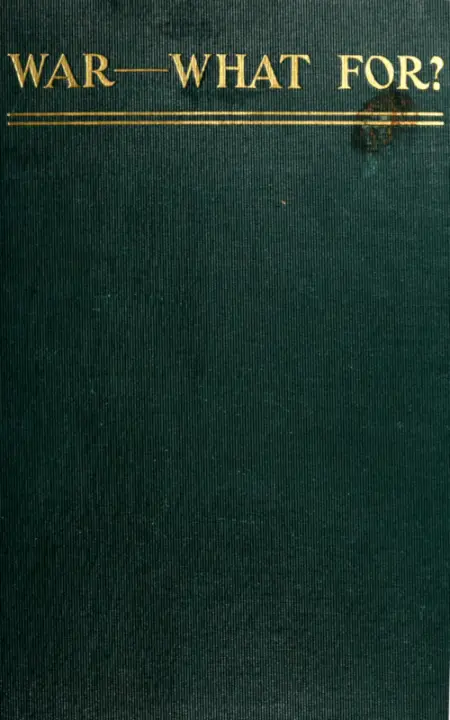
THE CLASSIC COLLECTION · 1910
"War—What For?" by George R. Kirkpatrick is a socialist political pamphlet written in the early 20th century. The work delves into the concept of war from a working-class perspective, arguing that it primarily serves the interests of the capitalist class while leading to the suffering and death of the working class. Kirkpatrick aims to awaken class consciousness among wage earners, urging them to recognize their common struggles and unite against their oppressors. At the start of the book, Kirkpatrick addresses the working class directly, emphasizing their shared brotherhood and urging them to reject the notion of fighting against their own kind under the manipulation of the capitalist class. He paints war as a sham set in motion by the ruling elite, who gain wealth and power by enlisting the working class to fight their battles. By breaking down societal roles and pressure, he aims to enlighten the labor force about the true costs of war—both in blood and in economic terms—while prompting them to demand justice and social reform. The opening sets the stage for a critical examination of militarism and class struggle, highlighting the need for solidarity among workers.
Introduction adapted from the source catalogue; source summaries may be automatically generated.
Free to read · English · 115,939 words · No account needed
MAKE TIME FOR A GOOD BOOK
On by default. Untick to stop anonymous reading totals. Each page counts after 10 seconds in view. How this works.
Anonymous counting is on unless you have switched it off.
“Under the ascendency of the rich and leisured, property becomes more sacred than persons, moral standards vary with the pecuniary status, and it is felt that ‘God will think twice before He damns a person of quality.’”
Footnote 335:
Even great literatures, regarded as divinely inspired and boasted to be The Truth, have been kept from the free access of the people—the “plain people,” too plain to understand the literature said to have life in it. Such literature has been hidden from the people for many hundreds of years—or “rightly divided” and diluted.
Footnote 336:
The inauguration of human slavery was a profound change in human relations—the greatest possible “change in circumstances”—down at the very foundations of society. Vast fundamental changes resulted—inevitably—in changed, and even new, institutions.
“Institutions must change with changing circumstances, since they are of the nature of an habitual method of responding to stimuli which these changing circumstances afford.... The institutions are, in substance, prevalent habits of thought with respect to particular relations and particular functions of the individual and of the community....”—Thorstein Veblen: The Theory of the Leisure Class, p. 190. See quotation from Dr. Small at the head of Chapter Ten. Also consult Ross’s Social Control.
Footnote 337:
See Thomas’s History of the United States, p. 68.
Footnote 338:
See Hyndman: The Economics of Socialism, Lecture 1, Methods of
Production.
Footnote 339:
And get these things into the minds of the children. If the teacher at your nearest school does not know these things, have the children teach the teacher.
Footnote 340:
Pure Sociology, p. 61. Italics mine. G. R. K.
Footnote 341:
Ancient Law, p. 164.
Footnote 342:
Folkways, pp. 262–3 and 307. Italics mine. G. R. K.
Footnote 343:
Elementary Economics, pp. 27–33.
Footnote 344:
Laws of Imitation, Parson’s translation, pp. 277–79.
Footnote 345:
American Journal of Sociology, May, 1902, pp. 764–65. Italics mine.
G. R. K.
Footnote 346:
Principles of Sociology, Vol. III., pp. 84, 92, 148, 448; Appleton’s Edition, 1899. See also Lester F. Ward: Dynamic Sociology, Vol. I., pp. 287–90. (Italics mine. G. R. K.)
Footnote 347:
Dynamic Sociology, Vol. I., pp. 583–85.
Footnote 348:
The New Basis of Civilization, pp. 67, 69. Italics mine. G. R. K.
Footnote 349:
See discussion of parasites in Chapter Ten.
Footnote 350:
Newer Ideals of Peace, pp. 115–16.
Footnote 351:
National and Social Problems, p. 255.
Footnote 352:
Introduction to Sociology, pp. 136–39.
Footnote 353:
For a powerful argument showing the intellectual equality of the working class and the ruling class see Professor Lester F. Ward’s Applied Sociology. The political foolishness of the working class is not due to lack of brains, but to lack of books—books that tell the truth, the truth that clears the vision and rouses the passion for freedom and points the way.—Suggestions, next chapter.
CHAPTER TWELVE.
More Suggestions and What to Read.
Your reading position is saved on this browser. Take it to another device with a library code. Reading pages adapt to text, rather than matching a printed edition.
BEHIND THE BOOK
This eBook is for the use of anyone anywhere in the United States and most other parts of the world at no cost and with almost no restrictions whatsoever. You may copy it, give it away or re-use it under the terms of the Project Gutenberg License included with this eBook or online at www.gutenberg.org. If you are not located in the United States, you will have to check the laws of the country where you are located before using this eBook. Read the source licence.
The original source file, including credits and licence, is retained by this library. Request an original-format copy at no charge. Please include the book title and Project Gutenberg identifier #58266.
KEEP YOUR CURIOSITY GOING
David Patterson (Spirit) Hatch
Cécile Tormay

Moritz Busch
Coulson Kernahan
John L. Ransom

Ralph Waldo Emerson