
Last letters from the living dead man
David Patterson (Spirit) Hatch
THE CLASSIC COLLECTION · 1910
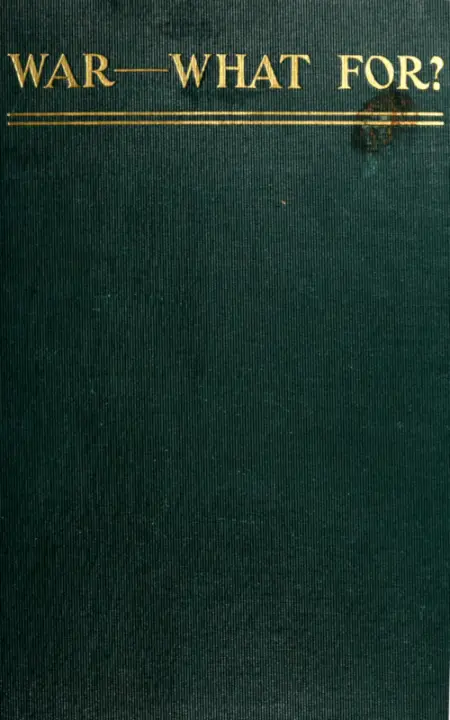
"War—What For?" by George R. Kirkpatrick is a socialist political pamphlet written in the early 20th century. The work delves into the concept of war from a working-class perspective, arguing that it primarily serves the interests of the capitalist class while leading to the suffering and death of the working class. Kirkpatrick aims to awaken class consciousness among wage earners, urging them to recognize their common struggles and unite against their oppressors. At the start of the book, Kirkpatrick addresses the working class directly, emphasizing their shared brotherhood and urging them to reject the notion of fighting against their own kind under the manipulation of the capitalist class. He paints war as a sham set in motion by the ruling elite, who gain wealth and power by enlisting the working class to fight their battles. By breaking down societal roles and pressure, he aims to enlighten the labor force about the true costs of war—both in blood and in economic terms—while prompting them to demand justice and social reform. The opening sets the stage for a critical examination of militarism and class struggle, highlighting the need for solidarity among workers.
Introduction adapted from the source catalogue; source summaries may be automatically generated.
Free to read · English · 115,939 words · No account needed
MAKE TIME FOR A GOOD BOOK
On by default. Untick to stop anonymous reading totals. Each page counts after 10 seconds in view. How this works.
Anonymous counting is on unless you have switched it off.
These golden words, these words of immortal beauty, are, “like love, wine for the heart and brain.” They fire the soul, especially the mother’s soul, with a glorious joy, a splendid vision of unstained, untroubled pleasure: Mankind at Peace—Socialized. The children safe. The future vast and beautiful and kind for her and for those that call her Mother.
But again and yet again the cannon’s roar will banish the vision. The future holds agony for the mother, especially for the humble mother in the working class. Her husband and her older sons will go to war. They will even thoughtlessly sink to the level of joining the local militia for local war—for strike service. The men she loves have been poisoned—poisoned with the base teaching that brutality is bravery, that the drawn sword marks the patriot. They are ready, ready now, at the word of command from a cheap commander to murder the men of their own class, and break the hearts and mock the tears of the wage-slave mothers of the world.
These mothers must defend themselves—for the present.
These mothers can defend themselves only through their younger sons and daughters—by teaching them a class loyalty which is a new patriotism that will close the local armory, shame the assassin back to the factory, to the farm, to the mine, and silence all the cannon on all the earth.
Footnote 241:
See footnote on page 13; and also introductory paragraph, Chapter
Seven, preceding Section 1.
Footnote 242:
See Index: “Another War.”
Footnote 243:
See Chapter Seven, Section 30.
Footnote 244:
See Index: “Napoleon.”
Footnote 245:
The Moral Damage of War, pp. 97–99.
Footnote 246:
See The Downfall, passim, Part II., also p. 446. This powerful story (published by the Macmillan Company, New York) is here again heartily commended to all readers of War—What For? Again the author thanks the publishers for reprint privileges.
Footnote 247:
Precisely! Never stopping to inquire: Who declared this war? or what
for?
Footnote 248:
Quoted by George Allan England, in New York Daily Call, Dec. 2,
1909.
Footnote 249:
See Lucia A. Mead’s Patriotism and the New Internationalism, p. 22.
Footnote 250:
Read Walter Walsh’s Moral Damage of War, Chapter Three on the “Moral Damage of War to the Children.” The chapter is of startling importance.
Footnote 251:
New York World, editorial, May 6, 1910.
Footnote 252:
See New York Times, October 31, 1908, long article on the increasing manufacture of such toys.
Footnote 253:
Quoted by Walter Walsh: Moral Damage of War, p. 380.
Footnote 254:
The Economy of Happiness, pp. 519–20.
Footnote 255:
Walter Walsh: Moral Damage of War, p. 376.
Footnote 256:
Imperial Democracy, p. 270.
Footnote 257:
See Annual Report of the Secretary of War, 1908, p. 22.
Footnote 258:
Your reading position is saved on this browser. Take it to another device with a library code. Reading pages adapt to text, rather than matching a printed edition.
BEHIND THE BOOK
This eBook is for the use of anyone anywhere in the United States and most other parts of the world at no cost and with almost no restrictions whatsoever. You may copy it, give it away or re-use it under the terms of the Project Gutenberg License included with this eBook or online at www.gutenberg.org. If you are not located in the United States, you will have to check the laws of the country where you are located before using this eBook. Read the source licence.
The original source file, including credits and licence, is retained by this library. Request an original-format copy at no charge. Please include the book title and Project Gutenberg identifier #58266.
KEEP YOUR CURIOSITY GOING
David Patterson (Spirit) Hatch
Cécile Tormay

Moritz Busch
Coulson Kernahan
John L. Ransom

Ralph Waldo Emerson