THE CLASSIC COLLECTION✦An outlaw’s diary: the CommuneCLASSIC FREE BOOKS
An outlaw’s diary: the Commune
Cécile Tormay
THE CLASSIC COLLECTION · 1920
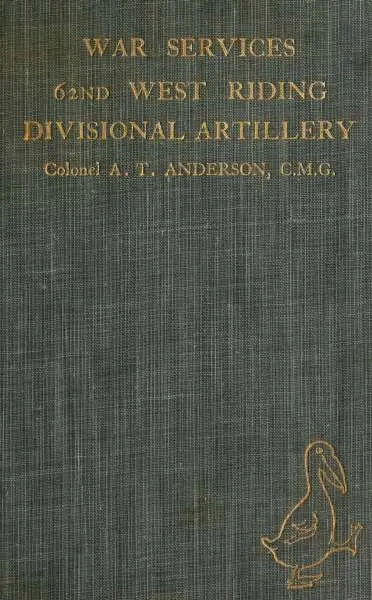
"War Services of the 62nd West Riding Divisional Artillery" by Austin Thomas Anderson is a historical account written in the early 20th century. The book chronicles the experiences and operations of the 62nd Divisional Artillery during World War I, detailing their training, battles, and the challenges faced by the troops and their horses in various theatres of war. The beginning of the account sets the stage for the Divisional Artillery's deployment to France, commencing with their orders received in late December 1916. Anderson vividly describes the harsh conditions encountered as the artillery advanced into the frontline, characterized by bitter cold, mud, and incessant shelling. He details early operations, including a series of tactical movements and engagements as the artillery units moved into action, all while maintaining a record of casualties and the indomitable spirit of the troops as they adapted to warfare's brutal realities.
Introduction adapted from the source catalogue; source summaries may be automatically generated.
Free to read · English · 38,250 words · No account needed
MAKE TIME FOR A GOOD BOOK
On by default. Untick to stop anonymous reading totals. Each page counts after 10 seconds in view. How this works.
Anonymous counting is on unless you have switched it off.
"The Division is performing a very important rôle of holding up the German advance in this part of the battlefield, and the very heavy casualties inflicted on the enemy are an earnest of their determined fighting.
"He congratulates all troops on their splendid gallantry, and is confident in the continuation of the fine resistance they are making to the enemy's attempts to break our line.
"Well done, 62nd (West Riding) Division!
"WALTER BRAITHWAITE,
"29/3/18. Major-General."
Lieut. G. A. Ellis was this day awarded the Military Cross:
"He maintained communication and observed for his battery throughout the day, though his O.P. was spotted by the enemy and subjected to continuous rifle fire and shelling. He twice mended the wire, which was cut by shell fire, in the open."
Fifteen Military Medals were gained in the Divisional Artillery during the fighting from the 21st to the end of the month (v. Appendix).
During these strenuous days I had seven brigades of Field Artillery under my command, disposed as follows:
Right group. 93rd and 235th Brigades.
Centre " 187th, 236th and 310th Brigades.
Left " 190th and 312th Brigades.
And also the 54th, 71st, and 92nd Brigades of Heavy Artillery.
On the 30th March Lieut. C. R. Witcher was again wounded.
[Sidenote: April 1918.]
On the 1st April the 37th Division relieved our infantry but the artillery remained unchanged, the batteries of the relieving division not having arrived yet in the area.
On the 3rd April, Major J. Willey, Commanding A/312, was killed, to the great sorrow of all who knew him. He was a gallant, unassuming officer, with a rather diffident and altogether charming manner, and the loss of so able a battery commander at this critical time was felt severely.
Early on the morning of April 5th the 37th Division carried out an attack on Rossignol Wood and a position running thence westwards, under cover of a barrage from the guns, which was kept up from 5.30 to 7.30 a.m. The enemy answered with a very heavy fire on all the batteries, and especially on the headquarters of the right group at Chateau la Haie. Here the Adjutant of the 235th Brigade was wounded, and there were several casualties among the telephonists. About 130 prisoners were captured, including four officers. It soon appeared, however, that this local operation had merely forestalled another tremendous German attack, which reached its full force at about 10.45 a.m., and was kept up all through this and the following day. The Boche bombardment was extraordinarily intense, and stretched far into the back area. It included a large amount of gas shell, concentrated chiefly on the 312th Brigade, which was in action along a hedge close to and south-west of Les Essarts. The brigade fought with magnificent courage, and though inundated with gas shell the batteries never failed to fire when called upon throughout the day; there was scarcely a man but had his hands badly blistered by the foul mustard gas, while many officers and men were temporarily blinded by it. C/312 had a particularly terrible experience. All the six officers with the guns, including Major M. R. H. Crofton, D.S.O., were wounded or gassed, and the majority of the gunners, while several guns were knocked out. In fact by the evening the battery had ceased to exist as a fighting unit, and it was about a fortnight before it could take an active share again in the fighting. Much sympathy was felt for the gallant Battery Commander, Major Crofton. He had already been three or four times wounded during the war, and on this day orders arrived appointing him to the command of a brigade, a promotion which he was unable to avail himself of owing to this fresh wound. It was particularly bad luck, as he had once before missed promotion in Mesopotamia for the same reason, having been badly wounded on the day on which he was appointed to a command.
Your reading position is saved on this browser. Take it to another device with a library code. Reading pages adapt to text, rather than matching a printed edition.
BEHIND THE BOOK
This eBook is for the use of anyone anywhere in the United States and most other parts of the world at no cost and with almost no restrictions whatsoever. You may copy it, give it away or re-use it under the terms of the Project Gutenberg License included with this eBook or online at www.gutenberg.org. If you are not located in the United States, you will have to check the laws of the country where you are located before using this eBook. Read the source licence.
The original source file, including credits and licence, is retained by this library. Request an original-format copy at no charge. Please include the book title and Project Gutenberg identifier #50066.
KEEP YOUR CURIOSITY GOING
Cécile Tormay

Moritz Busch
John L. Ransom
Frances Wright
Cécile Tormay

Mabel Potter Daggett