Highways and Byways in the Border Illustrated
Andrew Lang & John Lang
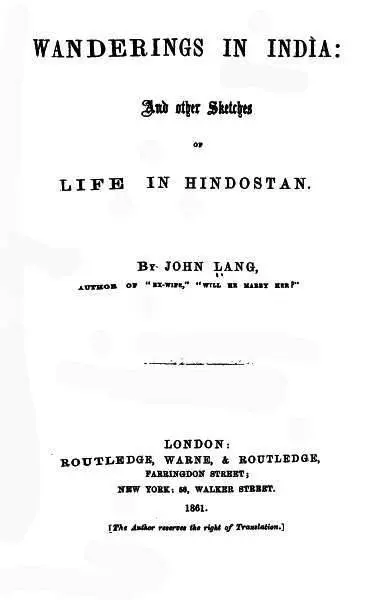
THE CLASSIC COLLECTION · 1861
"Wanderings in India, and Other Sketches of Life in Hindostan" by John Lang is a collection of observational essays written in the mid-19th century. The work provides a vivid portrayal of life in India during British colonial rule, with particular emphasis on the social dynamics in the hill station of Mussoorie, highlighting the interactions among British expatriates, their families, and the challenges they face in this exotic locale. The opening of the book introduces readers to the Himalaya Club, a retreat for British officials and their families looking to escape the oppressive heat of the Indian plains. It sets a leisurely tone as the narrator describes the club's social scene filled with idlers, intricate relationships, and casual gossip, emphasizing the vibrancy of life in the hills. Through the eyes of the narrator, we meet several characters, including grass widows and military officers engaging in various social activities, from breakfasts to morning rides, all while wrestling with personal issues and pressing societal expectations. The beginning sketches an intimate slice of colonial life, blending humor and keen social commentary that captures the complexities of 19th-century Anglo-Indian society.
Introduction adapted from the source catalogue; source summaries may be automatically generated.
Free to read · English · 101,170 words · No account needed
MAKE TIME FOR A GOOD BOOK
On by default. Untick to stop anonymous reading totals. Each page counts after 10 seconds in view. How this works.
Anonymous counting is on unless you have switched it off.
Humble Sahib (who, if he knows anything of Asiatic manners and customs, knows that he must not contradict his host, but eat his compliments with a good appetite). "Maharaj."
Native Rajah. "The acuteness of your perceptions, and the soundness of your understanding, have, by universal report, became as manifest as even the light of the sun itself." Then, turning to his attendants of every degree, who, by this time, had formed a circle round me and the Rajah, he put the question, "Is it true, or not?"
The attendants, one and all, declare that it was true; and inquire whether it could be possible for a great man like the Maharajah to say that which was false.
Native Rajah. "The Sahib's father is living?"
Humble Sahib. "No; he is dead, Maharaj."
Native Rajah. "He was a great man?"
Humble Sahib. "Maharaj. You have honoured the memory of my father, and exalted it in my esteem, by expressing such an opinion."
Native Rajah. "And your mother? She lives?"
Humble Sahib. "By the goodness of God, such is the case."
Native Rajah. "She is a very handsome woman?"
Humble Sahib. "On that point, Maharaj, I cannot offer an opinion."
Native Rajah. "You need not do so. To look in your face is quite sufficient. I would give a crore of rupees (one million sterling) to see her only for one moment, and say how much I admired the intelligent countenance of her son. I am going to England next year. Will the Sahib favour me with her address?"
Humble Sahib. "Maharaj."
Here the Native Rajah calls to the moonshee to bring pen, ink, and paper. The moonshee comes, sits before me, pen in hand, looks inquiringly into my eyes, and I dictate as follows, laughing inwardly all the while: "Lady Bombazine, Munnymunt, ka uper, Peccadilleemee, Bilgrave Isqueere, Sunjons wood-Cumberwill;" which signifies this: "Lady Bombazine, on the top of the Monument, in Piccadilly, Belgrave Square, St. Johns Wood, Camberwell." This mystification must be excused by the plea that the Rajah's assertions of his going to Europe are as truthful as Lady Bombazine's address.
The Maharajah then gives instructions that that document shall
be preserved amongst his most important papers, and resumes the
conversation.
Native Rajah. "The Sahib has eaten well?"
Humble Sahib. "Maharaj."
Native Rajah. "And drunk?"
Humble Sahib. "Maharaj."
Native Rajah. "The Sahib will smoke hookah?"
Humble Sahib. "The Maharajah is very good."
Your reading position is saved on this browser. Take it to another device with a library code. Reading pages adapt to text, rather than matching a printed edition.
Andrew Lang & John Lang
John Lang & Jean Lang
BEHIND THE BOOK
This eBook is for the use of anyone anywhere in the United States and most other parts of the world at no cost and with almost no restrictions whatsoever. You may copy it, give it away or re-use it under the terms of the Project Gutenberg License included with this eBook or online at www.gutenberg.org. If you are not located in the United States, you will have to check the laws of the country where you are located before using this eBook. Read the source licence.
The original source file, including credits and licence, is retained by this library. Request an original-format copy at no charge. Please include the book title and Project Gutenberg identifier #43997.
KEEP YOUR CURIOSITY GOING
Wilfrid Scawen Blunt
Wilfrid Scawen Blunt

E. W. (Edgar Watson) Howe

David Patterson (Spirit) Hatch

David Patterson (Spirit) Hatch

David Patterson (Spirit) Hatch