
Highways and Byways in the Border Illustrated
Andrew Lang & John Lang
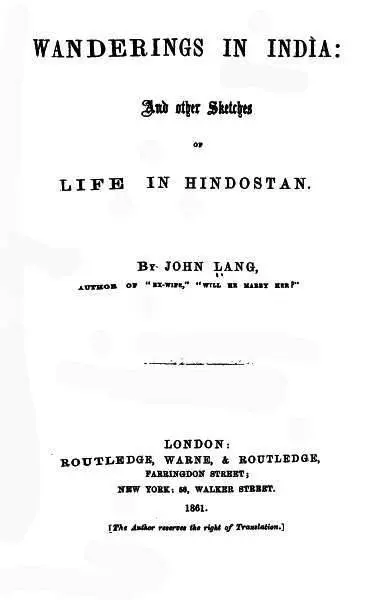
THE CLASSIC COLLECTION · 1861
"Wanderings in India, and Other Sketches of Life in Hindostan" by John Lang is a collection of observational essays written in the mid-19th century. The work provides a vivid portrayal of life in India during British colonial rule, with particular emphasis on the social dynamics in the hill station of Mussoorie, highlighting the interactions among British expatriates, their families, and the challenges they face in this exotic locale. The opening of the book introduces readers to the Himalaya Club, a retreat for British officials and their families looking to escape the oppressive heat of the Indian plains. It sets a leisurely tone as the narrator describes the club's social scene filled with idlers, intricate relationships, and casual gossip, emphasizing the vibrancy of life in the hills. Through the eyes of the narrator, we meet several characters, including grass widows and military officers engaging in various social activities, from breakfasts to morning rides, all while wrestling with personal issues and pressing societal expectations. The beginning sketches an intimate slice of colonial life, blending humor and keen social commentary that captures the complexities of 19th-century Anglo-Indian society.
Introduction adapted from the source catalogue; source summaries may be automatically generated.
Free to read · English · 101,170 words · No account needed
MAKE TIME FOR A GOOD BOOK
On by default. Untick to stop anonymous reading totals. Each page counts after 10 seconds in view. How this works.
Anonymous counting is on unless you have switched it off.
The Jhansi Rajah had been particularly faithful to the British Government, and Lord William Bentinck had presented the brother of the late Rajah with a British ensign, and a letter giving him the title of "Rajah," and assuring him that that title, and the independence attached to it, would be guaranteed by the British Government to him, the Rajah, and his heirs and successors (by adoption). That that treaty (for such it purported to be) of Lord William Bentinck was violated, without the slightest shadow of a pretence, there cannot be any sort of doubt. In the time of the Peishwah, the late Rajah of Jhansi was simply a large zemindar (landholder), and had he remained untitled there can be no question that his last wishes, so far as the disposition of his property was concerned, would have been attended to. It was the acceptance of the "Rajahship" which led to the confiscation of his estates, and the exchange of 6000l. a year for 25,000l. a year. Strange as that assertion may seem to the reader, it is nevertheless true.
I was at Agra when I received the Ranee's letter, and Agra is two days' journey. Even as I travelled from Jhansi, I sympathized with the woman. The boy whom the Rajah had adopted was only six years old, and during his minority, that is to say, until he had attained his eighteenth year, the Ranee--so the Rajah willed--was to have been the Regent, and the boy's guardian; and it is no small matter for a woman--a native woman of rank, too--to give up such a position and become a pensioner, even on 6000l. a year. Let me detail the particulars of my journey to the residence of the Ranee of Jhansi. I got into my palanquin at dusk, and on the following morning, at daylight, arrived at Gwalior. The Rajah of Jhansi had a small house about a mile and a half from the cantonment, which was used as a halting-place, and thither I was taken by the minister and the vakeel who accompanied me. At ten o'clock, after I had breakfasted and smoked my hookah, it was proposed that we "go on at once." The day was very warm, but the Ranee had sent a large and comfortable palanquin carriage; in short, it was more like a small room than a carriage, fitted up as it was with every convenience, including even a punkah, which was pulled from the outside by a servant, who sat upon a foot-board. In the carriage, beside myself and the minister and vakeel, was a khansamah, or butler, who, with the apparatus between his knees, kept on cooling water, and wine, and beer, in order that, whenever I felt thirsty, I might be supplied at a moment's notice. This enormous carriage was drawn by a pair of horses of immense strength and swiftness. Each stood about seventeen hands high. The late Rajah had imported them from France at a cost of 1500l. The road was rather rough in many places, but, on the average, we got over it at the rate of about nine miles an hour. At about two o'clock in the day we entered the Jhansi territory, having changed horses twice, and we had now some nine miles to drive. Hitherto we had been escorted only by four sowars (horsemen), but now our escort amounted to about fifty, each horseman carrying an immense spear, and dressed much in the same way as the Irregular Cavalry in the pay of the East India Company. And along the road, at intervals of a few hundred yards, were horsemen drawn up, and as we passed, they joined the cavalcade; so that by the time we came in sight of the fortress--if those old weak walls, surmounted by some nine pieces of old ordnance of inferior calibre, deserved the name--the whole strength of the Jhansi cavalry was in attendance. The carriage was driven to a place called "the Rajah's garden," where I alighted, and was conducted by the financial minister and the vakeel and other servants of state, to a large tent, which was pitched beneath a clump of gigantic mango trees. The tent, which was that in which the late Rajah used to receive the civil and military officers of the British Government, was elegantly fitted up, and carpeted; and at least a dozen domestic servants were ready to do my bidding. I must not omit to mention that the companions of my journey--the minister and the vakeel--were both men of good ability and pleasing manners. They were, moreover, men of learning, so that my time upon the road had been beguiled very agreeably.
Your reading position is saved on this browser. Take it to another device with a library code. Reading pages adapt to text, rather than matching a printed edition.
Andrew Lang & John Lang
John Lang & Jean Lang
BEHIND THE BOOK
This eBook is for the use of anyone anywhere in the United States and most other parts of the world at no cost and with almost no restrictions whatsoever. You may copy it, give it away or re-use it under the terms of the Project Gutenberg License included with this eBook or online at www.gutenberg.org. If you are not located in the United States, you will have to check the laws of the country where you are located before using this eBook. Read the source licence.
The original source file, including credits and licence, is retained by this library. Request an original-format copy at no charge. Please include the book title and Project Gutenberg identifier #43997.
KEEP YOUR CURIOSITY GOING
Wilfrid Scawen Blunt
Wilfrid Scawen Blunt

E. W. (Edgar Watson) Howe

David Patterson (Spirit) Hatch

David Patterson (Spirit) Hatch

David Patterson (Spirit) Hatch