
Highways and Byways in the Border Illustrated
Andrew Lang & John Lang
THE CLASSIC COLLECTION · 1861
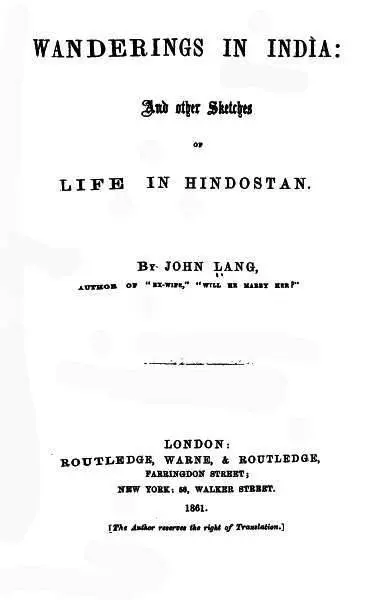
"Wanderings in India, and Other Sketches of Life in Hindostan" by John Lang is a collection of observational essays written in the mid-19th century. The work provides a vivid portrayal of life in India during British colonial rule, with particular emphasis on the social dynamics in the hill station of Mussoorie, highlighting the interactions among British expatriates, their families, and the challenges they face in this exotic locale. The opening of the book introduces readers to the Himalaya Club, a retreat for British officials and their families looking to escape the oppressive heat of the Indian plains. It sets a leisurely tone as the narrator describes the club's social scene filled with idlers, intricate relationships, and casual gossip, emphasizing the vibrancy of life in the hills. Through the eyes of the narrator, we meet several characters, including grass widows and military officers engaging in various social activities, from breakfasts to morning rides, all while wrestling with personal issues and pressing societal expectations. The beginning sketches an intimate slice of colonial life, blending humor and keen social commentary that captures the complexities of 19th-century Anglo-Indian society.
Introduction adapted from the source catalogue; source summaries may be automatically generated.
Free to read · English · 101,170 words · No account needed
MAKE TIME FOR A GOOD BOOK
On by default. Untick to stop anonymous reading totals. Each page counts after 10 seconds in view. How this works.
Anonymous counting is on unless you have switched it off.
"Yes, here it is, in the second instance of the second charge, 'having while in a state of intoxication at the mess-table of her Majesty's ---- Regiment of Foot, on the night,'" &c., &c.
"Oh! that's an infamous falsehood, you know. Who said that? Not Captain Stansfield, who put us under arrest? If he swears that he shall answer for it. Intoxicated! not a bit of it! Screwed, nothing more!" cried the young officer in a sort of stage whisper. "On my honour, as an officer and a gentleman, nothing more."
"These charges have come down from head-quarters, having been prepared in the office of the Judge-Advocate-General."
"Who is he? What's his name?" asked the prisoners.
"Colonel Birch," was the reply.
"Then he shall give up his authority."
"Well, plead Not guilty, and you will have it."
"Very well, then, off she goes: 'Not guilty!' Fifty not guilties, if
you like, on that point."
While this little, but interesting, debate was pending between the prosecutor and the prisoners, the various members of the court were holding with each other a miscellaneous conversation, or otherwise amusing themselves.
Colonel Jackstone, of the Native Infantry (who was the president of the court martial, in virtue of the seniority of his rank), was talking to Colonel Colverly of the Dragoons, about some extraordinary ailment of his wife which required the constant administration of brandy and soda-water, in order to keep her alive. It was a low sinking fever, he said, from which she had suffered for the last six or seven years at intervals of three months; and it was always worse in the hot weather than at any other season of the year. Captain Bulstrade, of the Artillery, was talking to Major Wallchaffe, of the Light (Bengal) Cavalry, concerning a fly-trap which he had that morning invented; a ginger-beer or soda-water bottle half filled with soapsuds and the opening besmeared with honey or moistened sugar. Captain Dundriffe was recommending Captain Nolens to buy some beer which a native merchant had recently imported into the station. Lieutenant Blade, of the Dragoons, was playing at odd and even with his fingers, on honour, with Lieutenant Theston, of the same regiment; and, with a pretence of being ready to take notes of the proceedings of the court martial, each, pen in right hand, was keeping an account of the score. Blade used to boast of being the inventor of this simple game, but there were officers in India who declared that it owed its existence to a late Commander-in-Chief of the Forces, and who invented it at school when he had been shut up in a dark room (with another boy as fond of gambling as himself), as a punishment for card playing and other games of chance requiring light to see what was going on. Nothing could possibly be simpler than the game, and played as it was, on honour, nothing could be fairer. Blade lost thirty pounds on the first day of the court martial, but won the greater part of it back on the day following. Of course it would not do to play at this game with strangers or promiscuous acquaintances. Lieutenant Belterton of the regiment was making use of the pens, ink, and paper, by sketching the President and several others who had somewhat prominent noses; and young Lofter was trying to rival him in this amusement. My own friend was very busy writing; and, from the serious expression on his countenance, you might have fancied he was composing a sermon, or writing a letter of advice to a refractory son; he folded up the paper, and passed it round till at last it reached me. I opened it, and read as follows:--"We shall be here till four. Take the buggy and drive up to the bungalow, and tell the khitmutghur to bring down the ice-basket, also Mr. Belterton's ice-basket, with a plentiful supply of soda-water from our mess; for they are rather short here, and can't stand a heavy run upon them. Tell him also to bring several bottles of our Madeira, for theirs I do not like, and won't drink. It has not age, and has not travelled sufficiently. Cigars also. I am literally bathed in perspiration, and so I fancy are most of us at this end of the table, for the punkah is too far distant to admit of our receiving any benefit therefrom. This is an awful business."
Your reading position is saved on this browser. Take it to another device with a library code. Reading pages adapt to text, rather than matching a printed edition.
Andrew Lang & John Lang
John Lang & Jean Lang
BEHIND THE BOOK
This eBook is for the use of anyone anywhere in the United States and most other parts of the world at no cost and with almost no restrictions whatsoever. You may copy it, give it away or re-use it under the terms of the Project Gutenberg License included with this eBook or online at www.gutenberg.org. If you are not located in the United States, you will have to check the laws of the country where you are located before using this eBook. Read the source licence.
The original source file, including credits and licence, is retained by this library. Request an original-format copy at no charge. Please include the book title and Project Gutenberg identifier #43997.
KEEP YOUR CURIOSITY GOING
Wilfrid Scawen Blunt
Wilfrid Scawen Blunt

E. W. (Edgar Watson) Howe

David Patterson (Spirit) Hatch

David Patterson (Spirit) Hatch

David Patterson (Spirit) Hatch