
Highways and Byways in the Border Illustrated
Andrew Lang & John Lang
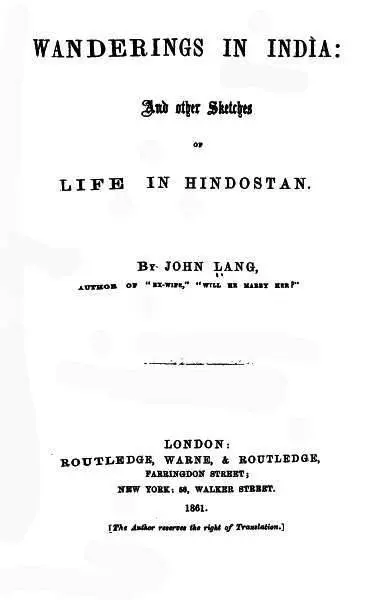
THE CLASSIC COLLECTION · 1861
"Wanderings in India, and Other Sketches of Life in Hindostan" by John Lang is a collection of observational essays written in the mid-19th century. The work provides a vivid portrayal of life in India during British colonial rule, with particular emphasis on the social dynamics in the hill station of Mussoorie, highlighting the interactions among British expatriates, their families, and the challenges they face in this exotic locale. The opening of the book introduces readers to the Himalaya Club, a retreat for British officials and their families looking to escape the oppressive heat of the Indian plains. It sets a leisurely tone as the narrator describes the club's social scene filled with idlers, intricate relationships, and casual gossip, emphasizing the vibrancy of life in the hills. Through the eyes of the narrator, we meet several characters, including grass widows and military officers engaging in various social activities, from breakfasts to morning rides, all while wrestling with personal issues and pressing societal expectations. The beginning sketches an intimate slice of colonial life, blending humor and keen social commentary that captures the complexities of 19th-century Anglo-Indian society.
Introduction adapted from the source catalogue; source summaries may be automatically generated.
Free to read · English · 101,170 words · No account needed
MAKE TIME FOR A GOOD BOOK
On by default. Untick to stop anonymous reading totals. Each page counts after 10 seconds in view. How this works.
Anonymous counting is on unless you have switched it off.
"Most of the young noblemen who come to this country, come only to travel about and amuse themselves. I come on business--I may say, Parliamentary business. My time is short, and I must make the most of it. I dare say, when you saw my name in the papers, as having arrived in India, you little thought that I was not a man of pleasure and excursion?"
"Upon my word, the subject never once became a matter of speculation
with me," said our host.
After some further conversation, in which our host spared his visitor as little as was consistent with good breeding, Lord Jamleigh, who had been "sitting upon thorns," rose and said:--
"I am afraid I have already trespassed on your goodness too long. I will not attempt to apolo--apolo--or to express how much--how much; nor to assure you that--assure you--that when--"
"Oh, pray don't mention it!" said our host, smiling. "You desire your
palkee?"
"If you please," said Lord Jamleigh.
The palkee was ordered, and we were standing in expectation that it would be instantly announced as "ready," when the sirdar-bearer (head personal attendant) came into the room, in a state of excessive trepidation, and informed us that the Sahib's Sahib (Lord Jamleigh's valet) was drunk, asleep, and refused to be disturbed on any pretence whatever.
This announcement, which caused general merriment, induced Lord
Jamleigh to ejaculate:--
"That's the champagne, I suspected as much!"
"Where is he?" inquired our host of the sirdar-bearer. "In his palkee?"
"No, Sahib," was the reply. "He is lying on that Sahib's bed," pointing
to me.
Here, again, everybody laughed, except myself. I was rather angry, being somewhat particular on this point. So I suggested that he might be put into his vehicle at once. The native servants, of course, were afraid to touch him, lest he should awake and "hit out;" so we, the five of us, Europeans, the magistrate, the two assistant magistrates, Lord Jamleigh, and myself, had to lift, remove, and pack in his palkee, the overcome, and perfectly unconscious valet. He must have been sipping brandy-and water before he came to the bungalow, for he had only half finished his bottle of champagne. Lord Jamleigh now got into his palanquin, and composed himself for the night, or, rather, the remainder of it, and in order that there might be no mistake as to his Lordship's destination, the magistrate sent a horseman to accompany the cortège, with directions that "the Sahibs" were to be taken to Durowlah, on the road to Meerut, and to the house of the magistrate, by whom Lord Jamleigh had been invited, or rather, "petitioned," to stay with him, should he pass through that station, and (to use his Lordship's own terms), as he had promised to do so, he supposed that he must keep his word. When a palanquin is escorted by a sowar, the sowar when the destination is approached, rides on and gives notice that a lady, or gentleman, as the case may be, is coming; and, as the natives of India can never pronounce European names properly, the precaution is usually taken of writing down the name of the traveller on a card, or a slip of paper, and giving it to the sowar. In this case, "Viscount Jamleigh" was written down for the guidance and information of the Durowlah functionary.
Your reading position is saved on this browser. Take it to another device with a library code. Reading pages adapt to text, rather than matching a printed edition.
Andrew Lang & John Lang
John Lang & Jean Lang
BEHIND THE BOOK
This eBook is for the use of anyone anywhere in the United States and most other parts of the world at no cost and with almost no restrictions whatsoever. You may copy it, give it away or re-use it under the terms of the Project Gutenberg License included with this eBook or online at www.gutenberg.org. If you are not located in the United States, you will have to check the laws of the country where you are located before using this eBook. Read the source licence.
The original source file, including credits and licence, is retained by this library. Request an original-format copy at no charge. Please include the book title and Project Gutenberg identifier #43997.
KEEP YOUR CURIOSITY GOING
Wilfrid Scawen Blunt
Wilfrid Scawen Blunt

E. W. (Edgar Watson) Howe

David Patterson (Spirit) Hatch

David Patterson (Spirit) Hatch

David Patterson (Spirit) Hatch