
Highways and Byways in the Border Illustrated
Andrew Lang & John Lang
THE CLASSIC COLLECTION · 1861
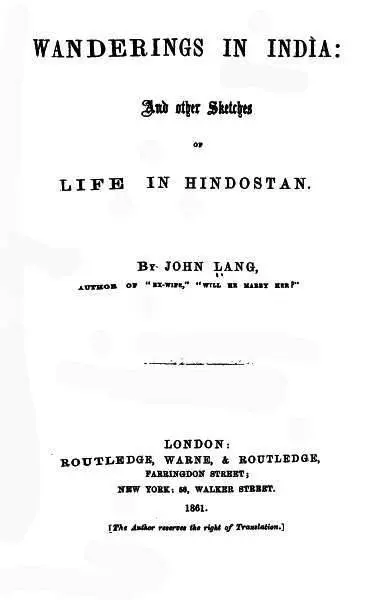
"Wanderings in India, and Other Sketches of Life in Hindostan" by John Lang is a collection of observational essays written in the mid-19th century. The work provides a vivid portrayal of life in India during British colonial rule, with particular emphasis on the social dynamics in the hill station of Mussoorie, highlighting the interactions among British expatriates, their families, and the challenges they face in this exotic locale. The opening of the book introduces readers to the Himalaya Club, a retreat for British officials and their families looking to escape the oppressive heat of the Indian plains. It sets a leisurely tone as the narrator describes the club's social scene filled with idlers, intricate relationships, and casual gossip, emphasizing the vibrancy of life in the hills. Through the eyes of the narrator, we meet several characters, including grass widows and military officers engaging in various social activities, from breakfasts to morning rides, all while wrestling with personal issues and pressing societal expectations. The beginning sketches an intimate slice of colonial life, blending humor and keen social commentary that captures the complexities of 19th-century Anglo-Indian society.
Introduction adapted from the source catalogue; source summaries may be automatically generated.
Free to read · English · 101,170 words · No account needed
MAKE TIME FOR A GOOD BOOK
On by default. Untick to stop anonymous reading totals. Each page counts after 10 seconds in view. How this works.
Anonymous counting is on unless you have switched it off.
Having divested himself of the dust with which he was covered, and having restored himself to his personal comforts, his lordship joined our little party, and partook of some dinner which the khansamah had prepared for him. His repast concluded, his lordship moistened his throat with a glass of cool claret, and proceeded, in his own manner, to interrogate his host, who was not only an accomplished scholar, but a ready and refined wit. It was thus that the dialogue was commenced and continued:--
"What is the number of inhabitants in this district?" asked the noble
guest.
"Upon my word I don't know; I have never counted them," said the host.
"But have you no idea? Can't you give a guess?"
"Oh, yes; some hundreds of thousands."
"Ah! And crime--much crime!" his lordship persevered.
"Very much. But we are going to reduce it, during the ensuing half-year, exactly thirty-three and a-half per cent.," answered the magistrate, looking uncommonly statistical.
"How?"
"Well, that is what my assistant and myself have decided upon."
"I do not understand you. How can you possibly say at this moment whether, during the next six months, the amount of crime shall be greater or less?" His lordship was puzzled.
"How? Why just in the same way that the directors of a joint-stock bank determine in their parlour what shall be the amount of dividend payable to shareholders. My assistant wanted to make a reduction of fifty per centum on the last returns; but I think thirty-three and a-half will be a very fair figure."
"You intend, perhaps, to be more severe?" said the young legislator.
"Nothing of the kind. On the contrary, we intend to be less energetic by thirty-three and a-half per cent.--to take matters more easily, in short."
"I wish I knew what you meant."
"I will explain it to you."
"As briefly as possible, please." His lordship did not want to be
bored, evidently.
"By all means."
"I only want facts, you see."
"And I am about to give you facts--dry facts."
"Well?"
"The facts are these. There is a district in these provinces nearly twice the size of this, and it contains nearly double the number of inhabitants."
"Yes."
"During the past half-year, the number of convictions in that district has been very much less than the number of convictions in this district. And the Sudder Court of Appeal has come to the conclusion, on looking at the figures in the official return, that the proportion of crime to population, in this district, is greater than it is in that district."
"Very naturally."
Your reading position is saved on this browser. Take it to another device with a library code. Reading pages adapt to text, rather than matching a printed edition.
Andrew Lang & John Lang
John Lang & Jean Lang
BEHIND THE BOOK
This eBook is for the use of anyone anywhere in the United States and most other parts of the world at no cost and with almost no restrictions whatsoever. You may copy it, give it away or re-use it under the terms of the Project Gutenberg License included with this eBook or online at www.gutenberg.org. If you are not located in the United States, you will have to check the laws of the country where you are located before using this eBook. Read the source licence.
The original source file, including credits and licence, is retained by this library. Request an original-format copy at no charge. Please include the book title and Project Gutenberg identifier #43997.
KEEP YOUR CURIOSITY GOING
Wilfrid Scawen Blunt
Wilfrid Scawen Blunt

E. W. (Edgar Watson) Howe

David Patterson (Spirit) Hatch

David Patterson (Spirit) Hatch

David Patterson (Spirit) Hatch