
Highways and Byways in the Border Illustrated
Andrew Lang & John Lang
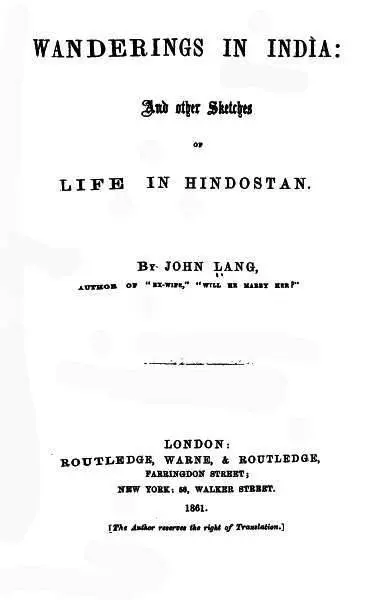
THE CLASSIC COLLECTION · 1861
"Wanderings in India, and Other Sketches of Life in Hindostan" by John Lang is a collection of observational essays written in the mid-19th century. The work provides a vivid portrayal of life in India during British colonial rule, with particular emphasis on the social dynamics in the hill station of Mussoorie, highlighting the interactions among British expatriates, their families, and the challenges they face in this exotic locale. The opening of the book introduces readers to the Himalaya Club, a retreat for British officials and their families looking to escape the oppressive heat of the Indian plains. It sets a leisurely tone as the narrator describes the club's social scene filled with idlers, intricate relationships, and casual gossip, emphasizing the vibrancy of life in the hills. Through the eyes of the narrator, we meet several characters, including grass widows and military officers engaging in various social activities, from breakfasts to morning rides, all while wrestling with personal issues and pressing societal expectations. The beginning sketches an intimate slice of colonial life, blending humor and keen social commentary that captures the complexities of 19th-century Anglo-Indian society.
Introduction adapted from the source catalogue; source summaries may be automatically generated.
Free to read · English · 101,170 words · No account needed
MAKE TIME FOR A GOOD BOOK
On by default. Untick to stop anonymous reading totals. Each page counts after 10 seconds in view. How this works.
Anonymous counting is on unless you have switched it off.
It would be hard to deprive either of the great sects of certain holidays in every year. The Doorgah-Poojah, for instance, or the Mohurrum; but it is sheer folly, and profitless withal, to sanction these constantly repeated interruptions to public business. The idlers of the covenanted civil service in India are, naturally, in favour of closing the doors of the various offices as often as possible; but the hard-working portion, those men who take some interest in the discharge of the duties for which they draw their pay, regard the native holidays as an intolerable nuisance which ought, long since, to have been abolished.
Whilst we were enjoying ourselves after dinner, on the evening of the Hindoo holiday, the khansamah came in, and announced that two Sahibs had arrived.
"Two Sahibs?" said our host. "Who are they?"
"They are strangers to me, Sahib," said the khansamah, "and they do not speak Hindostanee; but their bearers say that they are Lord Sahibs."
"Who on earth can they be?" said the magistrate of Bijnore (loudly) to himself; and, rising, he left the table to make inquiry in person, and offer the travellers every hospitality.
"O, I beg your pardon," said a voice from one of the palanquins. "But would you be good enough to tell me where I am?"
"You are at Bijnore," said the magistrate, blandly.
"Bij-what?"
"Bijnore."
"Then, how far am I from Meerut?"
"A very considerable distance--forty miles at least."
"How the deuce is that?"
"Well, sir--in the words of the Eton Latin Grammar--I may reply:--
Felix qui potuit rerum cognoscere causas.
But where have you come from?"
"From Seharry something or other; but confound these nores, and pores, and bores! There's no recollecting the name of any place, for an hour together. The magistrate--I forget his name just now; but it was Radley, Bradley, Bagley, Ragley, or Cragley, or some such name--told me he would push me on to Meerut, and here am I, it seems, forty miles out of my road! Well, look here. I am Lord Jamleigh."
"Indeed! Well, you are welcome to some refreshment and repose in my home, in common with your friend; and whenever you desire to be 'pushed on,' I will exert my authority to the utmost to further your views."
"O, thank you. My friend is my valet. Here, Mexton, jump out and take
my things into a room."
While Mexton is obeying this order, and while his lordship is following his host, let us inform the reader who his lordship was, and what was the object of his mission to India.
Your reading position is saved on this browser. Take it to another device with a library code. Reading pages adapt to text, rather than matching a printed edition.
Andrew Lang & John Lang
John Lang & Jean Lang
BEHIND THE BOOK
This eBook is for the use of anyone anywhere in the United States and most other parts of the world at no cost and with almost no restrictions whatsoever. You may copy it, give it away or re-use it under the terms of the Project Gutenberg License included with this eBook or online at www.gutenberg.org. If you are not located in the United States, you will have to check the laws of the country where you are located before using this eBook. Read the source licence.
The original source file, including credits and licence, is retained by this library. Request an original-format copy at no charge. Please include the book title and Project Gutenberg identifier #43997.
KEEP YOUR CURIOSITY GOING
Wilfrid Scawen Blunt
Wilfrid Scawen Blunt

E. W. (Edgar Watson) Howe

David Patterson (Spirit) Hatch

David Patterson (Spirit) Hatch

David Patterson (Spirit) Hatch