
Highways and Byways in the Border Illustrated
Andrew Lang & John Lang
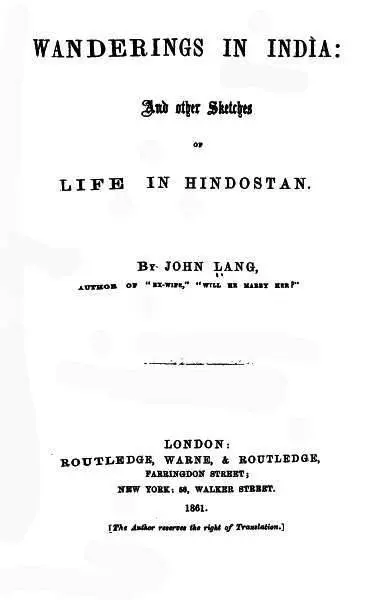
THE CLASSIC COLLECTION · 1861
"Wanderings in India, and Other Sketches of Life in Hindostan" by John Lang is a collection of observational essays written in the mid-19th century. The work provides a vivid portrayal of life in India during British colonial rule, with particular emphasis on the social dynamics in the hill station of Mussoorie, highlighting the interactions among British expatriates, their families, and the challenges they face in this exotic locale. The opening of the book introduces readers to the Himalaya Club, a retreat for British officials and their families looking to escape the oppressive heat of the Indian plains. It sets a leisurely tone as the narrator describes the club's social scene filled with idlers, intricate relationships, and casual gossip, emphasizing the vibrancy of life in the hills. Through the eyes of the narrator, we meet several characters, including grass widows and military officers engaging in various social activities, from breakfasts to morning rides, all while wrestling with personal issues and pressing societal expectations. The beginning sketches an intimate slice of colonial life, blending humor and keen social commentary that captures the complexities of 19th-century Anglo-Indian society.
Introduction adapted from the source catalogue; source summaries may be automatically generated.
Free to read · English · 101,170 words · No account needed
MAKE TIME FOR A GOOD BOOK
On by default. Untick to stop anonymous reading totals. Each page counts after 10 seconds in view. How this works.
Anonymous counting is on unless you have switched it off.
An act of retributive justice has just been committed by the worthy magistrate of this district. It was supposed that an escaped convict from the jail was secreted in a village about four miles distant from this cantonment. In the dead of the night, the magistrate, at the head of a large body of police, visited the village, aroused the inhabitants from their slumbers, and demanded the culprit. The villagers denied any knowledge of him. The magistrate, with characteristic kindness and consideration, gave them half-an-hour to make up their minds. At the expiration of that time, as the culprit was not produced, he set fire to the village. In those flames, which illuminated the country for miles round, thirteen lives were sacrificed; namely, those of three men, four women, and six children. One of the unfortunate women was in labour at the time. Some malicious natives in the neighbourhood of Meerut give out that the Sahib has been notoriously mad for several years past. Let us hope, however, that the Lieutenant-Governor will not heed such insinuations, but after complimenting the magistrate on his vigour and his zeal, appoint him to the first judgeship that may become vacant. No less than six hundred persons are, by this fire, rendered homeless beggars. But what of that? Must justice be obstructed?
It remains for us to add that the escaped convict of whom the magistrate was in search, has been in Oude for the past month, and that no notice of this affair will appear in any of the papers printed in English and edited by the Sahib Logue. Those gentlemen are far too modest to make known the manifest blessings which arise out of British rule in India.
For upwards of a year and a-half the native paper went on filching news, and writing in the above strain. At length the conductor of the Meerut journal was furnished with some information which led to his discharging his employées, the head pressman and the moonshee, and breaking up their journal, the Jam-i-Jumsheed. And more than this was done. The danger of permitting native newspapers to be published without any sort of supervision was elaborately, and from time to time dwelt upon by the English editor, and at length the Government was moved to call for a return of the journals printed in the Hindoostanee language in the Upper Provinces of India, and for an account of the number of copies that each issued. With this return and account the Government was well satisfied; first, because the aggregate circulation was so ridiculously small (comparatively), that it was quite clear that the native press had no power or influence; and, secondly, that the tone of the best conducted and most respectable journals of the native press were loud in their praises of British rule, and firm supporters of the Government. It was overlooked with reference to the first point, that in no country, and in India especially, is the actual circulation of a newspaper any criterion of the number of persons acquainted with its contents, its chief items of intelligence, and its sentiments on the most important questions of the day. Let us take for example, the greatest paper in the world--the Times. Compare the number of copies that are struck off daily with the number of hands into which that paper passes, the number of eyes that read it, and the number of ears that listen to hear it read. As to the second point, the praise of the Government of India, it was laughable to hear it mentioned, albeit the subject was of so serious a character. That praise was bestowed very much in the same spirit that Jack Wilkes is said to have conveyed a serious warning, with a humorous grin, to an election mob--"I hear that it is your intention, gentlemen, to take that person (there!) who is interrupting me, place him under that pump, and duck him! Now, if you should do so, no matter how much it may be for his own good, you will--I give you this emphatic warning--incur my most serious displeasure, gentlemen!" They (the native editors) used to wrap up the most bitter irony in the most complimentary phrases, and frequently their allusions, if viewed abstractedly, were both humorous and witty. A case in point. The late Lieutenant-Governor of the North-Western Provinces, a few years ago, presided at an examination of the students of a Government public school. Amongst other questions which his honour put to the boys of the first class was this--"How does the world go round?" The head boy, a very intelligent Hindoo, gave an admirable reply--spoke, as the saying is, like a book. The editor of a native paper, in a notice of the examination, predicted that this boy would come to a bad end for giving such an answer to the Lieutenant-Governor of the North-West Provinces. "He ought," said the native editor, "when so questioned by so potent a ruler, as to the cause of the world's going round, to have flung science into the gutter, and, having assumed the most cringing attitude imaginable, he should have placed his hands together, and then have responded meekly, 'By your honour's grace, favour, and kindness, does this planet revolve upon its axis.'" This same editor once wrote a notice of a ball given by the officers of the Horse Artillery mess at Meerut to the ladies of the Twenty-ninth Foot, on the occasion of that last-mentioned and distinguished regiment coming to the station. When translated, literally, to an Englishman this notice would seem the most flattering account possible; but, if such Englishman took it in the sense in which Asiatics understood and comprehended it, he would, without any sort of doubt, have admitted that it was the most extraordinary and ingenious admixture of satire and obscenity that ever was printed and published!
Your reading position is saved on this browser. Take it to another device with a library code. Reading pages adapt to text, rather than matching a printed edition.
Andrew Lang & John Lang
John Lang & Jean Lang
BEHIND THE BOOK
This eBook is for the use of anyone anywhere in the United States and most other parts of the world at no cost and with almost no restrictions whatsoever. You may copy it, give it away or re-use it under the terms of the Project Gutenberg License included with this eBook or online at www.gutenberg.org. If you are not located in the United States, you will have to check the laws of the country where you are located before using this eBook. Read the source licence.
The original source file, including credits and licence, is retained by this library. Request an original-format copy at no charge. Please include the book title and Project Gutenberg identifier #43997.
KEEP YOUR CURIOSITY GOING
Wilfrid Scawen Blunt
Wilfrid Scawen Blunt

E. W. (Edgar Watson) Howe

David Patterson (Spirit) Hatch

David Patterson (Spirit) Hatch

David Patterson (Spirit) Hatch