
Highways and Byways in the Border Illustrated
Andrew Lang & John Lang
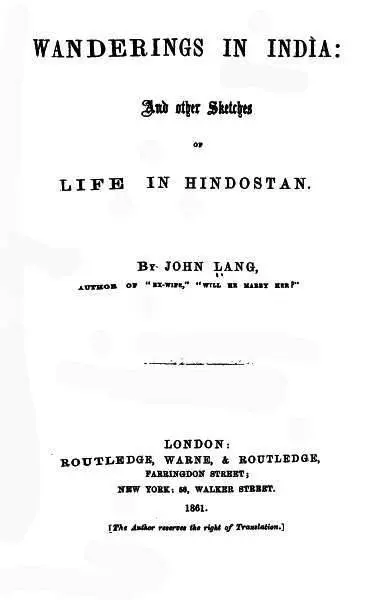
THE CLASSIC COLLECTION · 1861
"Wanderings in India, and Other Sketches of Life in Hindostan" by John Lang is a collection of observational essays written in the mid-19th century. The work provides a vivid portrayal of life in India during British colonial rule, with particular emphasis on the social dynamics in the hill station of Mussoorie, highlighting the interactions among British expatriates, their families, and the challenges they face in this exotic locale. The opening of the book introduces readers to the Himalaya Club, a retreat for British officials and their families looking to escape the oppressive heat of the Indian plains. It sets a leisurely tone as the narrator describes the club's social scene filled with idlers, intricate relationships, and casual gossip, emphasizing the vibrancy of life in the hills. Through the eyes of the narrator, we meet several characters, including grass widows and military officers engaging in various social activities, from breakfasts to morning rides, all while wrestling with personal issues and pressing societal expectations. The beginning sketches an intimate slice of colonial life, blending humor and keen social commentary that captures the complexities of 19th-century Anglo-Indian society.
Introduction adapted from the source catalogue; source summaries may be automatically generated.
Free to read · English · 101,170 words · No account needed
MAKE TIME FOR A GOOD BOOK
On by default. Untick to stop anonymous reading totals. Each page counts after 10 seconds in view. How this works.
Anonymous counting is on unless you have switched it off.
"Another very flagrant case occurred in this very station. A civilian took into his service a recently converted Hindoo, as a sirdar-bearer. The fellow had charge of a money-bag, and ran off with it. And where and how do you suppose he was apprehended? At Hurdwar, taking an active part in the Hoolee Festival! The Roman Catholic priests have long since left off asking the natives of India to become Christians. Those who voluntarily present themselves, are, after a strict examination, and a due warning that they must hope for no temporal advantage, admitted into the Church."
"And do they have any applications?"
"Very very few, indeed; but those whom they admit do, really and truly,
become Christians."
These last words of Nobinkissen were scarcely pronounced, when a palkee was brought up to my door, and out of it stepped a Roman Catholic priest--an Italian gentleman, a Jesuit--whom I had met a few evenings previously at the house of a mutual friend. Nobinkissen, who appeared to know the reverend father intimately, related to him the substance of the conversation we had just held, or rather the latter part thereof, and the priest corroborated every allegation that Nobinkissen had made.
"Yea," he added, "we now devote our attention, exclusively, to the spiritual wants of the white man who requires our aid--convinced, as we are, of the hopelessness of the task of converting the Hindoo and the Mussulman to Christianity." And, in addition to the instances of false converts afforded by Nobinkissen, he did not scruple to detail several others of an equally atrocious character and complexion.
Having seen Agra, its edifices, ruins, society, European and native, and having visited Secundra, Futteypore, Sickri, and Muttra, I journeyed upwards to Delhi, where I was received by Mr. Joseph Skinner, the eldest son of the late Colonel Skinner, renowned as the founder and commandant of the famous Skinner's Horse. Mr. Joseph Skinner's house was, at all times, open to all travellers. He was without exception the most hospitable man that I ever met in any part of the world. At his board were to be met daily, either at luncheon or at dinner, civilians and military men of every rank and grade in the service, as well as native gentlemen of position in India--Hindoos and Mahommedans. Even the young princes, sons of the King of Delhi and descendants of the Great Moghul, used frequently to honour Mr. Skinner with their company. The title by which they were usually greeted was Sahiban-i-Alum, signifying "Lords of the World." But the most remarkable native that I ever met at Mr. Skinner's hospitable board was the late Maharajah Hindoo-Rao, a little, fat, round Mahratta chieftain, with small twinkling eyes, and a countenance replete with fun and quiet humour. He was a pensioner of the Gwalior State, and drew therefrom twelve thousand pounds a year, which was guaranteed to him by the British Government. Large as was this income, Hindoo-Rao contrived annually to spend more than double the amount, trusting continually to fate to relieve him from his pressing pecuniary difficulties; not that he ever suffered them to prey upon his mind; on the contrary, he made them a subject of jocularity. In addition to being as hospitable as his friend Mr. Skinner, Hindoo-Rao was addicted to field sports on a large scale, and kept up a very large establishment for the purpose of gratifying this propensity. He was considered--and perhaps justly, by those qualified to form an opinion--the best shot in all India, and with his rifle he had destroyed several hundreds (some say thousands) of tigers. Hindoo-Rao had another very expensive hobby. He desired to possess himself of the Philosopher's Stone, by which he might transmute metals--a mode by which he proposed to improve the state of his finances and eventually pay his debts. On all other points, Hindoo-Rao was sufficiently sensible and shrewd, but on this point he was childish, if not insane. Thousands and thousands of pounds were squandered by him in this absurd pursuit, for he was constantly the victim of juggling forgers, swindlers, and rogues. His house was on a hill immediately overhanging Delhi, and it has recently been made famous throughout Europe as the position of one of our batteries. Night after night in that house would furnaces blaze, while some impostor, who pretended to have the secret, was at work with his chemicals.
Your reading position is saved on this browser. Take it to another device with a library code. Reading pages adapt to text, rather than matching a printed edition.
Andrew Lang & John Lang
John Lang & Jean Lang
BEHIND THE BOOK
This eBook is for the use of anyone anywhere in the United States and most other parts of the world at no cost and with almost no restrictions whatsoever. You may copy it, give it away or re-use it under the terms of the Project Gutenberg License included with this eBook or online at www.gutenberg.org. If you are not located in the United States, you will have to check the laws of the country where you are located before using this eBook. Read the source licence.
The original source file, including credits and licence, is retained by this library. Request an original-format copy at no charge. Please include the book title and Project Gutenberg identifier #43997.
KEEP YOUR CURIOSITY GOING
Wilfrid Scawen Blunt
Wilfrid Scawen Blunt

E. W. (Edgar Watson) Howe

David Patterson (Spirit) Hatch

David Patterson (Spirit) Hatch

David Patterson (Spirit) Hatch