
Highways and Byways in the Border Illustrated
Andrew Lang & John Lang
THE CLASSIC COLLECTION · 1861
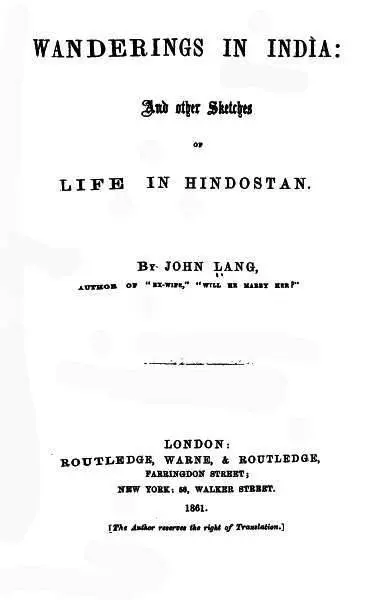
"Wanderings in India, and Other Sketches of Life in Hindostan" by John Lang is a collection of observational essays written in the mid-19th century. The work provides a vivid portrayal of life in India during British colonial rule, with particular emphasis on the social dynamics in the hill station of Mussoorie, highlighting the interactions among British expatriates, their families, and the challenges they face in this exotic locale. The opening of the book introduces readers to the Himalaya Club, a retreat for British officials and their families looking to escape the oppressive heat of the Indian plains. It sets a leisurely tone as the narrator describes the club's social scene filled with idlers, intricate relationships, and casual gossip, emphasizing the vibrancy of life in the hills. Through the eyes of the narrator, we meet several characters, including grass widows and military officers engaging in various social activities, from breakfasts to morning rides, all while wrestling with personal issues and pressing societal expectations. The beginning sketches an intimate slice of colonial life, blending humor and keen social commentary that captures the complexities of 19th-century Anglo-Indian society.
Introduction adapted from the source catalogue; source summaries may be automatically generated.
Free to read · English · 101,170 words · No account needed
MAKE TIME FOR A GOOD BOOK
On by default. Untick to stop anonymous reading totals. Each page counts after 10 seconds in view. How this works.
Anonymous counting is on unless you have switched it off.
"I thought it would have been me," said Mrs. Revenue Board.
"You?" said Mrs. Damzè.
"Yes; why not? My husband is a civilian of twenty years' standing."
"Is not my husband a Lieutenant-Colonel and a C.B.? If he were only a Major and a C.B. he would take precedence of Mr. Revenue Board."
"You are quite mistaken."
"Indeed not. Do you suppose a C.B. goes for nothing?"
"No; but----"
Here Lieutenant-Colonel Damzè and Mr. Revenue Board, who had been discussing the same question, but in a calmer spirit than their wives, approached, and, making common cause against the upstart enemy (Infantry and his wife), formed a quartette and went into the supper room; where, to their intense mortification, they heard little Mrs. Infantry talking loudly, on purpose to attract the notice of all present. What was even more mortifying still, the old General was paying her marked attention.
The red party, that is to say, the military, were in very high spirits; the black, the civilians, correspondingly depressed. The quartette, consisting of Damzè and Revenue Board, and their wives, ate voraciously, but evidently without appetite. They sipped their wine with an absent formality, which was very entertaining to lookers-on, who were in no way interested in the momentous question which was preying on their very souls.
"It shall not end here," said Damzè, moodily fixing his eyes on the
chandelier.
"Not, indeed!" said Mr. Revenue Board.
"I shall put my case to the Governor-General direct," said Damzè. "His Lordship is a near connexion of mine."
"I am perfectly aware of that," said Mr. Revenue Board; "but it is my intention to submit my case to his Lordship through Mr. Bommerson, the Lieutenant-Governor of these provinces, officially; and, if his Lordship's opinion should be adverse, I shall have my appeal to the Court of Directors, amongst whom, thank Heaven! I have several relations and warm friends."
"And you will write, I hope, my dear," said Mrs. Revenue Board, "to Sir John Bobgrouse, who is the President of the Board of Control, and whose secretary married your first cousin--recollect!"
"We can write, too," said Mrs. Lieutenant-Colonel Damzè.
"You may write to anybody you please," said Mrs. Revenue Board, defiantly and contemptuously; "but you will remember that the point between us is this--that even if your husband, in consequence of having got, no matter how, a C.B.ship, has the right to precede my husband, a civilian of twenty years' standing--whether you have the right to precede me? That is the question; and I hope, Revenue dear, you will not fail to raise it."
Your reading position is saved on this browser. Take it to another device with a library code. Reading pages adapt to text, rather than matching a printed edition.
Andrew Lang & John Lang
John Lang & Jean Lang
BEHIND THE BOOK
This eBook is for the use of anyone anywhere in the United States and most other parts of the world at no cost and with almost no restrictions whatsoever. You may copy it, give it away or re-use it under the terms of the Project Gutenberg License included with this eBook or online at www.gutenberg.org. If you are not located in the United States, you will have to check the laws of the country where you are located before using this eBook. Read the source licence.
The original source file, including credits and licence, is retained by this library. Request an original-format copy at no charge. Please include the book title and Project Gutenberg identifier #43997.
KEEP YOUR CURIOSITY GOING
Wilfrid Scawen Blunt
Wilfrid Scawen Blunt

E. W. (Edgar Watson) Howe

David Patterson (Spirit) Hatch

David Patterson (Spirit) Hatch

David Patterson (Spirit) Hatch