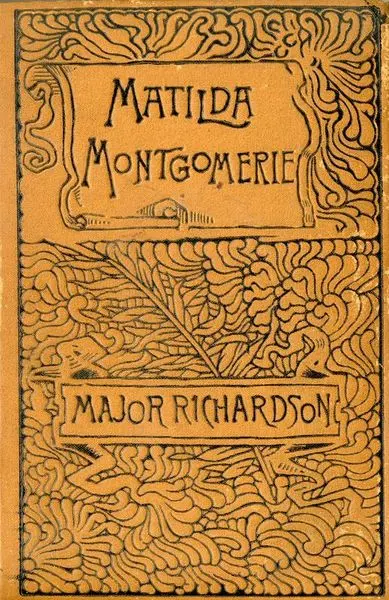
Matilda Montgomerie; Or, The Prophecy Fulfilled
Major (John) Richardson
THE CLASSIC COLLECTION · 1832
"Wacousta : a tale of the Pontiac conspiracy — Volume 1" by Major Richardson is a historical novel first published in 1832. Set during Pontiac's rebellion, this early Canadian work depicts British settlers besieged within a fort, caught between wilderness and civilization. The story explores prophecy, cross-cultural conflict, and dramatic contrasts between savagery and society. Its vivid portrayal of frontier tension helped establish a distinctly Canadian literary voice and inspired critical theories about the colonial imagination.
Introduction adapted from the source catalogue; source summaries may be automatically generated.
Free to read · English · 51,935 words · No account needed
MAKE TIME FOR A GOOD BOOK
On by default. Untick to stop anonymous reading totals. Each page counts after 10 seconds in view. How this works.
Anonymous counting is on unless you have switched it off.
At that moment Halloway, who had been gazing on the scene with an astonishment little inferior to that of his comrades, sprang suddenly to his feet upon the coffin, and waving his hand in the direction of the pursuing enemy, shouted aloud in a voice of mingled joy and triumph,--
"Ha! Almighty God, I thank thee! Here, here comes one who alone has the power to snatch me from my impending doom."
"By Heaven, the traitor confesses, and presumes to triumph in his guilt," exclaimed the voice of one, who, while closely attending to every movement of the Indians, was also vigilantly watching the effect likely to be produced on the prisoner by this unexpected interruption. "Corporal, do your duty."
"Stay, stay--one moment stay!" implored Halloway with uplifted hands.
"Do your duty, sir," fiercely repeated the governor.
"Oh stop--for God's sake, stop! Another moment and he will be here, and
I--"
He said no more--a dozen bullets penetrated his body--one passed directly through his heart. He leaped several feet in the air, and then fell heavily, a lifeless bleeding corpse, across the coffin.
Meanwhile the pursuit of the fugitive was continued, but by the warrior of the Fleur de lis alone. Aware of their inefficiency to keep pace with this singular being, his companions had relinquished the chace, and now stood resting on the brow of the hill where the wretched Halloway had first recognised his supposed deliverer, watching eagerly, though within musket shot of the detachment, the result of a race on which so much apparently depended. Neither party, however, attempted to interfere with the other, for all eyes were now turned on the flying man and his pursuer with an interest that denoted the extraordinary efforts of the one to evade and the other to attain the accomplishment of his object. Although the exertions of the former had been stupendous, such was the eagerness and determination of the latter, that at each step he gained perceptibly on his victim. The immediate course taken was in a direct line for the ravine, which it evidently was the object of the fugitive to clear at its nearest point. Already had he approached within a few paces of its brink, and every eye was fastened on the point where it was expected the doubtful leap would be taken, when suddenly, as if despairing to accomplish it at a bound, he turned to the left, and winding along its bank, renewed his efforts in the direction of the bridge. This movement occasioned a change in the position of the parties which was favourable to the pursued. Hitherto they had been so immediately on a line with each other, it was impossible for the detachment to bring a musket to bear upon the warrior, without endangering him whose life they were anxious to preserve. For a moment or two his body was fairly exposed, and a dozen muskets were discharged at intervals from the square, but all without success. Recovering his lost ground, he soon brought the pursued again in a line between himself and the detachment, edging rapidly nearer to him as he advanced, and uttering terrific yells, that were echoed back from his companions on the brow of the hill. It was evident, however, his object was the recapture, not the destruction, of the flying man, for more than once did he brandish his menacing tomahawk in rapid sweeps around his head, as if preparing to dart it, and as often did he check the movement. The scene at each succeeding moment became more critical and intensely interesting. The strength of the pursued was now nearly exhausted, while that of his formidable enemy seemed to suffer no diminution. Leap after leap he took with fearful superiority, sideling as he advanced. Already had he closed upon his victim, while with a springing effort a large and bony hand was extended to secure his shoulder in his grasp. The effort was fatal to him; for in reaching too far he lost his balance, and fell heavily upon the sward. A shout of exultation burst from the English troops, and numerous voices now encouraged the pursued to renew his exertions. The advice was not lost; and although only a few seconds had elapsed between the fall and recovery of his pursuer, the wretched fugitive had already greatly increased the distance that separated them. A cry of savage rage and disappointment burst from the lips of the gigantic warrior; and concentrating all his remaining strength and speed into one final effort, he bounded and leapt like a deer of the forest whence he came. The opportunity for recapture, however, had been lost in his fall, for already the pursued was within a few feet of the high road, and on the point of turning the extremity of the bridge. One only resource was now left: the warrior suddenly checked himself in his course, and remained stationary; then raising and dropping his glittering weapon several times in a balancing position, he waited until the pursued had gained the highest point of the open bridge. At that moment the glittering steel, aimed with singular accuracy and precision, ran whistling through the air, and with such velocity of movement as to be almost invisible to the eyes of those who attempted to follow it in its threatening course. All expected to see it enter into the brain against which it had been directed; but the fugitive had marked the movement in time to save himself by stooping low to the earth, while the weapon, passing over him, entered with a deadly and crashing sound into the brain of the weltering corpse. This danger passed, he sprang once more to his feet, nor paused again in his flight, until, faint and exhausted, he sank without motion under the very bayonets of the firing party.
Your reading position is saved on this browser. Take it to another device with a library code. Reading pages adapt to text, rather than matching a printed edition.
Major (John) Richardson
Major (John) Richardson
Major (John) Richardson
Major (John) Richardson
BEHIND THE BOOK
This eBook is for the use of anyone anywhere in the United States and most other parts of the world at no cost and with almost no restrictions whatsoever. You may copy it, give it away or re-use it under the terms of the Project Gutenberg License included with this eBook or online at www.gutenberg.org. If you are not located in the United States, you will have to check the laws of the country where you are located before using this eBook. Read the source licence.
The original source file, including credits and licence, is retained by this library. Request an original-format copy at no charge. Please include the book title and Project Gutenberg identifier #4719.
KEEP YOUR CURIOSITY GOING
Cécile Tormay

Moritz Busch
Coulson Kernahan
John L. Ransom

Maurice Baring
Frances Wright