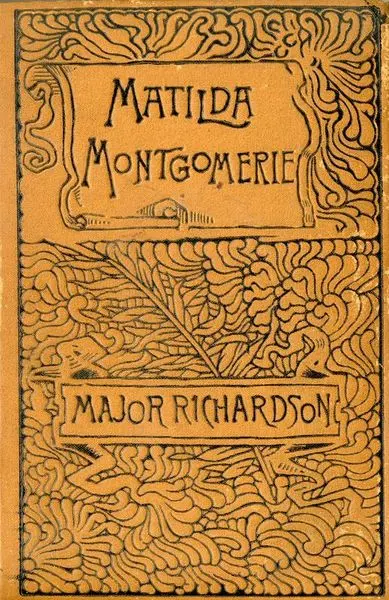
Matilda Montgomerie; Or, The Prophecy Fulfilled
Major (John) Richardson
THE CLASSIC COLLECTION · 1832
"Wacousta : a tale of the Pontiac conspiracy (Complete)" by Major Richardson is a historical novel first published in 1832. Set during Pontiac's rebellion, this early work of Canadian fiction depicts British settlers besieged inside a fort, confronting both external dangers and internal tensions. The novel explores themes of prophecy, civilization versus wilderness, and cross-cultural conflict. Richardson's Gothic tale competed with James Fenimore Cooper's frontier novels while offering a distinctly different perspective on colonial life and survival.
Introduction adapted from the source catalogue; source summaries may be automatically generated.
Free to read · English · 177,162 words · No account needed
MAKE TIME FOR A GOOD BOOK
On by default. Untick to stop anonymous reading totals. Each page counts after 10 seconds in view. How this works.
Anonymous counting is on unless you have switched it off.
Clara de Haldimar was the constant theme of her younger brother's praise. Her image was ever uppermost in his thoughts--her name ever hovering on his lips; and when alone with his friend Valletort, it was his delight to dwell on the worth and accomplishments of his amiable and beloved sister. Then, indeed, would his usually calm blue eye sparkle with the animation of his subject, while his colouring cheek marked all the warmth and sincerity with which he bore attestation to her gentleness and her goodness. The heart of Charles de Haldimar, soldier as he was, was pure, generous, and unsophisticated as that of the sister whom he so constantly eulogized; and, while listening to his eloquent praises, Sir Everard learnt to feel an interest in a being whom all had declared to be the counterpart of her brother, as well in personal attraction as in singleness of nature. With all his affected levity, and notwithstanding his early initiation into fashionable life--that matter-of-fact life which strikes at the existence of our earlier and dearer illusions--there was a dash of romance in the character of the young baronet which tended much to increase the pleasure he always took in the warm descriptions of his friend. The very circumstance of her being personally unknown to him, was, with Sir Everard, an additional motive for interest in Miss de Haldimar.
Imagination and mystery generally work their way together; and as there was a shade of mystery attached to Sir Everard's very ignorance of the person of one whom he admired and esteemed from report alone, imagination was not slow to improve the opportunity, and to endow the object with characteristics, which perhaps a more intimate knowledge of the party might have led him to qualify. In this manner, in early youth, are the silken and willing fetters of the generous and the enthusiastic forged. We invest some object, whose praises, whispered secretly in the ear, have glided imperceptibly to the heart, with all the attributes supplied by our own vivid and readily according imaginations; and so accustomed do we become to linger on the picture, we adore the semblance with an ardour which the original often fails to excite. When, however, the high standard of our fancy's fair creation is attained, we worship as something sacred that which was to our hearts a source of pure and absorbing interest, hallowed by the very secrecy in which such interest was indulged. Even where it fails, so unwilling are we to lose sight of the illusion to which our thoughts have fondly clung, so loth to destroy the identity of the semblance with its original, that we throw a veil over that reason which is then so little in unison with our wishes, and forgive much in consideration of the very mystery which first gave a direction to our interest, and subsequently chained our preference. How is it to be lamented, that illusions so dear, and images so fanciful, should find their level with time; or that intercourse with the world, which should be the means rather of promoting than marring human happiness, should leave on the heart so little vestige of those impressions which characterize the fervency of youth; and which, dispassionately considered, constitute the only true felicity of riper life! It is then that man, in all the vigour and capacity of his intellectual nature, feels the sentiment of love upon him in all its ennobling force. It is then that his impetuous feelings, untinged by the romance which imposes its check upon the more youthful, like the wild flow of the mighty torrent, seeks a channel wherein they may empty themselves; and were he to follow the guidance of those feelings, of which in that riper life he seems ashamed as of a weakness unworthy his sex, in the warm and glowing bosom of Nature's divinity--WOMAN--would he pour forth the swollen tide of his affection; and acknowledge, in the fullness of his expanding heart, the vast bounty of Providence, who had bestowed on him so invaluable--so unspeakably invaluable, a blessing.--But no; in the pursuit of ambition, in the acquisition of wealth, in the thirst after power, and the craving after distinction, nay, nineteen times out of twenty, in the most frivolous occupations, the most unsatisfactory amusements, do the great mass of the maturer man sink those feelings; divested of which, we become mere plodders on the earth, mere creatures of materialism: nor is it until after age and infirmity have overtaken them, they look back with regret to that real and substantial, but unenjoyed happiness, which the occupied heart and the soul's communion alone can bestow. Then indeed, when too late, are they ready to acknowledge the futility of those pursuits, the inadequacy of those mere ephemeral pleasures, to which in the full meridian of their manhood they sacrificed, as a thing unworthy of their dignity, the mysterious charm of woman's influence and woman's beauty.
Your reading position is saved on this browser. Take it to another device with a library code. Reading pages adapt to text, rather than matching a printed edition.
Major (John) Richardson
Major (John) Richardson
Major (John) Richardson
Major (John) Richardson
BEHIND THE BOOK
This eBook is for the use of anyone anywhere in the United States and most other parts of the world at no cost and with almost no restrictions whatsoever. You may copy it, give it away or re-use it under the terms of the Project Gutenberg License included with this eBook or online at www.gutenberg.org. If you are not located in the United States, you will have to check the laws of the country where you are located before using this eBook. Read the source licence.
The original source file, including credits and licence, is retained by this library. Request an original-format copy at no charge. Please include the book title and Project Gutenberg identifier #4912.
KEEP YOUR CURIOSITY GOING
Cécile Tormay

Moritz Busch
Coulson Kernahan
John L. Ransom

Maurice Baring
Frances Wright