THE CLASSIC COLLECTION✦The Open Question: A Tale of Two TemperamentsCLASSIC FREE BOOKS
The Open Question: A Tale of Two Temperaments
Elizabeth Robins
THE CLASSIC COLLECTION · 1923
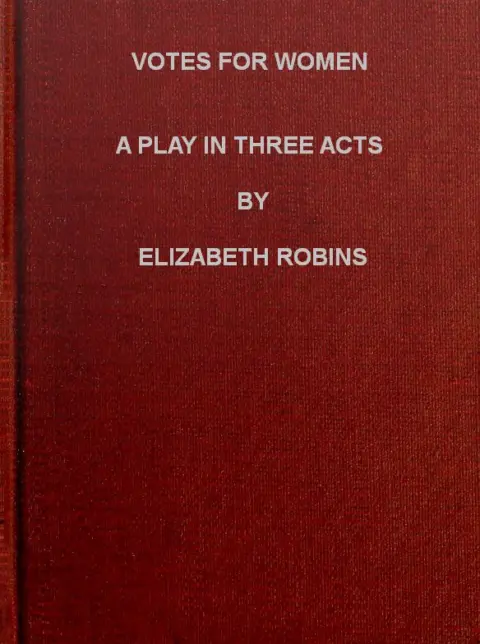
"Votes for Women: A Play in Three Acts" by Elizabeth Robins is a dramatic work written in the early 20th century. The play addresses the pivotal social issue of women's suffrage in Britain, depicting the struggles and conversations surrounding the fight for women's voting rights. The ensemble cast includes characters such as Lady John Wynnstay, her niece Jean Dunbarton, and the outspoken suffragette, Miss Ernestine Blunt, reflecting the varied opinions and tensions present in society regarding women's roles. The opening of "Votes for Women" sets the stage at Wynnstay House in Hertfordshire, introducing the key characters engaged in discussions about women's rights and the upcoming engagement of Jean Dunbarton to Geoffrey Stonor, a political figure. Lady John Wynnstay is portrayed as a matriarch keen on maintaining societal norms, while her niece, Jean, exhibits youthful enthusiasm and curiosity regarding political matters. The characters navigate personal dynamics intertwined with broader societal debates, revealing contrasting views on the suffrage movement, with mentions of planned philanthropic endeavors to support homeless women. The conflict in the dialogue hints at varying degrees of support and opposition to the cause, effectively establishing the setting for the exploration of these critical issues throughout the play.
Introduction adapted from the source catalogue; source summaries may be automatically generated.
Free to read · English · 27,601 words · No account needed
MAKE TIME FOR A GOOD BOOK
On by default. Untick to stop anonymous reading totals. Each page counts after 10 seconds in view. How this works.
Anonymous counting is on unless you have switched it off.
FARN. (pointing).--"tremendous effect of last night's Liberal manifesto ought to be counteracted in to-morrow's papers." (Very earnestly.) You see, Mr. Stonor, it's a battle-cry we want.
STONOR (turns on his heel). Claptrap!
FARN. (a little dashed). Well, they've been saying we have nothing to offer but personal popularity. No practical reform. No----
STONOR. No truckling to the masses, I suppose. (Walks impatiently
away.)
FARN. (snubbed). Well, in these democratic days---- (Turns to JEAN for countenance.) I hope you'll forgive my bursting in like this. (Struck by her face.) But I can see you realise the gravity---- (Lowering his voice with an air of speaking for her ear alone.) It isn't as if he were going to be a mere private member. Everybody knows he'll be in the Cabinet.
STONOR (drily). It may be a Liberal Cabinet.
FARN. Nobody thought so up to last night. Why, even your brother--but I am afraid I'm seeming officious. (Takes up his hat.)
STONOR (coldly). What about my brother?
FARN. I met Lord Windlesham as I rushed out of the Carlton.
STONOR. Did he say anything?
FARN. I told him the Dutfield news.
STONOR (impatiently). Well?
FARN. He said it only confirmed his fears.
STONOR (half under his breath). Said that, did he?
FARN. Yes. Defeat is inevitable, he thinks, unless---- (Pause.)
(GEOFFREY STONOR, who has been pacing the floor, stops but doesn't
raise his eyes.)
unless you can "manufacture some political dynamite within the next few hours." Those were his words.
STONOR (resumes his walking to and fro, raises his head and catches sight of JEAN'S white, drawn face. Stops short). You are very tired.
JEAN. No. No.
STONOR (to FARNBOROUGH). I'm obliged to you for taking so much trouble. (Shakes hands by way of dismissing Farnborough.) I'll see what can be done.
FARN. (offering the reply-paid form). If you'd like to wire I'll take
it.
STONOR (faintly amused). You don't understand, my young friend. Moves of this kind are not rushed at by responsible politicians. I must have time for consideration.
FARN. (disappointed). Oh, well, I only hope someone else won't jump into the breach before you--(Watch in hand) I tell you. (To JEAN.) I'll find out what time the newspapers go to press on Sunday. Goodbye. (To STONOR.) I'll be at the Club just in case I can be of any use.
STONOR (firmly). No, don't do that. If I should have anything new to
say----
FARN. (feverishly). B-b-but with our party, as your brother said--"heading straight for a vast electoral disaster----"
STONOR. If I decide on a counterblast I shall simply telegraph to
headquarters. Goodbye.
FARN. Oh--a--g-goodbye. (A gesture of "The country's going to the
dogs.")
Your reading position is saved on this browser. Take it to another device with a library code. Reading pages adapt to text, rather than matching a printed edition.
Elizabeth Robins
Elizabeth Robins
Elizabeth Robins
Elizabeth Robins
BEHIND THE BOOK
This eBook is for the use of anyone anywhere in the United States and most other parts of the world at no cost and with almost no restrictions whatsoever. You may copy it, give it away or re-use it under the terms of the Project Gutenberg License included with this eBook or online at www.gutenberg.org. If you are not located in the United States, you will have to check the laws of the country where you are located before using this eBook. Read the source licence.
The original source file, including credits and licence, is retained by this library. Request an original-format copy at no charge. Please include the book title and Project Gutenberg identifier #43502.
KEEP YOUR CURIOSITY GOING
Maurice Baring
W. B. (William Butler) Yeats
Edward Martyn

John Brougham & Charlotte Brontë
Marguerite Merington
Leonid Andreyev