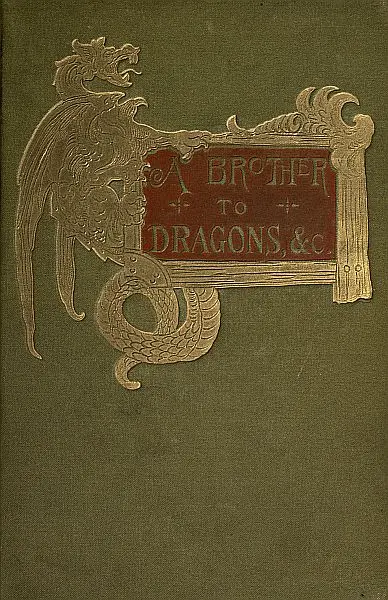
A brother to dragons, and other old-time tales
Amélie Rives
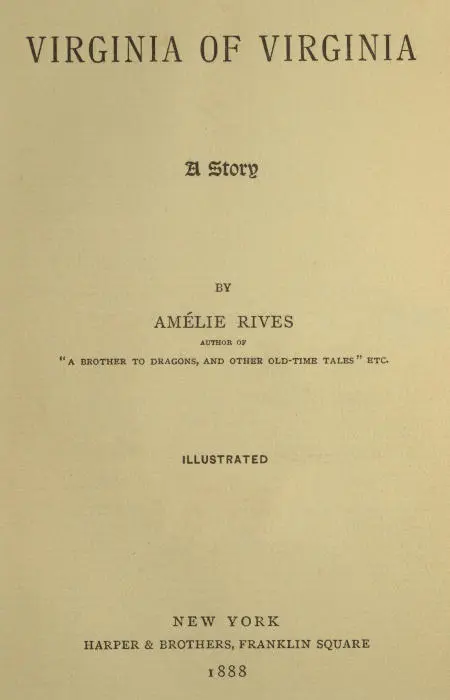
THE CLASSIC COLLECTION · 1888
"Virginia of Virginia: A Story" by Amélie Rives is a novel written in the late 19th century. The story is set in Virginia and centers around the protagonist, a young Englishman named Roden, who arrives in the state with ambitions of becoming a horse farmer. As he navigates his new surroundings, he encounters Virginia Herrick, the overseer's daughter, whose unique blend of charm, strength, and a carefree spirit captivates him, leading to potential romantic undertones. The opening of the story introduces Roden as he arrives in Virginia, where he has just purchased a farm called Caryston Hall. He meets Virginia while seeking directions, and the two engage in witty conversation that exposes their contrasting backgrounds—his as an English gentleman and hers as a native Virginian. Virginia’s vibrant personality shines through her casual ease with the local wildlife and her ability to swiftly transition from serious to playful. Their interactions reveal both humor and depth, setting the stage for a developing relationship as Roden settles into his new life on the farm amidst the Southern wilderness and its traditions.
Introduction adapted from the source catalogue; source summaries may be automatically generated.
Free to read · English · 34,623 words · No account needed
MAKE TIME FOR A GOOD BOOK
On by default. Untick to stop anonymous reading totals. Each page counts after 10 seconds in view. How this works.
Anonymous counting is on unless you have switched it off.
All these pets, he discovered later, had been presented from time to time by the “last Englishman,” or “the Englishman before the last,” or “the Englishman before the one with the glass eye,” or the fat wife, or the ugly sister, or what not.
“If I can only add a gorilla or a condor to this unique collection,” reflected Roden, “my position is assured. I will probably be forever the ‘last Englishman,’ and I will always be mentioned as ‘the Englishman who gave me the gorilla.’”
He then sat down in a corner as far removed as was consistent with politeness from the other inhabitants of the apartment, and occupied himself with watching “Faginia,” her “mammy,” and the “things.”
“Aunt Tishy,” said Miss Herrick, indicating him with a movement of her bright head, as he sat withdrawn into his coign of vantage, like a hermit-crab within its shell, “that’s the new Englishman, Mr. Roden.”
“How yo’ do, sur? Hope yo’ coporosity segastuate fus rate, sur,” quoth the dusky dame, with an elephantine dab, supposed in the innocence of her Virginian heart to correspond to the courtesy of civilization.
“My what?” said Roden.
“She means she hopes you are well,” explained Virginia, about whose neck the raccoon was coiling himself with serpentine affection.
“Oh yes, thanks, very well. Are you?” said Roden.
“Gord! yes, sur; Tishy she al’uz well--ain’ she, honey?” This last
appeal to Virginia.
“Oh yes,” said that young woman “’cep’ when you get th’ misery, or th’ year-ache in th’ middle o’ th’ coldest nights, an’ have me huntin’ all over creation for somethin’ to put in your year. Oh yes!”
“G’way, chile!” exclaimed the thus maligned personage, with an air of indignant sufferance. “If I didn’ know yer wuz jess projeckin’, I sutny would feel bade.”
“Oh no, you wouldn’t,” said her mistress, easily. “This one,” again indicating Roden, “’s goin’ in fur horse-racin’. Some of his horses’s comin’ day after to-morrer. That’s better’n Herefordshire cattle, ain’t it?”
“Co’se you think so,” said Aunt Tishy, with something between a sniff and a grunt, as she settled herself in the chimney-corner with a basket of darning, and fell to work, stretching the stockings to be mended over a little gourd.
“Why, Aunt Tishy?” said Roden, beginning to feel as though he were a character in a book, and might spoil the plot by saying the wrong thing.
The old negress looked up at him over her big gold-rimmed spectacles, with her great underlip pushed out, showing its pale yellowish lining.
Your reading position is saved on this browser. Take it to another device with a library code. Reading pages adapt to text, rather than matching a printed edition.
BEHIND THE BOOK
This eBook is for the use of anyone anywhere in the United States and most other parts of the world at no cost and with almost no restrictions whatsoever. You may copy it, give it away or re-use it under the terms of the Project Gutenberg License included with this eBook or online at www.gutenberg.org. If you are not located in the United States, you will have to check the laws of the country where you are located before using this eBook. Read the source licence.
The original source file, including credits and licence, is retained by this library. Request an original-format copy at no charge. Please include the book title and Project Gutenberg identifier #53838.
KEEP YOUR CURIOSITY GOING
Coulson Kernahan

Maurice Baring
Frances Wright
Cécile Tormay

Frederic Jesup Stimson

W. H. P. (William Henry Pope) Jarvis