Playwrights on playmaking
Brander Matthews
THE CLASSIC COLLECTION · 1894
"Vignettes of Manhattan; Outlines in Local Color" by Brander Matthews is a collection of urban sketches and character portraits written in the late 19th century. This work aims to capture the essence and diverse life of New York City through a series of vignettes that reflect various aspects of its society and environment, showcasing the interactions of different types of people in the metropolis. Each vignette serves as a snapshot, introducing readers to the unique characters and happenings that define the city's lifestyle during that era. At the start of the book, Matthews sets the tone with a reflective letter addressed to Theodore Roosevelt, explaining his affection for New York. He presents the city not just as a backdrop but as a character in its own right, filled with life and variation. The opening portion includes a poignant depiction of a funeral in a small church, highlighting the lives of actors and sympathetic characters who gather for a young man's burial. This setting serves as a stage for exploring themes of ambition, loss, and the fleeting nature of life, inviting readers to delve deeper into the multifaceted world of Manhattan as portrayed throughout the collection.
Introduction adapted from the source catalogue; source summaries may be automatically generated.
Free to read · English · 89,595 words · No account needed
MAKE TIME FOR A GOOD BOOK
On by default. Untick to stop anonymous reading totals. Each page counts after 10 seconds in view. How this works.
Anonymous counting is on unless you have switched it off.
On the top floor, under the steps which led to the roof, was a den scarce six feet by eight. Small as it was, this room had better furniture than most of those De Ruyter had seen; it contained evidences of a desire to make a home. There were violent chromos pinned to the wall. The bed had a parti-colored coverlet. The sole inhabitant was a tall, dark Italian with fiery eyes. He was cooking macaroni with ropy cheese over an oil-lamp. His door was ajar only.
"Good-morning, Pietro," said Suydam, cheerfully.
Pietro obeyed his first impulse, and shut the door swiftly. Then he changed his mind, for he opened the door and peered out suspiciously. Recognizing Suydam, he was about to throw it wide, when he caught sight of De Ruyter. There was a moment of hesitancy, and then he took his hand from the knob of the door and went on with his cooking.
"I am showing my friend over the building," explained Suydam.
The Italian said nothing. Apparently his cooking absorbed all his attention. But he gave De Ruyter a searching glance.
Suydam turned to the novelist. "This is Pietro Barretti," he said; "he is one of the most expert layers of mosaic in America. He is from Naples; that's the reason he cooks macaroni so well, I suppose."
"Certainly I haven't seen macaroni cooked that way since I was in Naples last," the novelist remarked, for the sake of talk, not knowing just what to make of the Italian's manner.
"Your wife not here?" asked Suydam.
"No," the Italian answered, abruptly.
"Where is she?" persisted the young man.
"She mort," responded Barretti.
"Dead?" Suydam cried. "That is very sad. When did she die?"
"Ten days," the Italian replied.
When Suydam and De Ruyter had made an end of their visit, and were going down the stairs cautiously, the young man from the University Settlement asked the novelist if he had seen anything interesting.
"Oh yes," was the answer. "I've got lots of color; just what I wanted. And that Italian whose wife was mort--he's copy, I'm sure."
"Copy?" queried Suydam.
"I mean I can use him in one of my sketches for the Metropolis," the novelist explained. "I wish I knew what his wife was like."
"She was a pretty girl--dark-haired, dark-eyed, with a lively smile," Suydam said. "He was very jealous of her. I've been told they used to quarrel bitterly."
"I shouldn't like to have that fellow for an enemy," De Ruyter declared, as they passed through the alleyway and came out in the open air. "He has an eye like a glass stiletto."
Your reading position is saved on this browser. Take it to another device with a library code. Reading pages adapt to text, rather than matching a printed edition.
Brander Matthews
Brander Matthews
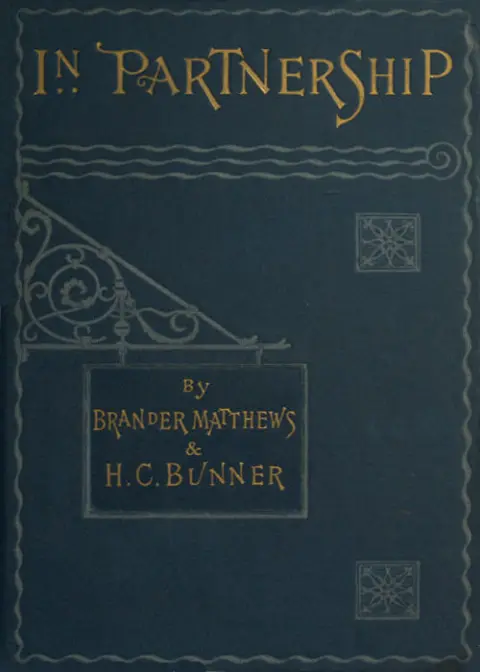
Brander Matthews & H. C. (Henry Cuyler) Bunner

Brander Matthews
BEHIND THE BOOK
This eBook is for the use of anyone anywhere in the United States and most other parts of the world at no cost and with almost no restrictions whatsoever. You may copy it, give it away or re-use it under the terms of the Project Gutenberg License included with this eBook or online at www.gutenberg.org. If you are not located in the United States, you will have to check the laws of the country where you are located before using this eBook. Read the source licence.
The original source file, including credits and licence, is retained by this library. Request an original-format copy at no charge. Please include the book title and Project Gutenberg identifier #38918.
KEEP YOUR CURIOSITY GOING
Coulson Kernahan

Maurice Baring
Frances Wright
Cécile Tormay

Frederic Jesup Stimson

W. H. P. (William Henry Pope) Jarvis