Playwrights on playmaking
Brander Matthews
THE CLASSIC COLLECTION · 1894
"Vignettes of Manhattan; Outlines in Local Color" by Brander Matthews is a collection of urban sketches and character portraits written in the late 19th century. This work aims to capture the essence and diverse life of New York City through a series of vignettes that reflect various aspects of its society and environment, showcasing the interactions of different types of people in the metropolis. Each vignette serves as a snapshot, introducing readers to the unique characters and happenings that define the city's lifestyle during that era. At the start of the book, Matthews sets the tone with a reflective letter addressed to Theodore Roosevelt, explaining his affection for New York. He presents the city not just as a backdrop but as a character in its own right, filled with life and variation. The opening portion includes a poignant depiction of a funeral in a small church, highlighting the lives of actors and sympathetic characters who gather for a young man's burial. This setting serves as a stage for exploring themes of ambition, loss, and the fleeting nature of life, inviting readers to delve deeper into the multifaceted world of Manhattan as portrayed throughout the collection.
Introduction adapted from the source catalogue; source summaries may be automatically generated.
Free to read · English · 89,595 words · No account needed
MAKE TIME FOR A GOOD BOOK
On by default. Untick to stop anonymous reading totals. Each page counts after 10 seconds in view. How this works.
Anonymous counting is on unless you have switched it off.
"That won't take me long," he returned. "Very little has happened to me. I was going to Germany--perhaps you remember--that fall, after you left us. Well, I went, and I stayed two years, and I took my Ph.D. there, and I came back to the old college, and they gave me a professorship--and that's all."
"That's enough, I think," she answered, looking at him frankly with her dark eyes. "You have your work to do, and you do it. I don't believe there is anything better in life than to be sure what you ought to work at and to be able to work at it."
"I suppose you are right," Morton acknowledged. "I find hard labor is often the best fun, after all. But I can get solid enjoyment out of loafing, too. I don't recall that we worked very steadily that month that you were with us, and we certainly had a very good time. At least I did!"
"And so did I," she declared, unbending a little, and with a laugh of pleasant recollection. "I enjoyed every minute of my visit. I wish I could have such good times now!"
"Don't you?" he asked.
"Not often," she answered. "Perhaps never."
"You surprise me," he replied. "I supposed you were being entertained by day and by night, week in and week out, from one year's end to another."
"So we are," she explained. "But being entertained isn't always being
interested, is it?"
"That's the theory, isn't it?" he rejoined.
"It may be the theory," she confessed, "but I'm sure it isn't the
practice."
"I know that little college town of ours is remote from the path of progress," he went on, "but sometimes we behold those messengers of civilization, the New York Sunday newspapers. And whenever I do get one I am certain to see that you have been to a dinner-dance here, to a bal poudre there. I should judge that you lived in an endless merry-go-round of gayety."
She smiled again, and there was no sadness in her smile, only a vague, detached weariness. "Dinner-dances are the fashion just now," she said; "and if there is anything more absurd than the fashion it's to waste one's strength struggling against it."
"That is very end-of-the-century philosophy," he commented.
"It's philosophical not to want to be left out of things, isn't it?" she inquired. "Even if one doesn't care to go, one doesn't like not to be asked, and so one goes often when one would rather stay at home."
"I should think that if many people had motives like that, your parties here in New York might be rather dull," he retorted, with a little laugh.
Your reading position is saved on this browser. Take it to another device with a library code. Reading pages adapt to text, rather than matching a printed edition.
Brander Matthews
Brander Matthews
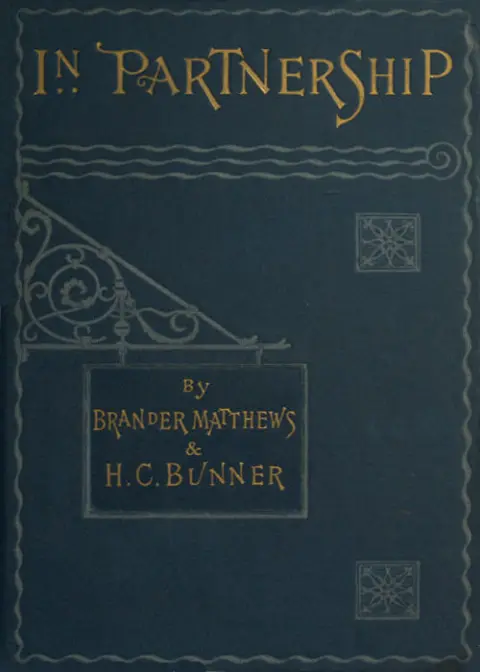
Brander Matthews & H. C. (Henry Cuyler) Bunner

Brander Matthews
BEHIND THE BOOK
This eBook is for the use of anyone anywhere in the United States and most other parts of the world at no cost and with almost no restrictions whatsoever. You may copy it, give it away or re-use it under the terms of the Project Gutenberg License included with this eBook or online at www.gutenberg.org. If you are not located in the United States, you will have to check the laws of the country where you are located before using this eBook. Read the source licence.
The original source file, including credits and licence, is retained by this library. Request an original-format copy at no charge. Please include the book title and Project Gutenberg identifier #38918.
KEEP YOUR CURIOSITY GOING
Coulson Kernahan

Maurice Baring
Frances Wright
Cécile Tormay

Frederic Jesup Stimson

W. H. P. (William Henry Pope) Jarvis