THE CLASSIC COLLECTION✦An outlaw’s diary: the CommuneCLASSIC FREE BOOKS
An outlaw’s diary: the Commune
Cécile Tormay
THE CLASSIC COLLECTION · 1890
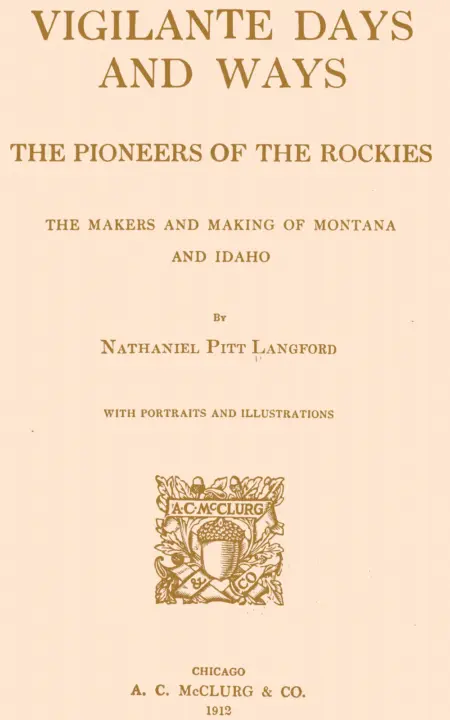
"Vigilante Days and Ways" by Nathaniel Pitt Langford is a historical account written in the late 19th century that explores lawlessness and the rise of vigilante justice during the early settlement of Montana and Idaho. The narrative delves into the tumultuous lives in mining camps fraught with crime, as individuals band together to establish order in a society plagued by violence and corruption. The opening chapters introduce key characters such as the notorious gambler Henry Plummer, leading the criminal underworld, and Patrick Ford, a figure who advocates for law and order amidst the chaos. At the start of the narrative, Langford provides a vivid picture of the mining town of Lewiston, highlighting its rapid growth and the moral degradation that followed the gold rush. The community is depicted as being in constant threat from bandits, with Plummer forming a gang that ravages the area. As crime escalates, the citizens, desperate for safety, consider taking justice into their own hands, culminating in the formation of a Vigilance Committee after a series of violent robberies. This establishes the groundwork for a dramatic conflict between the lawless elements and those striving for justice, setting the stage for the tensions and moral ambiguities that will unfold throughout the rest of the book.
Introduction adapted from the source catalogue; source summaries may be automatically generated.
Free to read · English · 164,131 words · No account needed
MAKE TIME FOR A GOOD BOOK
On by default. Untick to stop anonymous reading totals. Each page counts after 10 seconds in view. How this works.
Anonymous counting is on unless you have switched it off.
In the Spring of 1868, Beidler, on his return to Helena from the Whoop-up mines, spent a few days en route at Benton. The steamboats from St. Louis were daily arriving with freights, which from this point were conveyed by teams to all the towns and mining camps in the Territory. Hynson, hired as a teamster to Scott Bullard, a heavy Helena freighter, was on his way to Benton. Learning that Beidler was there, he frequently in conversation avowed the intention of shooting him on sight. As the train approached Benton, Bullard rode into town in advance of it, and apprised Beidler of his danger.
The day after the arrival of the train, Hynson and Beidler approached each other in the street. The former extended his hand in a friendly manner, which Beidler seized with his left hand, keeping his right in reserve for the use of his pistol.
“I am told,” said Beidler, “that you have come here to kill me.”
“I kill you!” said Hynson, in well-affected surprise.
“Yes, you,” said Beidler, dropping the hand he held, “and if you wish to try it, you’ll never have a better chance. If that’s what you want, you can’t pull your pistol too quick.”
Hynson glared at the little, athletic man who confronted him so boldly, and saw in those burning eyes and that steady muscle not the smallest trace of fear.
Seizing Beidler again by the hand, he said in hurried tones,
“X., I did make a fool of myself when drunk in camp with the boys, in some remarks relating to you, but I didn’t mean it. I don’t want to hurt you, and never did. Now, let’s be friends.”
Beidler, who had no other feeling than contempt for the bragging
poltroon, listened in silence.
“I want you,” said Hynson, “to aid me in getting the position of night-watchman in this city.”
X. replied to this request in general terms, and, turning on his heel, left Hynson, who afterwards, by some means which X. could not fathom, received the appointment he desired.
Before leaving Benton, X. received a letter from Silver Bow requesting him to watch for and arrest a person who had stolen a lot of nuggets and jewelry, and gone from that place to Benton. Called suddenly away by more important business, X. instructed Hynson with this service, who caught the thief and recovered the property, which he appropriated to his own use, pawning the jewelry for a sum of money, which was soon squandered. When X. returned, Hynson, with much difficulty, redeemed most of the jewelry, which Beidler returned to the owner.
Your reading position is saved on this browser. Take it to another device with a library code. Reading pages adapt to text, rather than matching a printed edition.
BEHIND THE BOOK
This eBook is for the use of anyone anywhere in the United States and most other parts of the world at no cost and with almost no restrictions whatsoever. You may copy it, give it away or re-use it under the terms of the Project Gutenberg License included with this eBook or online at www.gutenberg.org. If you are not located in the United States, you will have to check the laws of the country where you are located before using this eBook. Read the source licence.
The original source file, including credits and licence, is retained by this library. Request an original-format copy at no charge. Please include the book title and Project Gutenberg identifier #64135.
KEEP YOUR CURIOSITY GOING
Cécile Tormay

Moritz Busch
John L. Ransom
Frances Wright
Cécile Tormay

Mabel Potter Daggett