THE CLASSIC COLLECTION✦An outlaw’s diary: the CommuneCLASSIC FREE BOOKS
An outlaw’s diary: the Commune
Cécile Tormay
THE CLASSIC COLLECTION · 1890
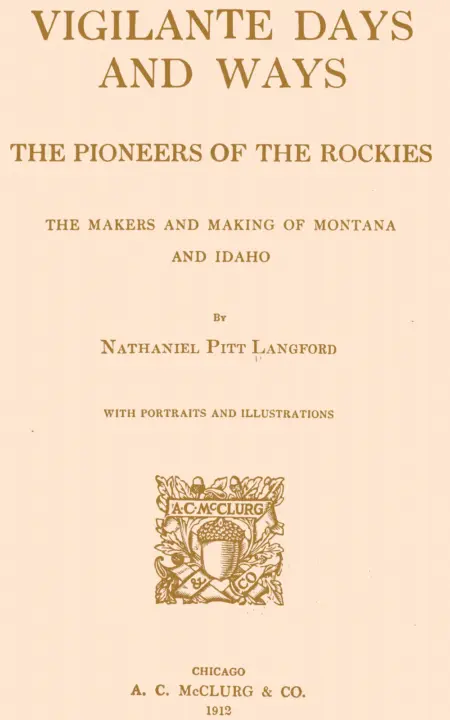
"Vigilante Days and Ways" by Nathaniel Pitt Langford is a historical account written in the late 19th century that explores lawlessness and the rise of vigilante justice during the early settlement of Montana and Idaho. The narrative delves into the tumultuous lives in mining camps fraught with crime, as individuals band together to establish order in a society plagued by violence and corruption. The opening chapters introduce key characters such as the notorious gambler Henry Plummer, leading the criminal underworld, and Patrick Ford, a figure who advocates for law and order amidst the chaos. At the start of the narrative, Langford provides a vivid picture of the mining town of Lewiston, highlighting its rapid growth and the moral degradation that followed the gold rush. The community is depicted as being in constant threat from bandits, with Plummer forming a gang that ravages the area. As crime escalates, the citizens, desperate for safety, consider taking justice into their own hands, culminating in the formation of a Vigilance Committee after a series of violent robberies. This establishes the groundwork for a dramatic conflict between the lawless elements and those striving for justice, setting the stage for the tensions and moral ambiguities that will unfold throughout the rest of the book.
Introduction adapted from the source catalogue; source summaries may be automatically generated.
Free to read · English · 164,131 words · No account needed
MAKE TIME FOR A GOOD BOOK
On by default. Untick to stop anonymous reading totals. Each page counts after 10 seconds in view. How this works.
Anonymous counting is on unless you have switched it off.
“No, this is all I want”; then, fixing his gaze upon Conley, whose face was red and swollen with anger, he seized the “case keeper” used for marking the game, and hurled it violently at his head. Conley dodged, and the only effect of the act was a deep indentation in the adobe wall. Conley sprung from his seat and ran out of the building. Peel drew his revolver with the intention of pursuing, but Robinson, seizing his arm, said,
“Stay your hand, Peel. For God’s sake, don’t make any disturbance.”
Peel sheathed his pistol at the moment, and, taking Robinson by the hand, replied, “No; you must excuse me. I beg a thousand pardons, but I was very angry. You’re the only friend I have in this country. Conley has treated me like a dog. All of ’em have. I have fed them for weeks in my own house, when they had nothing to eat. My wife has cooked, and washed and ironed their clothes for them, and this is the return I get for it.”
He then started to leave, but, as if suddenly reminded that he had neglected to say something, he returned; and while the tears, which he vainly tried to suppress, were streaming down his cheeks, he said,
“I’ll certainly repay this money. I would rather die than wrong you out
of it.”
He had been gone about twenty minutes when shots were heard.
“I reckon,” said Robinson, starting for the door, “that Peel has killed
Conley.”
All followed, but they found that the exchange of shots was between Peel and Rucker, the latter the proprietor of a faro bank on Commercial Street, where Peel had gone and staked his money on the turn of a card.
Rucker, perceiving it, pushed the money away, remarking, in a
contemptuous tone,
“I don’t want your game.”
Smarting under the insult conveyed in these words, Peel raised a chair to hit Rucker on the head. Rucker fled through the rear door of the building, and entered Miller’s store adjoining, the back stairs of which he hurriedly ascended, drawing his revolver by the way. Peel soon after went into the store by the front door, and inquired for Miller, who was absent. Sauntering to the rear of the apartment, which was but dimly lighted, he came suddenly upon Rucker, who had just descended the stairs, and, with revolver in hand, was waiting his approach.
“What do you want of me?” inquired Rucker, thrusting his pistol against
Peel’s side.
Your reading position is saved on this browser. Take it to another device with a library code. Reading pages adapt to text, rather than matching a printed edition.
BEHIND THE BOOK
This eBook is for the use of anyone anywhere in the United States and most other parts of the world at no cost and with almost no restrictions whatsoever. You may copy it, give it away or re-use it under the terms of the Project Gutenberg License included with this eBook or online at www.gutenberg.org. If you are not located in the United States, you will have to check the laws of the country where you are located before using this eBook. Read the source licence.
The original source file, including credits and licence, is retained by this library. Request an original-format copy at no charge. Please include the book title and Project Gutenberg identifier #64135.
KEEP YOUR CURIOSITY GOING
Cécile Tormay

Moritz Busch
John L. Ransom
Frances Wright
Cécile Tormay

Mabel Potter Daggett