THE CLASSIC COLLECTION✦An outlaw’s diary: the CommuneCLASSIC FREE BOOKS
An outlaw’s diary: the Commune
Cécile Tormay
THE CLASSIC COLLECTION · 1890
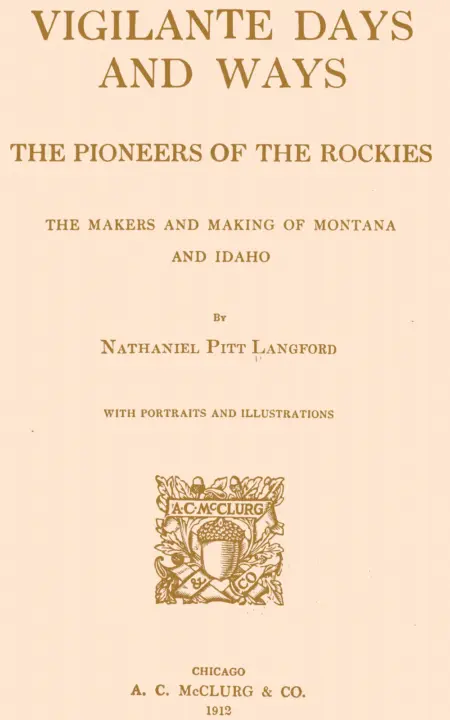
"Vigilante Days and Ways" by Nathaniel Pitt Langford is a historical account written in the late 19th century that explores lawlessness and the rise of vigilante justice during the early settlement of Montana and Idaho. The narrative delves into the tumultuous lives in mining camps fraught with crime, as individuals band together to establish order in a society plagued by violence and corruption. The opening chapters introduce key characters such as the notorious gambler Henry Plummer, leading the criminal underworld, and Patrick Ford, a figure who advocates for law and order amidst the chaos. At the start of the narrative, Langford provides a vivid picture of the mining town of Lewiston, highlighting its rapid growth and the moral degradation that followed the gold rush. The community is depicted as being in constant threat from bandits, with Plummer forming a gang that ravages the area. As crime escalates, the citizens, desperate for safety, consider taking justice into their own hands, culminating in the formation of a Vigilance Committee after a series of violent robberies. This establishes the groundwork for a dramatic conflict between the lawless elements and those striving for justice, setting the stage for the tensions and moral ambiguities that will unfold throughout the rest of the book.
Introduction adapted from the source catalogue; source summaries may be automatically generated.
Free to read · English · 164,131 words · No account needed
MAKE TIME FOR A GOOD BOOK
On by default. Untick to stop anonymous reading totals. Each page counts after 10 seconds in view. How this works.
Anonymous counting is on unless you have switched it off.
“Language was inadequate to express my gratitude, or the admiration with which I regarded this noble act of humanity. I begged and insisted that my benefactress should remain, at least long enough for rest, but she refused. I then told her my own history, prepared a hasty meal, and asked her to favor me with a song. In the sweetest voice I think I ever heard, she sung the Hunters’ Chorus in ‘Der Freyschutz’; then, springing to the saddle, she waved me a farewell, and in a few moments disappeared. So sudden had been her appearance and disappearance, so startling the warning she gave me, so wonderful her long and dreary ride, that it all seemed like a dream. I had never made a habit of prayer, but, influenced by the emotion of the moment, I dropped on my knees, and thanked God, in a fervent prayer, for this special manifestation of His Providence.
“The next day I made every needful preparation for defence, and calmly awaited the arrival of the ruffians. In the afternoon of the day my informant mentioned I saw them approaching, one, whom I recognized as Helm, half a mile or more in advance of the other two. I stood in the gate of my stockade, with my revolver in my belt, and as he approached me greeted him kindly, bade him enter, and closed and bolted the door behind him. As this had always been my custom, he did not notice it. I saw at once, by his subdued, churlish manner, and his crabbed style of address, that he was bent upon mischief. Hardly waiting for an exchange of common civilities, he said,
“‘Lend me your pistols. I am going on a perilous expedition.’
“‘I cannot spare them,’ I replied.
“‘But you must spare them. I want them.’
“‘I tell you, I cannot let you have them.’
“Flying into a passion, he with bitter oaths rejoined,
“‘I’ll make you give ’em to me, or I’ll kill you,’ at the same time grasping his revolver.
“Before he could pull it from its scabbard, I had mine levelled with deadly aim at his head, and my finger on the trigger.
“‘Make a single motion,’ said I emphatically, ‘and I will shoot
you.’
“He quailed, for he saw I had the advantage of him. His comrades now approached the gate from without.
“‘Break down the door,’ he shouted, and, adding an opprobrious epithet, ordered them to kill me.
“Still holding my pistol level with his temple, I replied sternly,
“‘If they attempt such a movement, I will kill you instantly.’
Your reading position is saved on this browser. Take it to another device with a library code. Reading pages adapt to text, rather than matching a printed edition.
BEHIND THE BOOK
This eBook is for the use of anyone anywhere in the United States and most other parts of the world at no cost and with almost no restrictions whatsoever. You may copy it, give it away or re-use it under the terms of the Project Gutenberg License included with this eBook or online at www.gutenberg.org. If you are not located in the United States, you will have to check the laws of the country where you are located before using this eBook. Read the source licence.
The original source file, including credits and licence, is retained by this library. Request an original-format copy at no charge. Please include the book title and Project Gutenberg identifier #64135.
KEEP YOUR CURIOSITY GOING
Cécile Tormay

Moritz Busch
John L. Ransom
Frances Wright
Cécile Tormay

Mabel Potter Daggett