THE CLASSIC COLLECTION✦An outlaw’s diary: the CommuneCLASSIC FREE BOOKS
An outlaw’s diary: the Commune
Cécile Tormay
THE CLASSIC COLLECTION · 1890
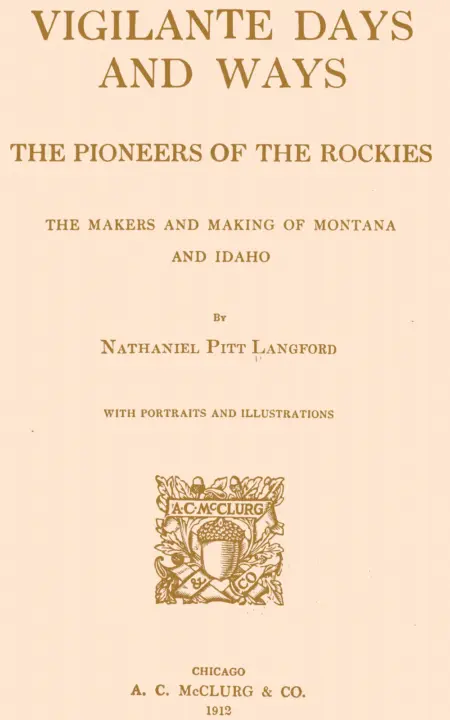
"Vigilante Days and Ways" by Nathaniel Pitt Langford is a historical account written in the late 19th century that explores lawlessness and the rise of vigilante justice during the early settlement of Montana and Idaho. The narrative delves into the tumultuous lives in mining camps fraught with crime, as individuals band together to establish order in a society plagued by violence and corruption. The opening chapters introduce key characters such as the notorious gambler Henry Plummer, leading the criminal underworld, and Patrick Ford, a figure who advocates for law and order amidst the chaos. At the start of the narrative, Langford provides a vivid picture of the mining town of Lewiston, highlighting its rapid growth and the moral degradation that followed the gold rush. The community is depicted as being in constant threat from bandits, with Plummer forming a gang that ravages the area. As crime escalates, the citizens, desperate for safety, consider taking justice into their own hands, culminating in the formation of a Vigilance Committee after a series of violent robberies. This establishes the groundwork for a dramatic conflict between the lawless elements and those striving for justice, setting the stage for the tensions and moral ambiguities that will unfold throughout the rest of the book.
Introduction adapted from the source catalogue; source summaries may be automatically generated.
Free to read · English · 164,131 words · No account needed
MAKE TIME FOR A GOOD BOOK
On by default. Untick to stop anonymous reading totals. Each page counts after 10 seconds in view. How this works.
Anonymous counting is on unless you have switched it off.
Less for any more important purpose than that of testing the utter depravity of the wretch, the interrogator handed him a Bible. With the utmost solemnity of manner and expression, he repeated the denial, invoking the most terrible penalties upon his soul, in attestation of its truthfulness, and kissed the volume impressively at its close.
The Committee regarded this sacrilegious act of the crime-hardened reprobate with mingled feelings of horror and disgust.
“This denial,” said the president, “can avail you nothing. Your life for many years has been a continuous career of crime. It is necessary that you should die. You had better improve the little time left you in preparation.”
Helm looked hopelessly around, but saw no glance of sympathy in the stern features of his judges. Beckoning to a person standing near, he whispered,
“Can I see you alone for a few minutes?”
The man, supposing that he was desirous of obtaining spiritual counsel,
replied,
“I will send for a clergyman.”
“No,” was the instant rejoinder. “I want no clergyman. You’ll do as
well.”
Stepping into the inner room, Helm closed the door, and, turning to the man, in an anxious tone asked,
“Is there no way of getting out of this scrape?”
“None. No power here is available to save you. You must die.”
“Well, then,” said he, “I’ll admit to you that I did kill a man by the name of Shoot, in Missouri. When I left there I went to California, and killed another chap there. I was confined in jail in Oregon, and dug my way out with tools given me by my squaw.”
“Now,” said his confessor, “having told me thus much, will you not give me what information you can concerning the band to which you belong, their names, crimes, and purposes?”
“Ask Jack Gallagher. He knows more than I do.”
Gallagher, who had been brought into an adjoining apartment, separated from the one in which this conversation occurred by a thin board partition, on hearing this reference to himself, poured forth a torrent of profane abuse upon the head of his guilty confederate.
“It is just such cowardly rascals and traitors as you,” said he, “that have brought us into this difficulty. You ought to die for your treachery.”
“I have dared death in all its forms,” said Helm, “and I do not fear to die. Give me some whiskey.”
The guilty wretch, having been consigned to the custody of keepers, steeped what little sensibility he possessed in whiskey, and passed the time until the execution in ribald jesting and profanity.
Your reading position is saved on this browser. Take it to another device with a library code. Reading pages adapt to text, rather than matching a printed edition.
BEHIND THE BOOK
This eBook is for the use of anyone anywhere in the United States and most other parts of the world at no cost and with almost no restrictions whatsoever. You may copy it, give it away or re-use it under the terms of the Project Gutenberg License included with this eBook or online at www.gutenberg.org. If you are not located in the United States, you will have to check the laws of the country where you are located before using this eBook. Read the source licence.
The original source file, including credits and licence, is retained by this library. Request an original-format copy at no charge. Please include the book title and Project Gutenberg identifier #64135.
KEEP YOUR CURIOSITY GOING
Cécile Tormay

Moritz Busch
John L. Ransom
Frances Wright
Cécile Tormay

Mabel Potter Daggett