THE CLASSIC COLLECTION✦An outlaw’s diary: the CommuneCLASSIC FREE BOOKS
An outlaw’s diary: the Commune
Cécile Tormay
THE CLASSIC COLLECTION · 1890
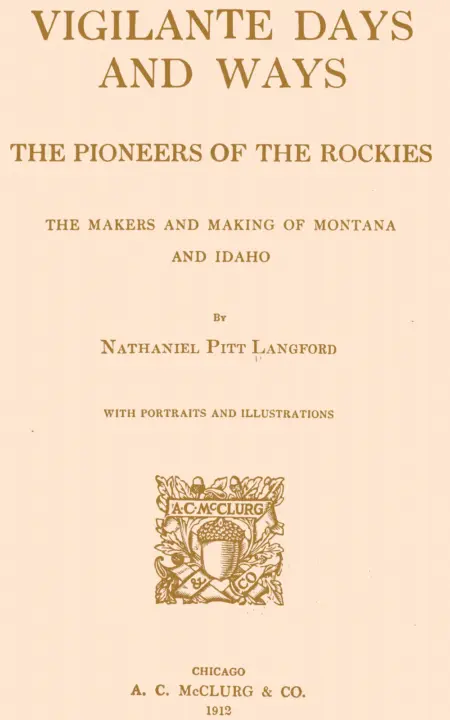
"Vigilante Days and Ways" by Nathaniel Pitt Langford is a historical account written in the late 19th century that explores lawlessness and the rise of vigilante justice during the early settlement of Montana and Idaho. The narrative delves into the tumultuous lives in mining camps fraught with crime, as individuals band together to establish order in a society plagued by violence and corruption. The opening chapters introduce key characters such as the notorious gambler Henry Plummer, leading the criminal underworld, and Patrick Ford, a figure who advocates for law and order amidst the chaos. At the start of the narrative, Langford provides a vivid picture of the mining town of Lewiston, highlighting its rapid growth and the moral degradation that followed the gold rush. The community is depicted as being in constant threat from bandits, with Plummer forming a gang that ravages the area. As crime escalates, the citizens, desperate for safety, consider taking justice into their own hands, culminating in the formation of a Vigilance Committee after a series of violent robberies. This establishes the groundwork for a dramatic conflict between the lawless elements and those striving for justice, setting the stage for the tensions and moral ambiguities that will unfold throughout the rest of the book.
Introduction adapted from the source catalogue; source summaries may be automatically generated.
Free to read · English · 164,131 words · No account needed
MAKE TIME FOR A GOOD BOOK
On by default. Untick to stop anonymous reading totals. Each page counts after 10 seconds in view. How this works.
Anonymous counting is on unless you have switched it off.
To all these, and many more petitions in the same vein, the only answer was an assurance that his pleadings were all in vain, and that he must die. Meantime, Stinson and Ray discharged volley after volley of oaths and epithets at the Vigilantes, employing all the offensive language of their copious vocabulary. At length the ropes were declared to be in readiness, and the stern command was given, “Bring up Ned Ray.”
Struggling wildly in the hands of his executioners, the wretched man was strung up, the rope itself arresting his curse before it was half uttered. Being loosely pinioned, he thrust his fingers under the noose, and, by a sudden twist of his head, the knot slipped under his chin.
“There goes poor Ned Ray,” whined Stinson, who a moment later was dangling in the death-agony by his side. As Stinson was being hoisted, he exclaimed, “I’ll confess.”
Plummer immediately remarked, “We’ve done enough already, twice over, to
send us to hell.”
Plummer’s time had come. “Bring him up,” was the stern order. No one stirred. Stinson and Ray were common villains; but Plummer, steeped as he was in infamy, was a man of intellect, polished, genial, affable. There was something terrible in the idea of hanging such a man. Plummer himself had ceased all importunity. The crisis of self-abasement had passed, hope fled with it, and he was now composedly awaiting his fate. As one of the Vigilantes approached him, he met with the request,
“Give a man time to pray.”
“Certainly,” replied the Vigilante, “but say your prayers up there,” at the same time pointing to the cross-beam of the gallows-frame.
The guilty man uttered no more prayers. Standing, erect under the gallows, he took off his necktie, and, throwing it over his shoulder to a young man who had boarded with him, he said,
“Keep that to remember me by,” and, turning to the Vigilantes, he said, “Now, men, as a last favor, let me beg that you will give me a good drop.”
The fatal noose being adjusted, several of the strongest of the Vigilantes lifted the frame of the unhappy criminal as high as they could reach, when, letting it suddenly fall, he died quickly, without a struggle.
The weather was intensely cold. A large number of persons had followed the cavalcade, but were stopped by a guard some distance from the gallows. The Vigilantes surrounded the bodies until satisfied that the hangman’s noose had completed their work, when they formed and marched back to the town. The bodies were afterwards buried by the friends of the criminals.
Your reading position is saved on this browser. Take it to another device with a library code. Reading pages adapt to text, rather than matching a printed edition.
BEHIND THE BOOK
This eBook is for the use of anyone anywhere in the United States and most other parts of the world at no cost and with almost no restrictions whatsoever. You may copy it, give it away or re-use it under the terms of the Project Gutenberg License included with this eBook or online at www.gutenberg.org. If you are not located in the United States, you will have to check the laws of the country where you are located before using this eBook. Read the source licence.
The original source file, including credits and licence, is retained by this library. Request an original-format copy at no charge. Please include the book title and Project Gutenberg identifier #64135.
KEEP YOUR CURIOSITY GOING
Cécile Tormay

Moritz Busch
John L. Ransom
Frances Wright
Cécile Tormay

Mabel Potter Daggett