THE CLASSIC COLLECTION✦An outlaw’s diary: the CommuneCLASSIC FREE BOOKS
An outlaw’s diary: the Commune
Cécile Tormay
THE CLASSIC COLLECTION · 1890
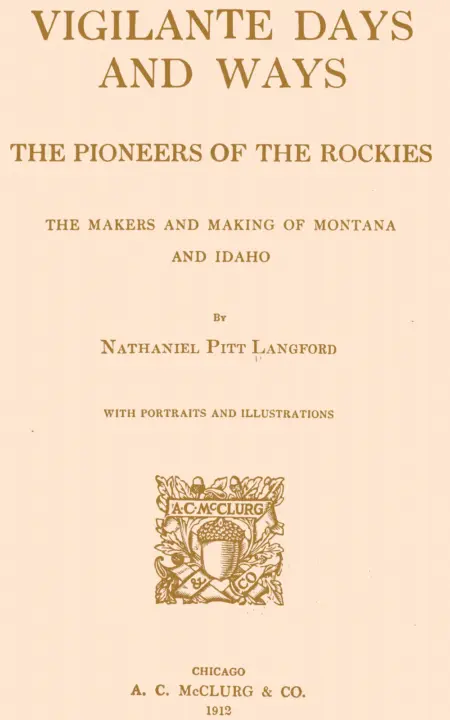
"Vigilante Days and Ways" by Nathaniel Pitt Langford is a historical account written in the late 19th century that explores lawlessness and the rise of vigilante justice during the early settlement of Montana and Idaho. The narrative delves into the tumultuous lives in mining camps fraught with crime, as individuals band together to establish order in a society plagued by violence and corruption. The opening chapters introduce key characters such as the notorious gambler Henry Plummer, leading the criminal underworld, and Patrick Ford, a figure who advocates for law and order amidst the chaos. At the start of the narrative, Langford provides a vivid picture of the mining town of Lewiston, highlighting its rapid growth and the moral degradation that followed the gold rush. The community is depicted as being in constant threat from bandits, with Plummer forming a gang that ravages the area. As crime escalates, the citizens, desperate for safety, consider taking justice into their own hands, culminating in the formation of a Vigilance Committee after a series of violent robberies. This establishes the groundwork for a dramatic conflict between the lawless elements and those striving for justice, setting the stage for the tensions and moral ambiguities that will unfold throughout the rest of the book.
Introduction adapted from the source catalogue; source summaries may be automatically generated.
Free to read · English · 164,131 words · No account needed
MAKE TIME FOR A GOOD BOOK
On by default. Untick to stop anonymous reading totals. Each page counts after 10 seconds in view. How this works.
Anonymous counting is on unless you have switched it off.
The argument followed, and the judge, soon comprehending the meaning of a nonsuit, decided that unless the defendant could show that he had suffered by reason of the informal service, the case must proceed. Some of the friends of the magistrate, seated near the door, understanding the cause of his embarrassment, enjoyed the scene hugely, and as it presented an opportunity for returning in kind some of the numerous jokes which he had played at their expense, one of them, thinking it too good to be lost, with much mock sobriety of manner and tone, arose and said,
“Most righteous decision!”
All eyes were turned upon the speaker, but before they could comprehend the joke at the bottom, another arose, and with equal solemnity, exclaimed,
“Most just judge!”
Dr. Steele, though embarrassed by this ill-timed jocularity, was so well satisfied with his sagacity in finding out what a nonsuit meant, without betraying his legal unlearnedness, that the joke was taken in good part, and formed a subject of frequent merriment in after times.
Charley Forbes was the clerk of the court, and sat beside the judge taking notes of the trial. After the decision denying the motion, the plaintiff passed around a bottle of liquor, of which the court and jury partook. Not to be outdone, the defendant circulated a box of cigars. And it was while the spectators were giving expression in various forms to their approval of the decision, that Stinson and Lyons came into the court, and, proceeding to the seat occupied by Forbes, engaged with him in a whispered conversation inaudible to the by-standers. After a few moments, Forbes suddenly rose in his place, and, with an oath, exclaimed,
“Well, we’ll kill the scoundrel then, at once,” and accompanied Stinson and Lyons out of the wakiup. The audience, startled by the announcement, hurriedly followed. Dillingham had come over from Bannack in his capacity as deputy sheriff, to look for some stolen horses. He had come on the ground a moment before, in search of Mr. Todd, the deputy at Virginia City, for assistance.
An assemblage of a hundred or more miners and others was congregated in and about the place where the court was in progress,—some intent upon the trial, others sauntering through the crowd and along the bank of Alder Creek. The three ruffians, after a moment’s conversation, approached in company the spot where Dillingham stood.
“We want to see you,” said Lyons, addressing him. “Step this way a
moment.”
Stinson advanced a few paces, and looking over his shoulder said to his
companions,
“Bring him along. Make him come.”
Your reading position is saved on this browser. Take it to another device with a library code. Reading pages adapt to text, rather than matching a printed edition.
BEHIND THE BOOK
This eBook is for the use of anyone anywhere in the United States and most other parts of the world at no cost and with almost no restrictions whatsoever. You may copy it, give it away or re-use it under the terms of the Project Gutenberg License included with this eBook or online at www.gutenberg.org. If you are not located in the United States, you will have to check the laws of the country where you are located before using this eBook. Read the source licence.
The original source file, including credits and licence, is retained by this library. Request an original-format copy at no charge. Please include the book title and Project Gutenberg identifier #64135.
KEEP YOUR CURIOSITY GOING
Cécile Tormay

Moritz Busch
John L. Ransom
Frances Wright
Cécile Tormay

Mabel Potter Daggett