
Last letters from the living dead man
David Patterson (Spirit) Hatch
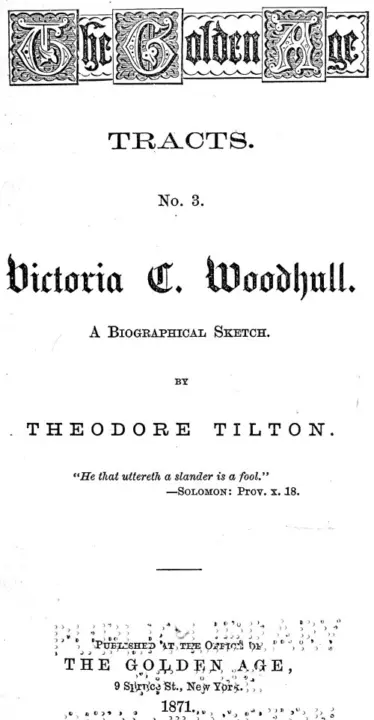
THE CLASSIC COLLECTION · 1871
"Victoria C. Woodhull: A Biographical Sketch" by Theodore Tilton is a biography written in the early 1870s, providing a detailed account of the remarkable life of Victoria Woodhull. This work explores Woodhull's extraordinary contributions as a social reformer, spiritualist, and an advocate for women's rights, particularly her candidacy for the presidency in a time when such aspirations were unprecedented for women. The book captures her journey from a difficult childhood to becoming a prominent public figure, highlighting the societal challenges she faced as a woman and her relentless pursuit of equality. The biography chronicles Woodhull's tumultuous early life marked by poverty and abuse, illustrating her resilience in overcoming numerous adversities. Tilton describes her spiritual beliefs and practices, asserting that her guidance from spirits played a significant role in her self-discovery and activism. Throughout the narrative, he details her notable achievements, including her establishment of a brokerage firm and her audacious nomination for president, emphasizing her commitment to women's suffrage and social reform. Overall, this biographical sketch paints a vivid picture of a woman far ahead of her time, who not only defied societal norms but also left an indelible mark on the fight for women's rights in America.
Introduction adapted from the source catalogue; source summaries may be automatically generated.
Free to read · English · 11,623 words · No account needed
MAKE TIME FOR A GOOD BOOK
On by default. Untick to stop anonymous reading totals. Each page counts after 10 seconds in view. How this works.
Anonymous counting is on unless you have switched it off.
In 1870, following the English plan of self-nomination, Mrs. Woodhull announced herself as a candidate for the Presidency—mainly for the purpose of drawing public attention to the claims of woman to political equality with man. She accompanied this announcement with a series of papers in the Herald on politics and finance, which have since been collected into a volume entitled "The Principles of Government." She has lately received a more formal nomination to that high office by "The Victoria League," an organization which, being somewhat Jacobinical in its secrecy, is popularly supposed, though not definitely known, to be presided over by Commodore Vanderbilt, who is also similarly imagined to be the golden corner-stone of the business house of Woodhull, Claflin & Co. Should she be elected to the high seat to which she aspires, (an event concerning which I make no prophecy,) I am at least sure that she would excel any Queen now on any throne in her native faculty to govern others.
One night in December, 1869, while she lay in deep sleep, her Greek guardian came to her, and sitting transfigured by her couch, wrote on a scroll (so that she could not only see the words, but immediately dictated them to her watchful amanuensis) the memorable document now known in history as "The Memorial of Victoria C. Woodhull"—a petition addressed to Congress, claiming under the Fourteenth Amendment the right of women as of other "citizens of the United States" to vote in "the States wherein they reside"—asking, moreover, that the State of New York, of which she was a citizen, should be restrained by Federal authority from preventing her exercise of this constitutional right. As up to this time neither she nor her husband had been greatly interested in woman suffrage, he had no sooner written this manifesto from her lips, than he awoke her from the trance, and protested against the communication as nonsense, believing it to be a trick of some evil-disposed spirits. In the morning the document was shown to a number of friends, including one eminent judge, who ridiculed its logic and conclusions. But the lady herself, from whose sleeping and yet unsleeping brain the strange document had sprung like Minerva from the head of Jove, simply answered that her antique instructor, having never misled her before, was guiding her aright then. Nothing doubting, but much wondering, she took the novel demand to Washington, where, after a few days of laughter from the shallow-minded, and of neglect from the indifferent, it suddenly burst upon the Federal Capitol like a storm, and then spanned it like a rainbow. She went before the Judiciary Committee, and delivered an argument in support of her claim to the franchise under the new Amendments, which some who heard it pronounced one of the ablest efforts which they had ever heard on any subject. She caught the listening ears of Senator Carpenter, Gen. Butler, Judge Woodward, George W. Julian, Gen. Ashley, Judge Loughridge, and other able statesmen in Congress, and harnessed these gentlemen as steeds to her chariot. Such was the force of her appeal that the whole city rushed together to hear it, like the Athenians to the market-place when Demosthenes stood in his own and not a borrowed clay. A great audience, one of the finest ever gathered in the capital, assembled to hear her defend her thesis in the first public speech of her life. At the moment of rising, her face was observed to be very pale, and she appeared about to faint. On being afterward questioned as to the cause of her emotion, she replied that, during the first prolonged moment, she remembered an early prediction of her guardian-spirit, until then forgotten, that she would one day speak in public, and that her first discourse would be pronounced in the capital of her country. The sudden fulfilment of this prophecy smote her so violently that for a moment she was stunned into apparent unconsciousness. But she recovered herself, and passed through the ordeal with great success—which is better luck than happened to the real Demosthenes, for Plutarch mentions that his maiden speech was a failure, and that he was laughed at by the people.
Your reading position is saved on this browser. Take it to another device with a library code. Reading pages adapt to text, rather than matching a printed edition.
BEHIND THE BOOK
This eBook is for the use of anyone anywhere in the United States and most other parts of the world at no cost and with almost no restrictions whatsoever. You may copy it, give it away or re-use it under the terms of the Project Gutenberg License included with this eBook or online at www.gutenberg.org. If you are not located in the United States, you will have to check the laws of the country where you are located before using this eBook. Read the source licence.
The original source file, including credits and licence, is retained by this library. Request an original-format copy at no charge. Please include the book title and Project Gutenberg identifier #51861.
KEEP YOUR CURIOSITY GOING
David Patterson (Spirit) Hatch

David Patterson (Spirit) Hatch

David Patterson (Spirit) Hatch
Cécile Tormay

Moritz Busch
John L. Ransom