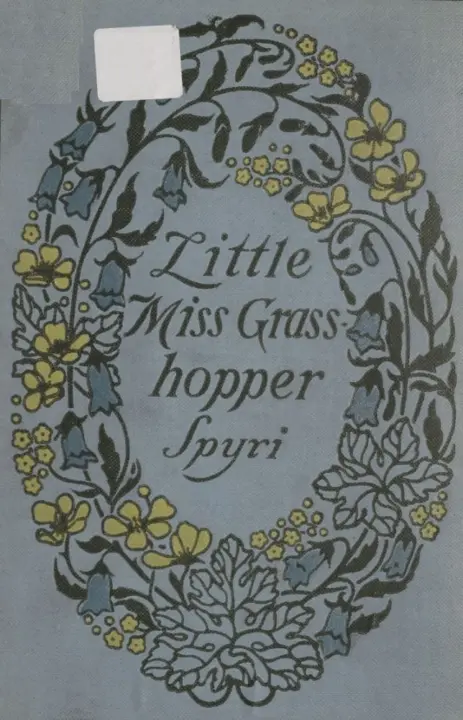
Little Miss Grasshopper
Johanna Spyri
THE CLASSIC COLLECTION · 1886
"Veronica" by Johanna Spyri is a children's novel written in the late 19th century. It tells the story of two children, Veronica and Dietrich, navigating their lives in a mountain village, facing various trials and challenges, particularly revolving around family issues and personal growth. Central themes likely include the importance of work, family bonds, and the journey towards understanding one’s own fortune and happiness. The opening of "Veronica" introduces us to a somber atmosphere in the village of Tannenegg, where a young woman has just died, and her children, a girl named Veronica and her cousin Dietrich, are left waiting for their mother. The children are portrayed in contrasting manners; Veronica, with a serious demeanor, is seeking something to play with, while Dietrich is energetic and eager. The chapter shifts focus to their mother, who is distressed over her ill husband. This sets the stage for themes of loss and familial responsibility, as Gertrude, their mother, navigates grief while trying to keep her family together. The narrative also hints at the children's futures and the challenges they will face, establishing a foundation for their character development and the adventures to come.
Introduction adapted from the source catalogue; source summaries may be automatically generated.
Free to read · English · 31,773 words · No account needed
MAKE TIME FOR A GOOD BOOK
On by default. Untick to stop anonymous reading totals. Each page counts after 10 seconds in view. How this works.
Anonymous counting is on unless you have switched it off.
Judith had been busy at her washing full two hours longer, when in the doorway of the sexton's house appeared a young fellow, whose figure, almost as broad as it was long, filled the opening, with scarce anything to spare. He tried to yawn, but there was not room enough to stretch his arms, so he stepped outside for the purpose, and there he gaped so heartily that all the inside of his big mouth and throat was distinctly visible.
"There's nothing in it, Blasi! I've had a good look at it," cried Judith. "If you had been here two hours ago, you might have seen a sight. A girl with a whole mouthful of gold! What do you say to that?"
Blasi caught at this, and brought his jaws together with a snap.
"What! full of gold?" he exclaimed, and opened his sleepy eyes to their utmost extent. "Why doesn't the foolish thing carry it in her pocket? Where does she come from?"
"That's no concern of yours. You will never come up with her," replied
Judith.
"Tell me, for all that," urged Blasi, coming toward Judith, "I can go after her, and I've no doubt I shall come up with her, and then there's no telling what may happen. Come, where did she go, now? Do you know her name?"
"Her name is Early Morn, Blasi," said Judith pleasantly. "Did you never hear the saying, 'There's gold in the mouth of the early morn.'"
Blasi made a wry face and began in an angry tone,
"There's nothing very clever in that"--but just then he remembered that when he came out of the house he had intended to come over and say something quite different to Judith; so he changed his tone quickly, and said,
"Can you lend me a franc or two; I have just time to do a little business before eleven o'clock, and then I must be back to ring the noon bell; I must try to help father, a little."
"No, no, Blasi, I have no francs for you," said Judith decidedly. "It wants three hours yet of being eleven o'clock. Use those big arms of yours, and they'll bring you francs enough." And so saying, she lifted her clothes-basket on her head, and walked away.
Blasi stood looking after her, a moment, then he sauntered off, with both hands in his pockets, up the road towards, the shoemaker's old house. There sat Jost before the door, hammering away at something as if for dear life. Blasi drew near, and stood watching the busy hands of his friend, who presently cried out angrily,
Your reading position is saved on this browser. Take it to another device with a library code. Reading pages adapt to text, rather than matching a printed edition.
Johanna Spyri
BEHIND THE BOOK
This eBook is for the use of anyone anywhere in the United States and most other parts of the world at no cost and with almost no restrictions whatsoever. You may copy it, give it away or re-use it under the terms of the Project Gutenberg License included with this eBook or online at www.gutenberg.org. If you are not located in the United States, you will have to check the laws of the country where you are located before using this eBook. Read the source licence.
The original source file, including credits and licence, is retained by this library. Request an original-format copy at no charge. Please include the book title and Project Gutenberg identifier #14627.
KEEP YOUR CURIOSITY GOING
Coulson Kernahan

Maurice Baring
Frances Wright
Cécile Tormay

Frederic Jesup Stimson

W. H. P. (William Henry Pope) Jarvis