Advice to Singers
Frederick James Crowest
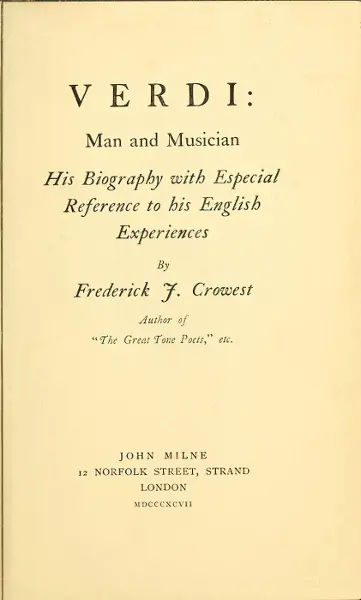
THE CLASSIC COLLECTION · 1897
"Verdi: Man and Musician" by Frederick James Crowest is a biographical account written in the late 19th century. The book examines the life and career of the illustrious Italian composer Giuseppe Verdi, with a particular focus on his experiences in England and his significant impact on the world of music. It portrays Verdi not just as a prolific composer, but also as a person shaped by his early life and the circumstances surrounding his works. The opening of the book introduces readers to Verdi's origins, detailing his birth in Roncole, Italy, and the humble beginnings of his family, who ran an inn. Crowest provides insight into Verdi's childhood, highlighting crucial moments that sparked his interest in music, such as his enchantment with street organ players and the music at church. It emphasizes that Verdi was not a prodigy but rather a quietly thoughtful child who developed his musical talents through a natural, passionate dedication rather than through forced instruction. This early foundation in a music-poor environment raises questions about how someone from such modest beginnings could eventually transform into one of the greatest composers in opera history.
Introduction adapted from the source catalogue; source summaries may be automatically generated.
Free to read · English · 61,517 words · No account needed
MAKE TIME FOR A GOOD BOOK
On by default. Untick to stop anonymous reading totals. Each page counts after 10 seconds in view. How this works.
Anonymous counting is on unless you have switched it off.
That empress of song, Madame Patti, created the principal character in Aïda when it was first given in this country on the 23rd June 1876. The other principal singers were Mdlle. Ernestina Gindale (Amnéris), Signori Nicolini (Radamès), Graziani (Amonasro), Capponi (Ramfis), and M. Feitlinger (King of Egypt). As every frequenter of the opera who can recall that eventful night will remember, it was a brilliant night. The Royal box was fully tenanted, including the Prince and Princess of Wales, with the Princes Albert Ernest and George Frederick. The cantatrice thrilled the audience by the purity and tenderness of her singing, notably in her delivery of Aïda's agonised soliloquy in the third act. In no previous part had she shown greater powers, and the assumption of the part placed her in the front rank of lyric tragédiennes. On all sides it was admitted that Verdi had achieved a great and unexampled success. The main topic was the new order of Verdi's music in Aïda, of which more in another chapter.
In 1876 something much like a change of front takes place on the part of the Athenæum. It no longer gives Verdi his congé, but blames the English directors for allowing four years to elapse before producing Aïda:--"The reputation of Signor Verdi ought to have induced the directors to bring out, as promptly as possible, any new opera by him."[61] Referring to Aïda the notice runs:--"The consecration scene, in which Radamès is invested with the command of the Egyptian army, is highly dramatic; still finer is the finale of the second act. Here are found the most telling points, for the composer revels in the expression of extreme emotion; he has varied and conflicting passions to set; there is the glorification of the return of a victorious general with his army; there is the lament of the Ethiopian prisoners; there is the exultation of Amnéris at her father, the King, having awarded her to Radamès as the prize for his valour; there are the suppressed tones of vengeance of Amonasro, who is not recognised as the Ethiopian monarch and warrior in his thraldom; and there is the deep despair of Aïda at losing Radamès, and her grief at her father being in the hands of his enemies. The effect of the ensemble is most imposing; the parts are well and distinctly defined, and to the individual bursts are added the choral and orchestral combinations. This finale is the grandest number in the entire score; there is no other situation in which there is such variety and power. There are no less than six duets in the four acts, but in no one of them is there consistent and coherent writing; there are isolated breaks of beauty, such as passages here and there in the duet between Aïda and Amnéris, 'Amore! amore!' in the second act, in which the Egyptian princess discovers that she has a rival in her Ethiopian slave, who is a prisoner; and in the two duets in the third act, the first between Aïda and her father Amonasro, in which she is forced to turn spy in the subsequent duo with her lover Radamès, and induce him to disclose the secret pass by which his troops may be attacked by the enemy. The two duets in the last act--the first in which Amnéris endeavours to persuade Radamès to sue for pardon, and the second in the vault under the temple between Aïda and Radamès, 'Morir! si pura e bella'--are also excellent. There are few solos. The first is for the tenor, 'Celeste Aïda'; the second is the scena of Aïda, 'L'insana parola,' when she learns that Radamès is to be the chief to attack her father's army; the third is the romanza of Aïda in the third act, 'O cieli azzurri,' recalling the beauties of her own country; and the final solo is that of Amnéris while listening to the trial and condemnation in the vault of Radamès for his treason. The characteristics of these solos are peculiarly those of Signor Verdi, but their finest features forcibly recall airs which he has composed from other operas--thus the Miserere theme of the Trovatore is paraphrased more than once. The work is very heavily scored--over-instrumented in the brass particularly, and it would exact double the number and twice the tone of the strings at Covent Garden to counterbalance the blatant effects. But there are also some remarkably interesting parts in the orchestration; the prelude or overture is short, but it conveys the notion of the Eastern story which follows. It is dreamy and charmingly coloured; the March is magnificent, and is sure to be played by our military bands even if they do not possess the six long Egyptian trumpets used by Signor Verdi.... It is true that the composer in seeking for scientific combinations has not shown his former spontaneity, and that his themes are at times commonplace, while his instrumentation generally is too ponderous; but there are redeeming features in the elaborate score sufficient to prove that he still maintains that peculiar ascendency over the sympathies of audiences which asserts itself in striking situations so vividly. In short, Signor Verdi has the faculty, amidst trivialities, of never writing an opera in which there is not some display of emotional and sensational power."[62]
Your reading position is saved on this browser. Take it to another device with a library code. Reading pages adapt to text, rather than matching a printed edition.
Frederick James Crowest
BEHIND THE BOOK
This eBook is for the use of anyone anywhere in the United States and most other parts of the world at no cost and with almost no restrictions whatsoever. You may copy it, give it away or re-use it under the terms of the Project Gutenberg License included with this eBook or online at www.gutenberg.org. If you are not located in the United States, you will have to check the laws of the country where you are located before using this eBook. Read the source licence.
The original source file, including credits and licence, is retained by this library. Request an original-format copy at no charge. Please include the book title and Project Gutenberg identifier #46316.
KEEP YOUR CURIOSITY GOING
John L. Ransom

Herman W. Mudgett

Harriet Monroe
Daniel Dulany Addison
Charles Lanman

Harold Rosher