Advice to Singers
Frederick James Crowest
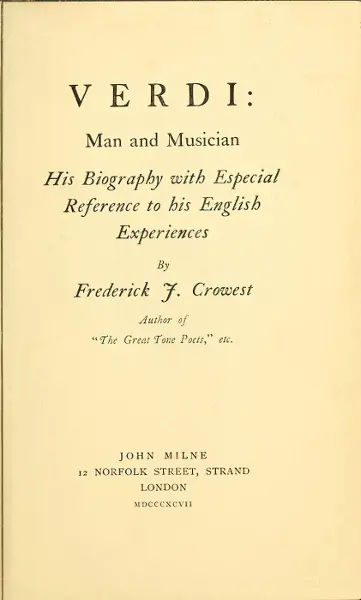
THE CLASSIC COLLECTION · 1897
"Verdi: Man and Musician" by Frederick James Crowest is a biographical account written in the late 19th century. The book examines the life and career of the illustrious Italian composer Giuseppe Verdi, with a particular focus on his experiences in England and his significant impact on the world of music. It portrays Verdi not just as a prolific composer, but also as a person shaped by his early life and the circumstances surrounding his works. The opening of the book introduces readers to Verdi's origins, detailing his birth in Roncole, Italy, and the humble beginnings of his family, who ran an inn. Crowest provides insight into Verdi's childhood, highlighting crucial moments that sparked his interest in music, such as his enchantment with street organ players and the music at church. It emphasizes that Verdi was not a prodigy but rather a quietly thoughtful child who developed his musical talents through a natural, passionate dedication rather than through forced instruction. This early foundation in a music-poor environment raises questions about how someone from such modest beginnings could eventually transform into one of the greatest composers in opera history.
Introduction adapted from the source catalogue; source summaries may be automatically generated.
Free to read · English · 61,517 words · No account needed
MAKE TIME FOR A GOOD BOOK
On by default. Untick to stop anonymous reading totals. Each page counts after 10 seconds in view. How this works.
Anonymous counting is on unless you have switched it off.
Trovatore, 95;
produced at Rome, 113, 115;
in Naples, 116;
in Paris and London, 118;
opinions on, 119-125;
universal success, 125, 128;
135, 138, 146, 197;
and the organ-grinder, 215;
place in Verdi's development, 232, 236, 250, 252, 259;
revival of, 260, 290, 292.
Varesi, baritone, in La Traviata, 128, 214.
"Variety" entertainment and the opera, 290.
Vêpres Siciliennes, 76, 138;
reception of, 139;
at Drury Lane, 140;
opinions on, 140;
a rehearsal in Paris, 213;
its manner, 236;
a departure, 282.
Verdi, birth, 1;
parents, 4;
early circumstances, 6;
characteristics of his music, 7;
and street organs, 9;
acolyte at the village church, 10;
indications of musical aptitude, 11;
his first musical instrument, 12;
sent to school, 13;
first musical training, 14;
goes into the world, 15;
office boy, 18;
and Provesi, 19;
organist of Roncole, 20;
esteem for Barezzi, 21;
conductor of the Busseto Philharmonic Society, 22;
seeks the Milan Conservatoire and is rejected, 24;
under Lavigna, 25;
returns to Busseto and is in love, 26;
marries, 28;
first attempt at a complete opera, 28;
conducts in Haydn's Creation, 29;
conductor of the Milan Philharmonic Society, 30;
his Oberto produced on the stage, 31;
his wife's devotion, 32;
domestic bereavements, 33;
failure of Un Giorni di Regno, 34;
on Nabucco's success, 36, 38;
his "best friends," 37;
famous, 38;
diverse opinions on, 40-47;
alleged indebtedness to Wagner, 46;
his success assured, 49;
chosen to compose the opera d'obbligo for La Scala Theatre
direction, 50;
another triumph, 55;
I Lombardi, 55;
Ernani, 58;
his reception in England, 62;
only Italian composer, 65;
I Due Foscari, 70-75;
Giovanna d'Arco, 75;
Alzira, 76;
Attila, 76-82;
Macbeth, 83;
I Masnadieri, 84-92;
leaves England, 91;
offered the bâton at Her Majesty's, 92;
Il Corsaro and La Battaglia di Legnano, 93;
Luisa Miller, 94-103;
his evil genius, 96;
Stiffelio and Il Finto Stanislas, 103;
Rigoletto, 105-113;
Trovatore, 113-126;
La Traviata, 126-138;
letter on the failure of La Traviata, 128;
Les Vêpres Siciliennes, 138-143;
Simon Boccanegra, 143;
Un Ballo in Maschera, 144;
sued by the San Carlo Theatre, Naples, 144;
Forza del Destino, 148, 149;
his Third style, 149;
a writer of sacred music, 150;
and the Rossini mass, 151;
on Manzoni, 153;
his Requiem at San Marco, Milan, 153;
at La Scala Theatre, in Paris, and in London, 154;
as a conductor, 155;
his Requiem as a contribution to church music, 158-162;
other compositions, 162;
the cantata L'Inno delle Nazioni, 163;
at Her Majesty's, 164;
Third period in his career, 167;
Aïda, 167-177;
Otello and Falstaff, 168;
Montezuma, 179;
Otello, 177-186;
in Paris, on presentation of Otello, 182;
Falstaff, 187-202;
congratulations from King Humbert, 192;
as a writer of comic music, 201;
a born politician, 203;
politics in his music, 204-208;
political significance of his name, 205;
member of the National Assembly of Parma, 208;
honours, 208-211;
external appearance and character, 212-216;
his fortune and residence, 217;
second marriage, 218;
habits, 218-222;
popularity, 223;
influence on opera, 225;
estimate and characteristics of his work, 228-255;
adverse criticism of, 256-271;
his starting point, 279;
outside influence upon, 281;
and the growth of opera, 282;
in Aïda, Otello, and Falstaff, 283;
a "Wagnerite," 284;
his place in musical art, 287;
his imitators, 287;
his masterpieces, 291;
his fame, 292;
bibliography, 293;
literature about--why scanty, 296.
Verdians and anti-Verdians, 57.
Verdi-ites on Luisa Miller, 97.
Verdinian characteristics in Ernani, 63.
Your reading position is saved on this browser. Take it to another device with a library code. Reading pages adapt to text, rather than matching a printed edition.
Frederick James Crowest
BEHIND THE BOOK
This eBook is for the use of anyone anywhere in the United States and most other parts of the world at no cost and with almost no restrictions whatsoever. You may copy it, give it away or re-use it under the terms of the Project Gutenberg License included with this eBook or online at www.gutenberg.org. If you are not located in the United States, you will have to check the laws of the country where you are located before using this eBook. Read the source licence.
The original source file, including credits and licence, is retained by this library. Request an original-format copy at no charge. Please include the book title and Project Gutenberg identifier #46316.
KEEP YOUR CURIOSITY GOING
John L. Ransom

Herman W. Mudgett

Harriet Monroe
Daniel Dulany Addison
Charles Lanman

Harold Rosher