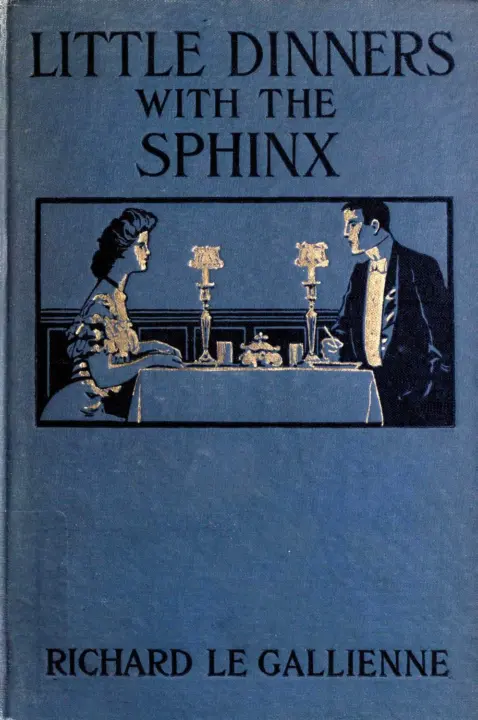
Little Dinners With the Sphinx, and Other Prose Fancies
Richard Le Gallienne
THE CLASSIC COLLECTION · 1915
"Vanishing Roads and Other Essays" by Richard Le Gallienne is a collection of reflective essays written in the early 20th century. The book explores themes of nature, beauty, human experiences, and the nuanced relationships between people and the world around them. Through poetic language and philosophical musings, Le Gallienne invites readers to ponder the mysteries of existence, the spiritual significance of nature, and the inherent beauty that lies within human connection. At the start of "Vanishing Roads," Le Gallienne sets the stage by introducing his contemplative vision of roads as metaphors for life's journey, suggesting they lead us not only through the physical landscape but also into the depths of our souls. He expresses a deep appreciation for the natural world, noting how roads, though manmade, have become intertwined with nature, evoking a sense of spirituality and mystery. The opening is rich with imagery and philosophical musings that foretell the author's exploration of deeper emotional currents within the human experience, thus setting a reflective tone for the essays to follow.
Introduction adapted from the source catalogue; source summaries may be automatically generated.
Free to read · English · 90,490 words · No account needed
MAKE TIME FOR A GOOD BOOK
On by default. Untick to stop anonymous reading totals. Each page counts after 10 seconds in view. How this works.
Anonymous counting is on unless you have switched it off.
Mrs. Grundy, of course, is man's embodied fear of his neighbour, the creation of timid souls who are afraid of being themselves, and who, instead of living their lives after their own fashion and desires, choose to live them in hypocritical discomfort according to the standards of others, standards which in their turn may be held insincerely enough from fear of someone else, and so on without end--a vicious circle of insincere living being thus created, in which no man is or does anything real, or as he himself would naturally prefer to be and to do. It is evident that such a state of mutual intimidation can exist only in small communities, economically interdependent, and among people with narrow boundaries and no horizons. If you live in a village, for example, and are dependent on the good opinion of your neighbours for your means of existence, your morals and your religious belief must be those of the village, or you are liable to starve. It is only the rich man in a village who can do as he pleases. The only thing for the dependent individualist in a village to do is to go somewhere else, to some place where a man may at the same time hold his job and his opinions, a place too big to keep track of its units, too busy to ask irrelevant questions, and so diverse in its constituents as to have generated tolerance and free operation for all.
Now, in spite of its bigness, the world was till quite recently little more than a village, curiously held in subjection by village superstitions and village ethics, narrow conceptions of life and conduct; but the last twenty years have seen a remarkable enlargement of the human spirit, a reassertion of the natural rights of man as against the figments of prurient and emasculate conventions, to which there is no parallel since the Renaissance. Voices have been heard and truths told, and multitudes have listened gladly that aforetime must take shelter either in overawed silence or in utterance so private that they exerted no influence; and the literature of the day alone, literature of wide and greedy acceptance, is sufficient warrant for the obituary announcement which, if not yet, as I said, officially made, is already writing in the hearts, and even in the actions, of society. The popularity of such writers as Meredith and Hardy, Ibsen and Nietzsche, Maeterlinck and Walt Whitman, constitutes a writing on the wall the significance of which cannot be gainsaid. The vogue alone of Mr. Bernard Shaw, apostle to the Philistines, is a portent sufficiently conclusive. To regard Mr. Shaw either as a great dramatist or an original philosopher is, of course, absurd. He, of all men, must surely be the last to imagine such a vain thing about himself; but even should he be so self-deluded, his immense coarse usefulness to his day and generation remains, and the value of it can hardly be overestimated. What others have said for years as in a glass darkly, with noble seriousness of utterance, he proclaims again through his brazen megaphone, with all the imperturbable aplomb of an impudent showman, having as little self-respect as he has respect for his public; and, as a consequence, that vast herd of middle-class minds to whom finer spirits appeal in vain hear for the first time truths as old as philosophy, and answer to them with assenting instincts as old as humanity. Truth, like many another excellent commodity, needs a vulgar advertisement, if it is to become operative in the masses. Mr. Shaw is truth's vulgar advertisement. He is a brilliant, carrying noise on behalf of freedom of thought; and his special equipment for his peculiar revivalist mission comes of his gift for revealing to the common mind not merely the untruth of hypocrisy, but the laughableness of hypocrisy, first of all. He takes some popular convention, that of medicine or marriage or what you will, and shows you not merely how false it is but how ludicrously false. He purges the soul, not with the terror and pity of tragedy, but with the irresistible laughter of rough-and-tumble farce. To think wrongly is, first of all, so absurd. He proves it by putting wrong thinking on the stage, where you see it for yourself in action, and laugh immoderately. Perhaps you had never thought how droll wrong thinking or no thinking was before; and while you laugh with Shaw at your side-splitting discovery, the serious message glides in unostentatiously--wrong thinking is not merely laughable; it is also dangerous, and very uncomfortable. And so the showman has done his work, the advertiser has sold his goods, and there is so much more truth in circulation in unfamiliar areas of society.
Your reading position is saved on this browser. Take it to another device with a library code. Reading pages adapt to text, rather than matching a printed edition.
Richard Le Gallienne
Richard Le Gallienne
Richard Le Gallienne
Richard Le Gallienne
BEHIND THE BOOK
This eBook is for the use of anyone anywhere in the United States and most other parts of the world at no cost and with almost no restrictions whatsoever. You may copy it, give it away or re-use it under the terms of the Project Gutenberg License included with this eBook or online at www.gutenberg.org. If you are not located in the United States, you will have to check the laws of the country where you are located before using this eBook. Read the source licence.
The original source file, including credits and licence, is retained by this library. Request an original-format copy at no charge. Please include the book title and Project Gutenberg identifier #11675.
KEEP YOUR CURIOSITY GOING

David Patterson (Spirit) Hatch

David Patterson (Spirit) Hatch

David Patterson (Spirit) Hatch

Ralph Waldo Emerson

Maurice Baring

Oscar Wilde & James McNeill Whistler