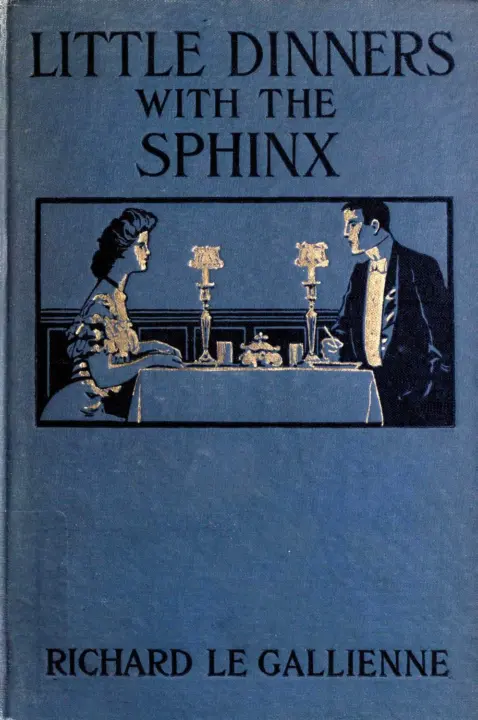
Little Dinners With the Sphinx, and Other Prose Fancies
Richard Le Gallienne
THE CLASSIC COLLECTION · 1915
"Vanishing Roads and Other Essays" by Richard Le Gallienne is a collection of reflective essays written in the early 20th century. The book explores themes of nature, beauty, human experiences, and the nuanced relationships between people and the world around them. Through poetic language and philosophical musings, Le Gallienne invites readers to ponder the mysteries of existence, the spiritual significance of nature, and the inherent beauty that lies within human connection. At the start of "Vanishing Roads," Le Gallienne sets the stage by introducing his contemplative vision of roads as metaphors for life's journey, suggesting they lead us not only through the physical landscape but also into the depths of our souls. He expresses a deep appreciation for the natural world, noting how roads, though manmade, have become intertwined with nature, evoking a sense of spirituality and mystery. The opening is rich with imagery and philosophical musings that foretell the author's exploration of deeper emotional currents within the human experience, thus setting a reflective tone for the essays to follow.
Introduction adapted from the source catalogue; source summaries may be automatically generated.
Free to read · English · 90,490 words · No account needed
MAKE TIME FOR A GOOD BOOK
On by default. Untick to stop anonymous reading totals. Each page counts after 10 seconds in view. How this works.
Anonymous counting is on unless you have switched it off.
"Ah! Mistral," he cried, with Gallic enthusiasm, using the words I have borrowed from his lips, "Mistral is the King of Provence!"
Marseilles had not always been so enthusiastic over Mistral and his fellows. And Mistral, in his memoirs, gives an amusing account of a philological battle fought over the letter "s" in a room behind one of the Marseilles bookshops between "the amateurs of trivialities, the rhymers of the white beard, the jealous, the grumblers," and the young innovators of the "félibrige."
But that was over fifty years ago, and the battle of those young enthusiasts has long since been won. What that battle was and what an extraordinary victory came of it must needs be told for the significance of Mistral in Provence to be properly understood.
The story is one of the most romantic in the history of literature.
Briefly, it is this:
The Provençal language, the "langue d'oc," was, of course, once the courtly and lettered language of Europe, the language of the great troubadours, and through them the vehicle of the culture and refinement of the thirteenth and fourteenth centuries. From it may be said to have sprung the beginnings of Italian literature.
But, owing to various historical vicissitudes, the language of Northern France, the "langue d'oil," gradually took its place, and when Mistral was born, in 1830, Provençal had long been regarded as little more than a patois.
Now it was the young Mistral's dream, as a school-boy in the old convent school of Saint Michael de Frigolet, at Avignon, to restore his native tongue to its former high estate, to make it once more a literary language, and it chanced that one of his masters, Joseph Roumanille, was secretly cherishing the same dream.
The master, looking over his pupil's shoulder one day, found that, instead of working at his prescribed task, he was busily engaged in translating the Penitential Psalms into Provençal. Instead of punishing him, the master gratefully hailed a kindred spirit, and presently confided Provençal verses of his own making. From that moment, though there was a dozen years' difference between their ages, Mistral and Roumanille began a friendship which was to last till Roumanille's death, a friendship of half a century.
Soon their dream attracted other recruits, and presently seven friends, whose names are all famous now, and most of whom have statues in Arles or in Avignon--Roumanille, Mistral, Aubanel, Mathieu, Giéra, Brunet, and Tavan--after the manner of Ronsard's "Pléiade," and Rossetti's "P.R.B."--formed themselves into a brotherhood to carry on the great work of regeneration.
Your reading position is saved on this browser. Take it to another device with a library code. Reading pages adapt to text, rather than matching a printed edition.
Richard Le Gallienne
Richard Le Gallienne
Richard Le Gallienne
Richard Le Gallienne
BEHIND THE BOOK
This eBook is for the use of anyone anywhere in the United States and most other parts of the world at no cost and with almost no restrictions whatsoever. You may copy it, give it away or re-use it under the terms of the Project Gutenberg License included with this eBook or online at www.gutenberg.org. If you are not located in the United States, you will have to check the laws of the country where you are located before using this eBook. Read the source licence.
The original source file, including credits and licence, is retained by this library. Request an original-format copy at no charge. Please include the book title and Project Gutenberg identifier #11675.
KEEP YOUR CURIOSITY GOING

David Patterson (Spirit) Hatch

David Patterson (Spirit) Hatch

David Patterson (Spirit) Hatch

Ralph Waldo Emerson

Maurice Baring

Oscar Wilde & James McNeill Whistler