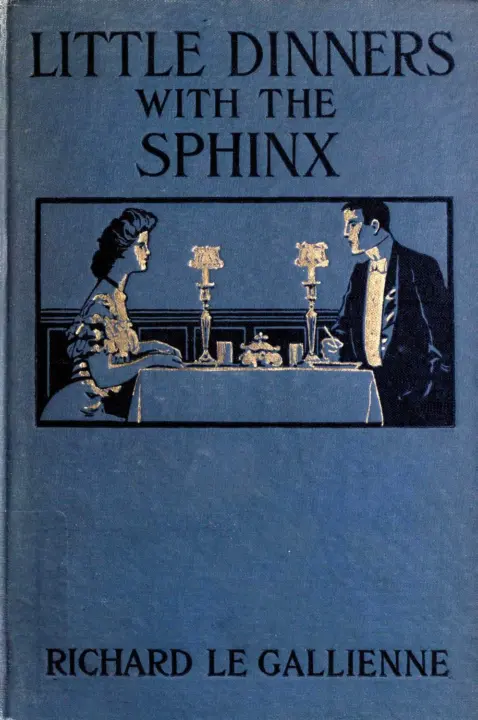
Little Dinners With the Sphinx, and Other Prose Fancies
Richard Le Gallienne
THE CLASSIC COLLECTION · 1915
"Vanishing Roads and Other Essays" by Richard Le Gallienne is a collection of reflective essays written in the early 20th century. The book explores themes of nature, beauty, human experiences, and the nuanced relationships between people and the world around them. Through poetic language and philosophical musings, Le Gallienne invites readers to ponder the mysteries of existence, the spiritual significance of nature, and the inherent beauty that lies within human connection. At the start of "Vanishing Roads," Le Gallienne sets the stage by introducing his contemplative vision of roads as metaphors for life's journey, suggesting they lead us not only through the physical landscape but also into the depths of our souls. He expresses a deep appreciation for the natural world, noting how roads, though manmade, have become intertwined with nature, evoking a sense of spirituality and mystery. The opening is rich with imagery and philosophical musings that foretell the author's exploration of deeper emotional currents within the human experience, thus setting a reflective tone for the essays to follow.
Introduction adapted from the source catalogue; source summaries may be automatically generated.
Free to read · English · 90,490 words · No account needed
MAKE TIME FOR A GOOD BOOK
On by default. Untick to stop anonymous reading totals. Each page counts after 10 seconds in view. How this works.
Anonymous counting is on unless you have switched it off.
"Have you done much dancing this season?" she asked.
"O indeed no," answered the other unsuspiciously, "my dancing days are
over."
"At your age!" commented Luccia with surprise. "Nonsense! You must let me teach you to dance the tango. I have enjoyed it immensely this winter."
"Really?" gasped the other in astonishment, with that intonation in the voice naturally so gratifying to the "old" suggesting that the person talking with them really regards them as dead and buried.
"Of course, why not?" asks Luccia with perfect seriousness. "I dance it with my grandsons. My husband doesn't care to dance it. He prefers the polka."
Not knowing what to think, the poor old maid--actually "old" compared with Luccia--looked from her to the beautiful venerable figure of her polka-dancing husband seemingly meditating over his pipe, a little withdrawn from them on the veranda, but inwardly shaken with mirth at the darling nonsense of her who is still the same madcap girl he first fell in love with so many years ago.
When the guest had departed, with a puzzled, questioning look still lingering on her face, Luccia turned to me, her eyes bright pools of merriment:
"It was quite true, wasn't it? Come, let us try it."
And, nimble as a girl, she was on her feet, and we executed quite a passable tango up and down the veranda, to the accompaniment of her husband's--"Luccia! Luccia! what a wild thing you are!"
A certain reputation for "wildness," a savour of innocent Bohemianism, has clung to Luccia, and Irene too, all through their lives, as a legacy from that far-off legendary time when, scarcely out of their girlhood, they were fellow art-students together in Paris. Belonging both to aristocratic, rather straitlaced New England families, I have often wondered how they contrived to accomplish that adventure in a day when such independent action on the part of two pretty young ladies was an adventure indeed. But it was the time when the first vigorous spring of feminine revolt was in the air. Rosa Bonheur, George Eliot, Elizabeth Cady Stanton, and other leaders were setting the pace for the advanced women, and George Sand was still a popular romancer. As a reminiscence of George Sand, Luccia to this day pretends that she prefers to smoke cigars to cigarettes, though, as a matter of fact, she has never smoked either, and has, indeed, an ultra-feminine detestation of tobacco--even in the form of her husband's pipe. She only says it, of course, for the fun of seeming "naughty"; which recalls to my mind her shocking behaviour one day when I went with her to call on some very prim cousins in New York. It was a household of an excessively brown-stone respectability, just the atmosphere to rouse the wickedness in Luccia. As we sat together in an upright conversation that sounded like the rustling of dried leaves in a cemetery, why! Luccia, for all her eighty years, seemed like a young wild-rose bush filling the tomb-like room with living light and fragrance. I could see the wickedness in her surging for an outburst. She was well aware that those respectable connections of hers had always looked upon her as a sort of "artistic" black sheep in the family. Presently her opportunity came. As our visit dragged mournfully towards its end, the butler entered, in pursuance of the early Victorian ritual on such occasions, bearing a tray on which was a decanter of sherry, some tiny wine-glasses, and some dry biscuits of a truly early Victorian dryness. This ghostly hospitality was duly dispensed, and Luccia, who seldom drinks anything but tea, instead of sipping her sherry with a lady-like aloofness, drained her glass with a sudden devil-may-care abandon, and, to the evident amazement even of the furniture, held it out to be refilled. Such pagan behaviour had never disgraced that scandalized drawing-room before. And when to her action she added words, the room absolutely refused to believe its ears. "I feel," she said, with a deep-down mirth in her eyes which only I could suspect rather than see, "I feel today as if I should like to go on a real spree. Do you ever feel that way?"
Your reading position is saved on this browser. Take it to another device with a library code. Reading pages adapt to text, rather than matching a printed edition.
Richard Le Gallienne
Richard Le Gallienne
Richard Le Gallienne
Richard Le Gallienne
BEHIND THE BOOK
This eBook is for the use of anyone anywhere in the United States and most other parts of the world at no cost and with almost no restrictions whatsoever. You may copy it, give it away or re-use it under the terms of the Project Gutenberg License included with this eBook or online at www.gutenberg.org. If you are not located in the United States, you will have to check the laws of the country where you are located before using this eBook. Read the source licence.
The original source file, including credits and licence, is retained by this library. Request an original-format copy at no charge. Please include the book title and Project Gutenberg identifier #11675.
KEEP YOUR CURIOSITY GOING

David Patterson (Spirit) Hatch

David Patterson (Spirit) Hatch

David Patterson (Spirit) Hatch

Ralph Waldo Emerson

Maurice Baring

Oscar Wilde & James McNeill Whistler